Ancient history
3,500 years of history: Haifa’s oldest site reopens
After two years of work and a NIS 3 million investment, the hill housing ancient purple-dye city remains and a Byzantine church with mosaic floors has been opened to the public.


Israeli Second Temple drama ‘Legend of Destruction’ now available in the US

On This Day: Jean-Francois Champollion announces his success at decoding the Rosetta Stone
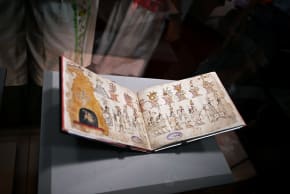
France loans Mexico rare Aztec manuscript as nations celebrate 200 years of diplomatic ties
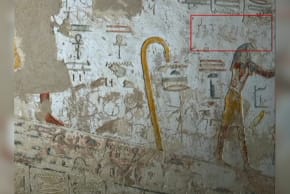
Ancient graffiti in Egypt’s Valley of the Kings proves presence of Indian tourists 2,000 years ago
According to the researchers, the inscriptions’ discovery is not new. Early Egyptologists noticed them, but did not know what language they’d been written in and were unable to translate.
Archaeologists find evidence of postmortem 'crucifixion' in Roman burials
Archaeologists report nails driven into remains and deliberately scattered in tombs, indicating non-accidental postmortem 'crucifixion' as part of a dark funerary ceremony.

Ancient Egyptian scribes used 'Wite-Out' correction liquid to fix mistakes in sacred texts
While preparing a papyrus for the museum’s upcoming “Made in Ancient Egypt” exhibit, conservators noticed a thick white pigment lining the body of a jackal illustrated in one of the scenes.

Egyptian researchers discover collection of ancient rock art spanning 10,000 years in Sinai desert
The engravings and drawings are divided into several groups, researchers learned in their initial study of the space, the oldest of which are done in red and dated to between 10,000 and 5,500 BCE.

On This Day: Howard Carter enters King Tut's burial chamber in Egypt's Valley of Kings
Additional treasures found within the burial chamber are housed in the Egyptian Museum in Cairo.

Residue from Roman vial reveals first evidence of ancient physicians' use of fecal medicine - study
The vial, also known as an unguentarium, is commonly believed to have held perfumes or cosmetic oils.

Elephant bone found at Spanish archaeological site may have marched on Rome with Hannibal - study
The finding represents the first elephant skeletal remains found to possibly confirm Hannibal’s historical march from Carthage to Italy during the Second Punic War.

Canine remains discovered in Bulgaria show dog meat may have been Iron Age delicacy - study
The Greeks, as well as the Thracians, who lived in what is now modern-day Bulgaria, are believed by researchers to have consumed dog meat.

Did giants exist? Ancient Egyptian papyrus points to proof of gargantuan Canaanite tribe, org says
The papyrus, known as Anastasi I, or “The Satirical Letter,” is believed by most to take the form of a somewhat mocking letter written between two army scribes.

Ancient tomb linked to King Midas’ family sheds new light on ancient kingdom
Discovered in 2010 and excavated since 2013, the tomb dates back to the ancient kingdom of Phrygia (1200 to 675 BCE), but is located more than 100 miles west of Gordion, the kingdom’s capital.
