
It was the early evening of October 17, 2023, Israel time, and then IDF Chief Spokesman Daniel Hagari was on the way to make a daily statement about the state of the then 10-day-old war.
A female officer whispered to him that there were reports of a mass death incident at an attack on a hospital.
Hamas had fired a barrage of rockets at 6:15 p.m., Palestinian Islamic Jihad had fired its own barrage of around 10 rockets around 7:00 p., and shortly after that barrage there were reports of an explosion at the al-Ahli Hospital.
No reporters asked Hagari any questions about the incident because the reports were still fresh, which was good because no one within Israel's military or government apparatuses had a clue at that point of whether Israel was responsible or not.
Hamas claimed around 500 Palestinian civilians had been killed, and the news spread like wildfire across the planet from Al Jazeera to the BBC to The New York Times, and on to other secondary sites taking their information from those major outlets.
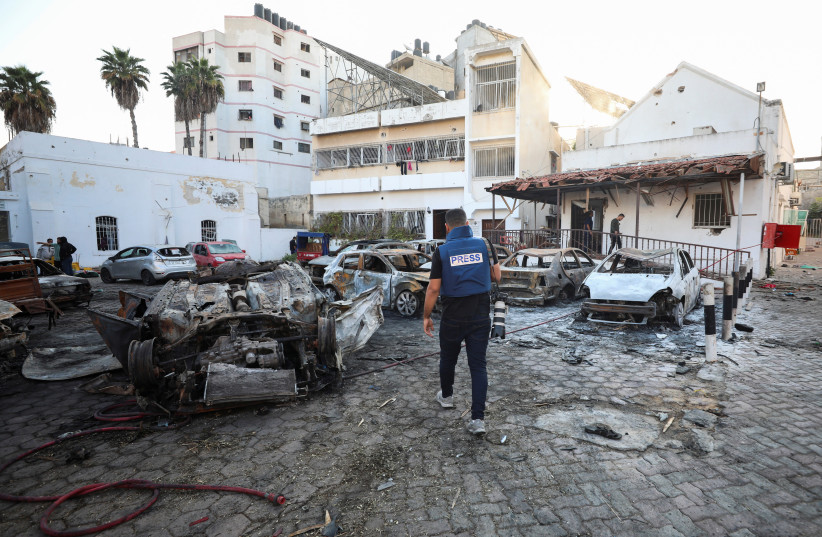
The IDF Spokesperson's Office went into high gear trying to connect the dots between videos and imagery of the alleged incident coming out from open sources compared to any inside special intelligence Israel might have.
There were several calls between senior IDF spokesperson's office officials and senior air force officials to ascertain what had really happened and to quickly decide how to probe the situation.
Top air force officials did not initially know about the incident.
Within a few hours, the initial reports and the beginnings of second-round reports started to present the incident as a more solid fact.
IDF Spokesperson's Office insisted on gathering facts first
There was already pressure from the political echelon to simply deny it as a ridiculous allegation, but the IDF Spokesperson's Office would insist on first gathering the facts.
This was no easy call. Simply the initial reports themselves, without even being validated, were already causing real-world riots in Amman, Turkey, and Cairo.
Also, then-US president Joe Biden had boarded his plane before the incident and was on his way to the Middle East for a summit with Arab leaders.
However, because of the unconfirmed reports, his summit was canceled by the Arab leaders who were alternating between fury at Israel and fear for their own populations if the incident were true.
But Biden was already on his plane, so he said he was still going to land in Israel to show solidarity with the Israeli people after Hamas's horrifying invasion.
The IDF Spokesperson's Office hoped that they would be able to resolve the issue before Biden landed, but there was still significant uncertainty.
But because of all of the unique momentous events happening at once, they understood the magnitude and gravity of the incident. It was an incident which could have stopped the entire war in its tracks. There would later be a few other major incidents of that magnitude that could have stopped the war, but this was the first one.
At a second stage, the air force's first review of battle damage assessments (BDA) in Gaza was that there was an air force bomb for which there still was no BDA.
It had been fired at a target that was a full kilometer away from the hospital in terms of the strike radius. But there were concerns that the proximity was close enough that a misfire could not be ruled out completely without probing further.
What if JDAM bomb had gone off course?
What if a JDAM bomb had gone off course? The IDF was carrying out a huge volume of airstrikes, and it was inevitable eventually that there would be errors, as with all wars.
Throughout the crisis, then-Defense Minister Yoav Gallant and then-IDF Chief of Staff Herzi Halevi were seeking and receiving debates about the incident, because it was viewed as having the potential power to prematurely end the war before Israel's counter-invasion of Gaza began (the full invasion only started on October 27).
In light of the second air force status update, it was decided to send a drone to the hospital perimeter to see if the hospital had been hit accidentally by an Israeli missile.
This process, including receiving footage and assessing the footage, would take a few precious hours, with much of the world continuing to boil over against Israel.
The IDF would later release a map showing the rocket launches of Hamas and the Islamic |Jihad against Israel.
As The Jerusalem Post would later report when visiting Israeli radars and interviewing Israeli LOTEM digital data-sharing commanders, IDF operations had tools that recorded every rocket launch from Gaza.
One could see from the vectors that there were launches fired from close proximity to the hospital and which passed over the hospital. The IDF spokesperson's office, the Intelligence Directorate, and the air force were working to connect that map to hitting the hospital.
IDF intercepts Hamas conversation about incident
After a few more hours, the IDF intelligence division intercepted astounding messages from two Hamas operatives. In these discussions, they admitted that they had misfired a rocket from a cemetery and that it hit the hospital.
Intercepted Hamas communications verified internally that this was what in fact happened, despite the fact that they continued to lie to the world externally.
The IDF spokesperson's office was buoyed and requested taking the almost unprecedented step of publishing the secretly intercepted information.
A deputy of IDF Intelligence Chief Aharon Haliva, at the rank of brigadier general, approved publishing the conversations. They said to paraphrase some of it to protect certain security considerations, but did not ask for too much in terms of editing.
Around 11:00 p.m., Hagari issued a statement in English – as opposed to his standard Hebrew statements - that the IDF had obtained intelligence proving that Palestinian Islamic Jihad had fired its missiles at the hospital.
Maybe this would turn the tide.
The IDF spokesperson's office was dismayed by the world and media reaction: there was almost no change.
The world was in such a frenzy of condemnation and anger, and the narrative was so extreme and important to maintain for critics of Israel that Hagari's words about having intelligence, without more, had zero impact.
Halevi asked the IDF spokesperson's office for recommendations.
Swiftly, the response came back that the discussions should be released.
It was one thing to have the approval of Haliva's top IDF intelligence deputy, and another to also have Halevi, who was the IDF chief and had previously headed IDF intelligence.
Haliva, Unit 8200 Chief Yossi Sariel, and others were also on board and invested massive efforts to prepare for the release of this highly classified intercepted conversation.
This required an extensive fast-forward process, but which still ensured not to harm Israeli intelligence sources. It was due to take 4-6 additional agonizing hours.
There was a debate among top IDF Spokesperson's Office officials about what else to do.
It was decided that the IDF would publish video footage from the air force of the attack and portions of information from Israeli radars.
Further, Hagari would carry out a major press conference live in English in the morning to give the disclosures more volume.
There was a third exchange with the air force.
Their drone, which had been sent hours earlier to probe the situation, had finally proven that Israel's missile had not hit the hospital.
It was unequivocally not a hit by an Israeli or American weapon.
Also, it clarified that what had been hit was not the hospital itself, but the parking lot, which had many evacuated refugees.
An analysis learned that the rocket had traveled such a short trajectory that it was still full of gas, and it was this gas and the sharp nails inside that caused dozens of deaths, around 50 - not 500.
Later, the IDF learned that Hamas always just rushed, without checking any facts, to claim around 500 were dead anytime it thought it had a chance at claiming a mass death incident.
A reservist from the international spokesperson team wrote the text of Hagari's speech the next morning. There was no time to rehearse.
IDF Col. and chief Arabic spokesperson Avichai Adraee personally translated the Gazan discussions to make sure they were worded correctly.
It started to seem possible that when Biden would check, he would be able to view the information as highly verified, and that it really would be released before he landed in Israel.
The next steps were coordinated not only with the air force and IDF intelligence, but also with Halevi, with Maj. Gen, Yaron Finkleman.
An entire operational probe which could take weeks or months was completed in a matter of several hours.
But much of this had been accomplished ad hoc.
Later, the IDF would build an improved apparatus for handling such crises.
Hagari's speech the morning after
Finally, it came time for Hagari's big morning speech.
The Post was present at the time, and there was an unusual air of excitement given that often such press conferences were just a rehash of news which had been disseminated throughout the day.
Hagari issued his list of dramatic statements, but that was only stage one.
Despite all the highly specific data points and astounding Hamas conversation transcripts, the first question showed there was still a major problem.
The angle of the first question was: the IDF lied to us about Shireen Abu Akleh; why should we believe you? In their understanding of the IDF's spokesperson's office, much of the foreign media viewed the IDF as having lost its credibility over two prior incidents: with a false denial of the IDF's mistaken killing of Al Jazeera Arab-American reporter Abu Akleh in the West Bank on May 11, 2022 (later the IDF admitted killing her) and with the false Gaza invasion and bombing of the "Gaza Metro" on May 14, 2021 (the IDF misled foreign media to say an invasion had started to try to trick Hamas into entering its tunnel network just before the IDF then bombed the network).
Hagari responded that he had been in his role only during 2023 and that before that he was the commander of Israel's navy commandos. He said he never spoke about Abu Akleh, but was presenting three facts about the current incident.
These facts were: 1) radar data on Gaza rockets; 2) telephone call intercepts; and 3) video provided by the air force. Hagari told reporters they could check with all of their local-home military officials: this was not a US or Israeli munition - 1000%.
After a few hours, BBC and The New York Times changed their coverage of the incident.
Biden saw the press conference while he was flying to Israel on Air Force One.
When he later commented on the incident, he completely adopted the Israeli version of events.
This incident rebuilt some IDF credibility, but it was still very hard to keep.
The IDF knew that it would not do as well in every crisis. Put simply: sometimes the IDF does not understand what happened in the fog of war.
Or the IDF figures out what happened, but it lacks the perfect video and phone calls.
Sometimes even if the IDF gets all of the data, it does not get all the relevant data until much later, when the media might have already moved on.
The longer a war goes, the harder it gets to impact the narrative and the curve of the coverage.
Later, there was the World Central Kitchen incident and the bakeries incident, and these were not always resolved well, and the government apparatus as a whole was often not ready.
There is also a difference between the mainstream media and social media. On social media, there were sites still falsely claiming that Israel had killed children at the al-Ahli hospital on a large scale even months later, because they can choose to ignore the facts.
How IDF disclosed information
How could Israel disclose classified sources and methods?
The Post has learned that disclosing eavesdropping on cellular communications is less complicated than some other instances.
In this case, the Post understands that the sources were intelligence operatives. In contrast, there are some sources which Israel cannot burn, as in the Eli Feldstein episode. But in this case, with different kinds of technology, the IDF could cope with the losses.
IDF sources believe Israel needs a diplomatic public relations mechanism, not just the IDF spokesperson's office.
Over three years, there were many crises, and there is a strategic price that Israel needs to take into account, according to the IDF.
The war over the narrative is complex, but it is profoundly important to combat disinformation with facts, data, and knowledge.