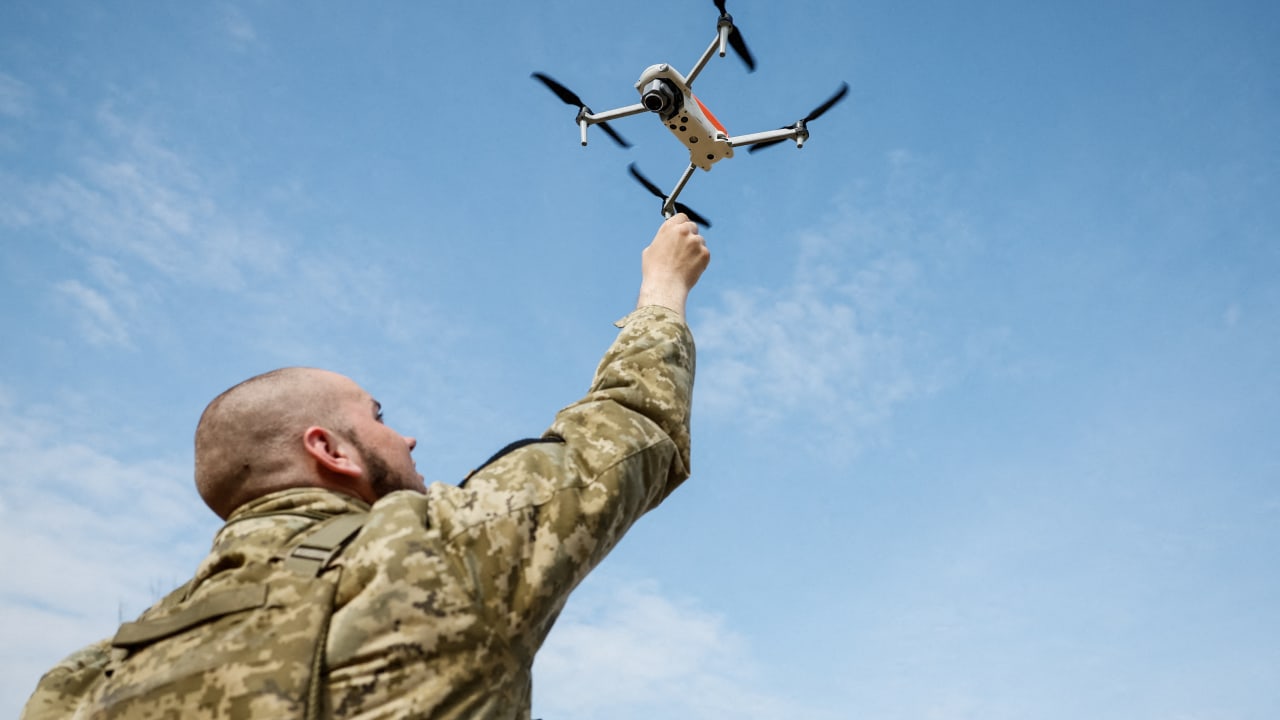
The Pentagon’s technology chief said in October that the United States was caught flat-footed by drone warfare. America now has a stockpile of roughly 500,000 drones, while Ukraine expects to manufacture 8 million to 10 million this year. Those numbers are not directly comparable, one is a stockpile and the other annual production, but Israelis should still pay attention to the gap.
The lesson is larger than drones. It pertains to the economics of modern defense. Four years of war have forced Ukraine to build a different economic model, designed for combat. Systems are manufactured quickly, lost routinely, redesigned after battlefield failures and returned to the front in new iterations. The advantage is the speed of the feedback loop, connecting soldiers with engineers, and then factories. Working with Ukraine’s defense industry, I have watched that loop become more important than any single airframe.
That should sound familiar in Israel. Iran does not need technological parity with the IDF. It needs enough missiles and inexpensive unmanned systems to keep Israel’s defenses working continuously while interceptor inventories move in one direction. Israel’s air-defense network remains among the world’s best, but the arithmetic is less impressive.
During this year’s war, Israel began rationing its most capable interceptors after four weeks of daily Iranian barrages, and missiles fired at Dimona and Arad got through the cheaper munitions sent up instead. An air-defense system can perform superbly and still lose the economic contest if the attacker replaces weapons faster than the defender replaces interceptors.
The financial asymmetry is not abstract. The 12-day war in 2025 alone, resulted in roughly $3 billion in property and business damage caused by Iranian missile strikes. Defensive spending sits on top of that bill. Iran does not need to destroy Israel’s military to impose strategic cost; it can force the government, employers, insurers and households to absorb repeated disruption while the defense establishment burns through scarce interceptors.
Iran understands that logic. By October, months of American and Israeli bombing had failed to erase Iran’s capacity to manufacture missiles and drones, as Tehran preserved enough of the industrial base to rebuild its arsenal. Israel can destroy launchers and factories, but it cannot assume that each round ends the production race.
Ukraine has approached the same problem from the opposite direction. It cannot afford to fire an exquisite missile at every Russian Shahed. Ukrainian interceptor drones can cost as little as $1,000 while pursuing targets worth $10,000 to $300,000. More than 100 Ukrainian companies now work on interceptor production. That breadth lets designs compete while tactics change with the threat.
What Western procurement often undervalues is the iteration cycle. In Ukraine, designs that worked months ago become obsolete when jamming or navigation changes, or when flight profiles shift. Manufacturers stay close to the battlefield because feedback has immediate commercial value. A company that cannot adapt loses orders. War has produced a brutally efficient venture-capital committee.
The Middle East is already importing the results. Ukraine is selling equipment and advice to countries facing Iranian drones, and new production partnerships are taking shape. Russia, meanwhile, has accumulated its own battlefield knowledge and is feeding parts of it back toward Tehran. Russian production documents show an agreement to supply Iran with 90 launchers for LMUR guided missiles used extensively in Ukraine, although the documents do not establish whether delivery was completed.
That two-way transfer matters more than one contract. Iran supplied Russia with Shahed technology early in the Ukraine war. Russia has since spent years testing weapons against dense electronic warfare and Western air defense, facing an adversary that changes tactics constantly. Israel should assume useful lessons will travel south. Military knowledge rarely respects sanctions regimes.
The cost problem extends beyond Israel. Gulf states have burned through interceptor stocks and are looking beyond the United States for fresh ammunition, including Ukrainian interceptor drones. American production is already stretched across several theaters. The region is consuming costly interceptors faster than factories can replace them. That is an awkward answer to an enemy weapon designed to be cheap.
Israel has been here before. The 1973 war did not make tanks or aircraft irrelevant. It showed that superior platforms become vulnerable when doctrine and organization lag behind a changed battlefield. Israel adapted rather than abandoning its platforms. Drones demand the same intellectual discipline.
Israel therefore needs an attrition industry alongside its existing arsenal industry. Arrow and David’s Sling remain indispensable. So does Iron Dome, alongside advanced aircraft and long-range strike systems. But the country also needs cheap interceptor drones, electronic warfare that can be updated quickly, modular production lines and procurement rules that tolerate short product lives. Those systems should be bought in volumes large enough to keep factories alive between wars, rather than ordered after inventories start disappearing.
U.S.-Israel defense cooperation should evolve in the same direction. Joint research produced some of the world’s best missile defenses. The next step should put more weight on joint manufacturing and rapid testing, backed by production capacity that can expand during a long conflict. Ukraine should be part of that conversation because it possesses something neither Washington nor Jerusalem can manufacture retrospectively: four years of battlefield feedback.
Israel’s technological edge remains real. So does America’s industrial scale. Ukraine has added the missing lesson, and it applies far beyond either country: in an attritional war, the side that learns and replaces fastest can turn modest technology into strategic power.
The next drone war will still reward brilliance. It will also reward the factory that can ship on Monday.