Operation Roaring Lion against the Islamic Republic of Iran is not just another round of fighting. It is intended to bring about the fall of the regime led by the Iranian people themselves, with American-Israeli support, as US President Donald Trump had promised.
It is also intended to neutralize the Islamic Republic’s ballistic missile and nuclear programs. The strikes that began this morning, targeting 28 locations across Iran, were not only aimed at downgrading the country’s military infrastructure but also at besieging the defense and intelligence ministries, the Atomic Energy headquarters, and the office of Ali Khamenei, the supreme leader, as well as the judiciary and the presidential building. In other words, a direct blow to the regime’s decision-making core, alongside damage to nuclear facilities and to the Islamic Revolutionary Guard Corps’ air, sea, and missile arrays.
On the eve of this war, the Islamic Republic possessed approximately 1,000 ballistic missiles – after roughly 1,000 were destroyed in Operation Rising Lion in June and another 500 were launched at that time. The regime’s objective was to rapidly rebuild its stockpile to several thousand, with external assistance (primarily Chinese) and an accelerated industrial effort.
By 5:30 p.m. Israel time, 25 waves of attacks have been launched toward the Jewish state, alongside launches at US bases in the Gulf states and in Jordan. This figure indicates restrained fire: These are relatively small barrages, reflecting calibrated use of firepower in a drip campaign designed to enable Iran to endure for weeks through sustained attrition of the Israeli home front, rather than a concentrated blow. It is evident that a hunt is underway from the skies for these missile launchers to bring about the complete elimination of this dangerous capability.
A major question now hangs over the Lebanese arena. In Israel, a working assumption is that Hezbollah will intervene, yet as the hours pass, it is becoming clear that this is far from certain. The organization is in a state of confusion and facing a major dilemma.

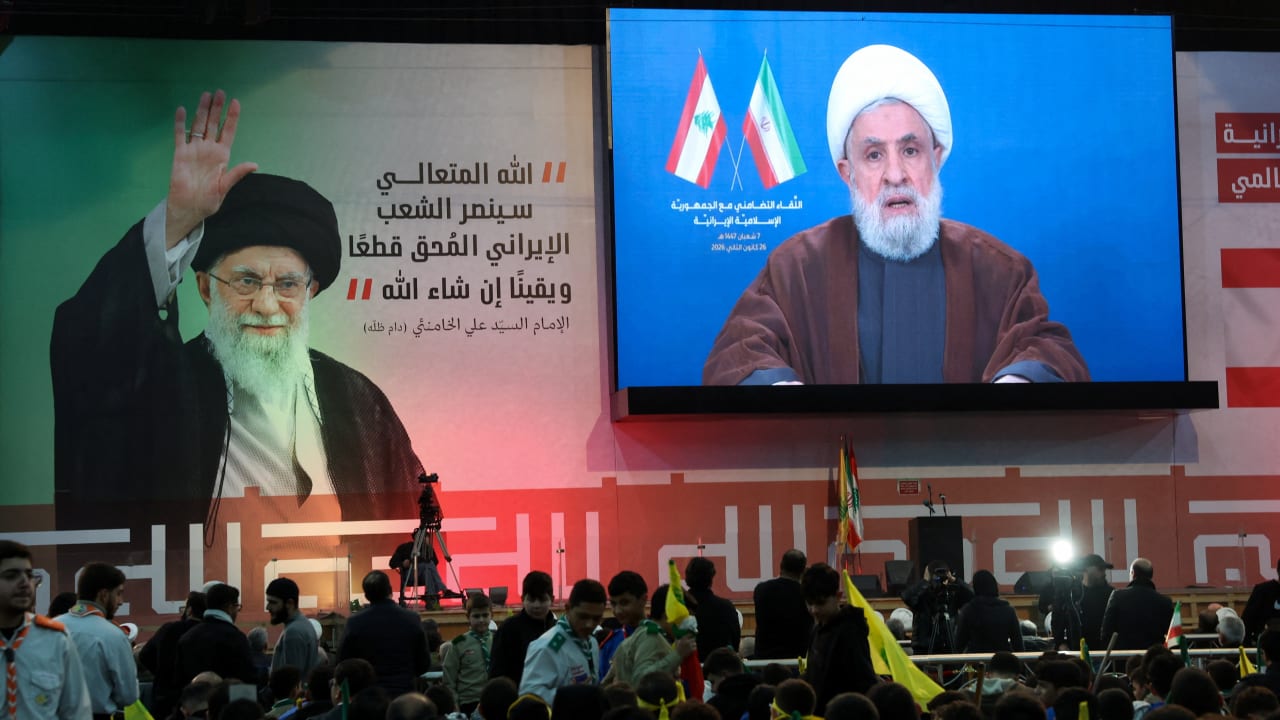
Hezbollah raised its alert level and cancelled public events; the scheduled speech by the organization’s secretary-general, Naim Qassem, was cancelled, and the organization issued a lukewarm statement of support for the Islamic Republic without explicitly threatening to enter the campaign.
If the Iranian leadership has indeed been eliminated, Hezbollah may be unable to decide how to proceed, with no one in Tehran to tell it what to do. This is a particularly sensitive situation for Hezbollah, which, since the elimination of Nasrallah, has grown accustomed to deep Iranian involvement in leadership-level decision-making and in guiding field-level operatives.
Waiting for Hezbollah is a strategic mistake
In parallel, internal pressure is being applied within Lebanon to prevent deterioration.
The president emphasized that the country must not be dragged into “external conflicts.” Nabih Berri, speaker of the parliament and leader of the Amal Movement – a central political ally of Hezbollah’s – made clear that Lebanon cannot bear another war. Over the past year, the Lebanese government has proven incapable of disarming Hezbollah; yet it also has no desire to be drawn into a full-scale regional confrontation.
Against this backdrop, waiting for Hezbollah to fire first would be a strategic mistake. While it still possesses some 25,000 rockets and 1,000 unmanned aerial vehicles (UAVs), and its rehabilitation has continued, despite almost daily IDF strikes, there is now a genuine window of opportunity to neutralize its capabilities without endangering civilian lives.
Regional relations
Another opportunity in the current campaign lies in the relationship between Israel and the United States and the Gulf states, foremost among them, Saudi Arabia.
On October 7, Hamas launched its attack on Israel in order to derail the emerging normalization between Israel and Saudi Arabia. While it appeared to have succeeded, today’s attacks on US bases in Sunni Arab states may strengthen American-Israeli-Sunni cooperation against Tehran and in terms of civilian post-war regional relations.
Now is the chance to strengthen the foundations of those regional relationships strained since October 7, 2023. Communication between the parties during this campaign will be the catalyst to reanimate their dialogue and cooperation for the “day after” reconstruction of the Middle East.
We are only at the end of the first day of the campaign. In my assessment, the list of Islamic Republic targets remains extensive.
Sustained and cumulative damage to the regime’s military capabilities and its decision-makers may weaken it sufficiently to allow the Iranian public to act, after years of internal repression and the prioritization of war over infrastructures and domestic needs.
The current move by the US and Israel, far from a confrontation with the Iranian people, is aimed at dismantling a regime that projects instability throughout the Middle East.
The initiative is now in the hands of the partners in what the US is calling Operation Epic Fury.
The current unknowns are how the campaign will end and whether the momentum created will finally be utilized to neutralize the tentacles of the Iranian octopus, thus allowing for a new era to arise in the Middle East, where future challenges can be faced together.
The writer is a lieutenant colonel in the reserves and founder and president of the Alma Center, which focuses on Israel’s northern security challenges. She is also a member of the Dvora Forum for the advancement of women in decision-making positions in Israel.