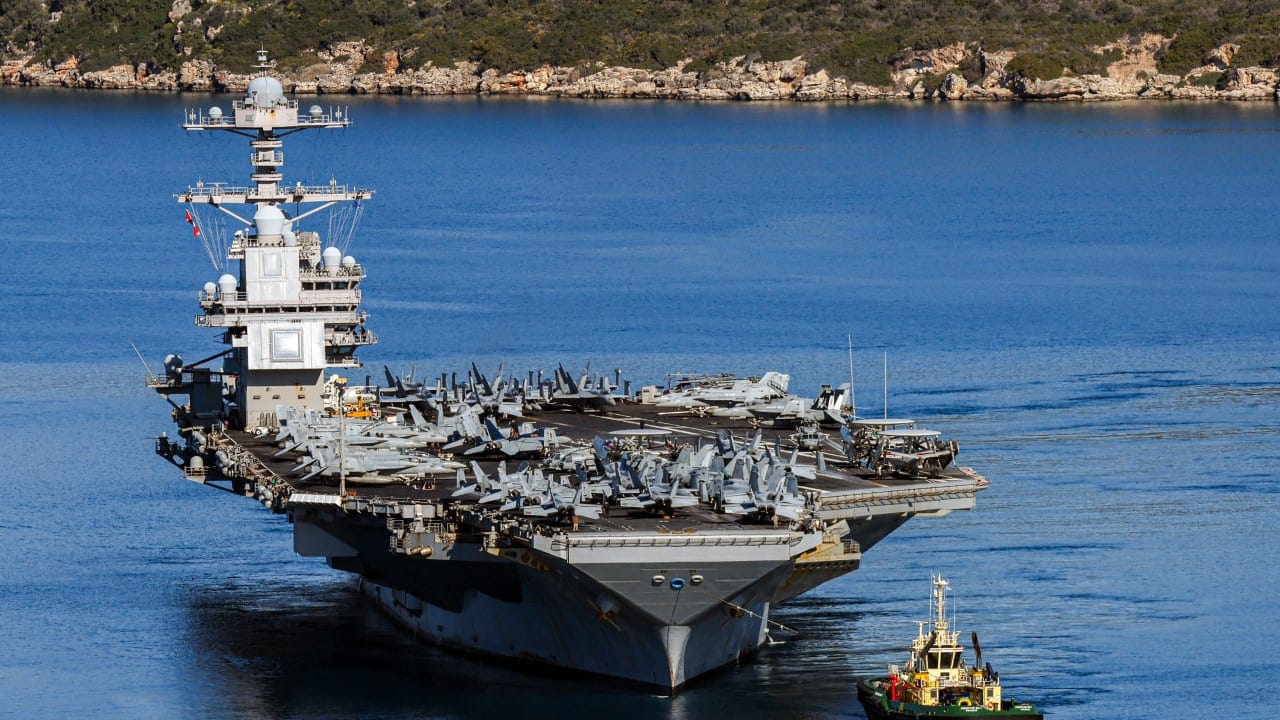
As security tensions in the Middle East continue to rise, the most powerful and expensive vessel ever built by humanity is making its way toward Israel’s shores. The aircraft carrier USS Gerald R. Ford (CVN 78) is not merely a platform for launching aircraft, but a technological fortress designed to project American power anywhere on the globe. Now, as it crosses the waters of the Mediterranean, it is doing so under a heavy veil of operational secrecy.
Unlike conventional vessels, the Ford is operating in an electromagnetic 'ghost mode,' shutting down its AIS (Automatic Identification System) and publicly visible GPS transmitters, rendering it effectively invisible to civilian tracking websites and navigation apps.
It moves through the sea like a massive shadow, its precise location known only to naval commanders, while demonstrating an impressive speed of over 30 knots, about 56 kilometers per hour, an almost unimaginable engineering achievement for a vessel weighing roughly 100,000 tons.

The current price tag of the Ford places it on par with the defense budgets of entire countries. The construction cost of the first ship in its class is estimated at $13.3 billion, officially making it the most expensive aircraft carrier in history. When combined with the class's overall research and development costs, estimated at around $37 billion, the result is an engineering project whose budget stretches the limits of imagination.
The high cost stems from integrating groundbreaking technologies never before deployed, designed to ensure the ship can serve the United States for the next 50 years while allowing future technological upgrades without the need for major structural changes.
Development and features of the world's largest aircraft carrier
Construction of the Ford was a painstaking process that lasted more than a decade at the Newport News shipyard in Virginia. Designers used advanced three-dimensional computer modeling to plan every millimeter of the ship, which measures 337 meters in length and stands about 76 meters high.
One of the most significant structural changes compared to the previous Nimitz-class carriers is the placement of the “island,” the command-and-control structure on the flight deck. On the Ford, the island is smaller and positioned farther aft, allowing for much greater maneuvering space for aircraft on the flight deck and streamlining arming and refueling operations.
At the heart of the vessel are two new A1B nuclear reactors. These reactors generate three times more electrical power than the previous generation and are key to operating the Electromagnetic Aircraft Launch System, EMALS. Instead of traditional steam catapults, which required massive infrastructure of pipes and freshwater, EMALS uses linear induction motors to accelerate aircraft in a smoother, more controlled manner.
This technology enables the launch of a wide range of aircraft, from heavy F-35C fighter jets to extremely light unmanned aerial vehicles, while reducing structural stress and extending their service life. Alongside this, the advanced arresting gear system, AAG, enables safe recovery of landing aircraft using turboelectric energy, providing a level of operational flexibility that did not previously exist.
The Ford’s operational capabilities are unprecedented. It can carry more than 75 aircraft, including strike aircraft, electronic warfare platforms, command-and-control aircraft, and helicopters. Thanks to high levels of automation and advanced weapons-handling systems, the ship can sustain a routine rate of 160 sorties per day and, in emergency situations, increase that pace to as many as 270 sorties in 24 hours.
Advanced weapons elevators, powered by linear electromagnetic motors, allow munitions to be transferred from deep ammunition magazines directly to aircraft within minutes, significantly reducing turnaround time for each plane on the flight deck.
Approximately 2,600 crew members serve as part of the ship’s permanent complement. When combined with the air wing personnel and support teams, the population of the floating city reaches about 4,500. Living conditions have been significantly improved compared to the past. Instead of large communal sleeping quarters, crews are divided into smaller, quieter living units with seating areas equipped with wireless internet access.
For medical staff at sea, the Ford offers facilities comparable to those of a modern medical center. The floating hospital includes an operating room, an intensive care unit, a pharmacy, a clinical laboratory, and an emergency department, staffed by 11 medical officers and 30 corpsmen trained in trauma and emergency medicine.
Yet even a $13 billion behemoth has drawbacks and malfunctions that have at times embarrassed the Pentagon. The 'growing pains' of the new systems were long and difficult. The electromagnetic launch and recovery systems suffered from high failure rates during development, leading to years-long delays in the ship’s entry into full operational service.
The most widely discussed problem, however, involved the ship’s sewage system. The pipe design proved inadequate for the enormous volume of users, leading to repeated blockages in the vacuum toilet system. The solution involved periodic acid flushes of the piping network at a cost of about $400,000 per treatment, an unplanned expense that will accompany the ship throughout its decades of service.
The significance of the Gerald R. Ford as it approaches Israel’s shores is first and foremost strategic and deterrent. Its presence in the region provides the United States with multidimensional offensive and defensive capabilities, ranging from missile defense through an advanced dual-band radar system capable of detecting threats at vast distances, to the ability to deliver a massive aerial strike.
The fact that the ship can move at such high speed while maintaining communications silence and avoiding detection makes it a flexible weapon that can appear anywhere and alter the course of events. The Ford is far more than a ship. It is a symbol of technological superiority, combining nuclear power, advanced aviation, and high-end engineering, now standing ready and alert in the depths of the Mediterranean Sea.