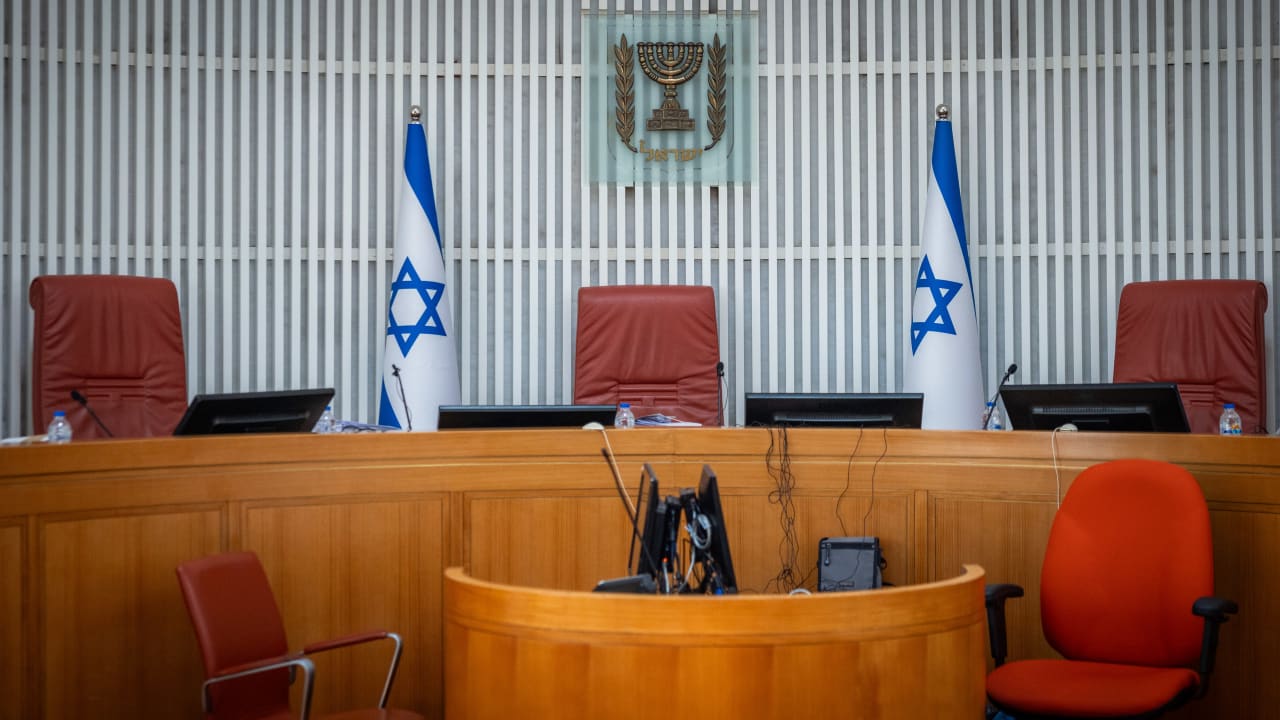
In February 2026, an Israeli constitutional law professor launched a public petition calling on US President Donald Trump to impose personal sanctions on Israel’s Supreme Court president and attorney-general – modeled on those applied to International Criminal Court judges. Within weeks, more than 80,000 Israelis had signed.
Deputy Supreme Court President Noam Sohlberg responded in an open letter, comparing the appeal to the ancient petitions to Rome that preceded the destruction of Jewish sovereignty. In 63 BCE, Pompey conquered Jerusalem, and Judea became a client state. “The solutions belong to us,” Sohlberg wrote, “even if they are difficult, not to others.”
Every element of this episode has a genealogy. The call for foreign intervention against Israeli judges arrived at the end of a trajectory that began with a legitimate institutional debate about judicial overreach and accelerated, over several years, into a campaign against the institutional foundations of the state itself. That trajectory runs through a single concept: the “deep state.”
In recent years, the term has moved from fringe rhetoric to the center of Israeli political life. Prime Minister Benjamin Netanyahu has invoked it explicitly on social media and from the Knesset podium. Finance Minister Bezalel Smotrich has promised to “trample” the Supreme Court president. Cabinet ministers have called for defiance of its rulings.
The term had a precise origin. In Turkey, derin devlet (Turkish for “deep state”) named something documentable: informal networks linking the military, intelligence services, and organized crime, exposed in concrete detail by the Susurluk scandal of 1996. Historian Mike Lofgren used the term in American political discourse in 2014, as a structural critique of the permanent federal bureaucracy.

Under Trump, it shed the specificity entirely. What survived was the grammar of hidden coordination – an entrenched elite operating within visible institutions to sabotage democratic outcomes – detached from any identifiable network.
As the concept expanded, it absorbed the logic of what historian Richard Hofstadter called the “paranoid style”: the reduction of complex institutional processes to the deliberate actions of a unified, covert actor. Courts, legal advisers, intelligence agencies, and the press are recast as coordinated limbs of a single hidden body. Individual rulings, investigations, or press reports become moves in a unified campaign of sabotage. Once this logic is adopted, the absence of evidence does not weaken the claim; it confirms the conspiracy’s depth.
QAnon offers a contemporary illustration of this logic: secret elites controlling governments, hidden networks operating behind visible institutions, coordinated deception of the public.
Scholars have shown that these narrative elements are structural replicas of historically antisemitic conspiracy frameworks – the same architecture, different surface targets. The “deep state” narrative carries no inherent antisemitic content. But the term circulates within these ecosystems alongside “globalist,” “elite,” and “New World Order,” where political distrust and antisemitic motifs intersect and reinforce one another.
Why the narrative resonates in Israel
The “deep state” narrative draws on real institutional tensions – and they are real enough to deserve a direct account. Every constitutional democracy confronts the counter-majoritarian difficulty: courts exercise power that elected governments cannot easily override, yet judges hold no electoral mandate.
The 19th-century philosopher Alexis de Tocqueville identified the American judiciary as democracy’s essential bulwark against the tyranny of transient majorities, and simultaneously recognized that a court without democratic anchoring becomes its own form of unaccountable power. That tension is structural and unresolved.
In Israel, it operates without the buffers present in comparable democracies: no written constitution of fixed authority, no second chamber, no defined amendment procedure. Into that vacuum, the constitutional revolution of the 1990s extended judicial reach substantially. Then-Supreme Court president Aharon Barak broadened standing requirements, adopted an elastic “reasonableness” standard allowing the Court to invalidate government decisions on broad normative grounds, and presided over a judicial appointments committee in which sitting judges hold effective blocking power over new appointments – a degree of institutional self-perpetuation with no close parallel in liberal democracies.
The political consequences were felt most acutely on the right. The recurring expression “bureaucrats run the state” captures a genuine political experience: that electoral victories do not translate into effective governing control. The Supreme Court’s January 2024 ruling striking down the “reasonableness” amendment – the first time in Israel’s history the Court asserted authority to invalidate a Basic Law amendment, by a margin of 8-7 – crystallized that experience. A constitutional turning point of that magnitude decided by a single vote was viewed, to its critics, as the definitive overextension of unaccountable power.
These are legitimate grievances with a legitimate political demand: constitutional reform, conducted through democratic channels, that draws a clearer and more defensible line around judicial authority. That project is overdue. A democracy unable to account for the gap between its electoral outcomes and its governing realities generates exactly the politics now on display.
From institutional tension to political weapon
The “deep state” narrative forecloses that project. By converting institutional constraint into evidence of hidden coordination, it removes the judicial question from the domain of reform and places it in the domain of warfare. Judges become agents of an occult agenda. The remedy shifts from institutional redesign to institutional destruction. The irony deserves to be named: that grammar is here applied to the institutions of the Jewish state, by its own elected leaders, to delegitimize the legal constraints on their authority.
In March 2025, Netanyahu posted in English on his official X/Twitter account: “In America and in Israel, when a strong right-wing leader wins an election, the leftist Deep State weaponizes the justice system to thwart the people’s will.” Days later, he told the Knesset: “Democracy isn’t in danger; the rule of bureaucrats is in danger. The deep state is in danger.” In a separate address, he accused the media of “full cooperation with the deep state.”
The petition that opened this article was the logical endpoint. The manifesto published by Moshe Cohen-Eliya in late April 2026 marks a further step in this evolution. The term he had been deploying for months on Channel 14 – “juristocratie,” a regime in which the judge is the sovereign and elected officials answer to unelected ones – here becomes the foundation of an operational program: a domestic constitutional crisis backed by Washington sanctions targeting named judges. The Israeli deep state, the document argues, operates in coordination with its American counterpart, funded by woke foundations and routed, until Trump shut it down, through USAID.
The months preceding October 7, 2023, provided a precise measure of what sustained internal fracture produces at the strategic level. The constitutional crisis consumed civil-military trust and public attention for the better part of a year. The fracture itself, its depth, and its duration are documented.
What has since been layered onto that record is a political operation. Netanyahu and his allies have systematically attributed the security failure of October 7 to the institutions the “deep state” narrative targets – the legal establishment, the military bureaucracy, the intelligence apparatus – while exempting the political leadership that held decision-making authority.
October 7 was a multi-systemic failure – military, intelligence, and political. The narrative selectively mobilizes that complexity: every institution a culprit, the political echelon a bystander.
The writer is a senior analyst specializing in antisemitism, radical ideologies, and cognitive warfare, working at the intersection of AI and large-scale discourse analysis. For over a decade, she has led AI-driven government projects focused on hate-speech detection and cognitive security. A former journalist for The Jerusalem Post, she is completing a PhD in Digital Humanities at Sorbonne University.