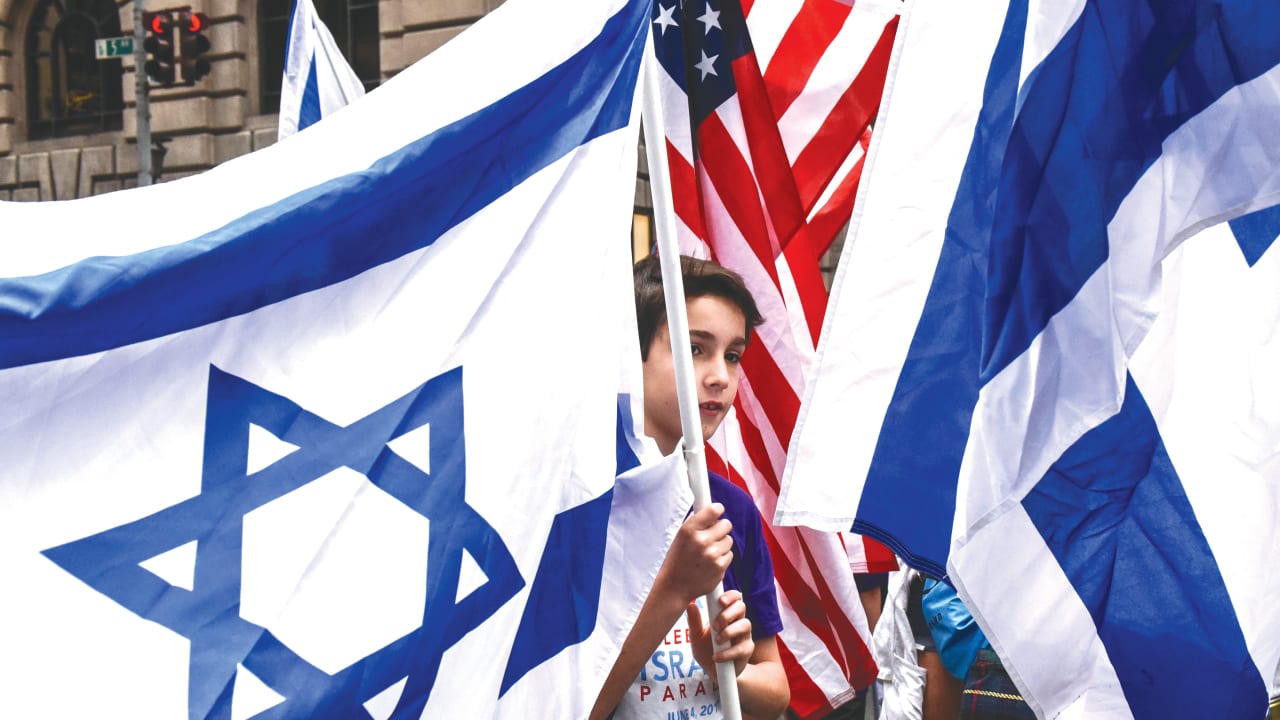
Calling roughly six million Jews “traitors” because they do not live in Israel is a moral mistake, a psychological mistake, and a Zionist mistake. Yet that is precisely what Haggai Segal did on Friday, in a sharp column in the religious-Zionist weekly Makor Rishon, aimed at American Jewry and its failure, as he sees it, to make aliyah, meaning immigration to Israel.
Segal is one of the most influential voices of Israel’s national-religious Right. He is a former editor-in-chief of Makor Rishon, a founding figure of Arutz 7, a longtime resident of the settlement of Ofra, and the author of seven books.
When he writes about Diaspora Jewry, he is articulating a worldview shared by a substantial slice of religious Zionism in Israel.
It will surprise no one that I disagree. Still, I want to say so with respect. Haggai was my editor for close to a decade at Makor Rishon. We always differed on this subject, and, even so, he kept the door open. When I wrote about, or interviewed, figures on the political and ideological edges of American Jewry, he published them.
The verdict has to be stated plainly. It is a moral mistake because a person who has not realized a Zionist ideal is still a Jew carrying out a full Jewish life. It is a psychological mistake because any community branded that way will close ranks and walk away from the conversation itself.

It is a Zionist mistake because Zionism is a demand, a call, a responsibility, and at times a rebuke. Zionism is a language of belonging, not a language of divorce.
The stakes sharpen now, after October 7. The massacre and the war shook American Jews, unsettled them, and brought back to the surface questions of identity, belonging, and shared fate. Among them, there is more interest in Israel. There is more conversation about Jewishness. There is more desire to come closer. To tell them at this moment that they are traitors is to slam shut a door that has only just opened.
Yes, most of them do not send their children to the IDF. They do not carry the burden borne by reservists, bereaved parents, the wounded, the displaced, and the Israelis who live here inside a reality of constant threat. That difference is real. And still, they pay a price for their Jewishness.
This year, I met a Jewish student at Columbia University who studies communications and was the lone Jewish and Israeli voice on the campus paper. She told me about threats, slurs, humiliations, and a daily fight over every headline and every phrase.
Every piece she filed was paired with an anti-Israel article for the sake of “balance.” Listening to her, I thought about courage. I told her that one day I want her to be my reporter. She asked how I already knew. I told her that what she was going through as a Jewish student defending Israel and her right to remain a Jew was real journalistic training.
She was born in America. Maybe she will make aliyah. Maybe not. Either way, the label of traitor does not fit.
She is one of many. There are Jews who stay because their parents are aging or ill. There are those living a Jewish mission, from Chabad shlichim, or emissaries, to community rabbis and educators. There are deeply Zionist families whose children study in Israel, come for a year of national service, weigh aliyah, or live for years between two worlds.
There are Jews who choose their Jewishness day after day, inside a surrounding culture that invites assimilation, comfort, and disappearance.
A vast world of Torah was built outside of Israel
A measure of humility is in order, historically and spiritually.
A vast world of Torah was built outside the Land of Israel. The Babylonian Talmud, the most foundational and influential text in our library, was written in Babylon. Aliyah is a commandment, a privilege, and a future. A Jewish life outside Israel is still a Jewish life.
On one point, Haggai is right. Aliyah from the United States is low. Too low. I myself made aliyah as a child with my parents. It was not my decision, but I know what they sacrificed to raise their children here out of Zionist conviction. Immigration is hard. Very hard. Many olim live for years with a sense of foreignness, with an accent, with an unfamiliar cultural code, with a glass ceiling. They know they may become a less natural version of who they could have been in their birthplace, and they come anyway. That is greatness. Not everyone is capable of it.
The right conclusion to reach from the low numbers of US Jews making aliyah is that greater investment is needed. I would keep The Jewish Agency for Israel and sharply increase the emissary budget. More shlichim. More Israeli teachers in Jewish day schools. More Zionist rabbis in communities. More summer camps and Zionist youth movements. More Hebrew instruction. More serious aliyah campaigns. Nefesh B’Nefesh (NBN) has done something very important. It has made aliyah easier, more accessible, and more stable for those who have already decided to come. The people who plant the dream in the first place are most often youth movements, educators, schools, and rabbis. That is where the real investment belongs.
There is an internal truth to speak here, too. Israelis love to explain to Jews abroad that they must make aliyah. Yet Israelis are far less adept at absorbing them. How many of us teach our children to be generous to immigrant classmates? How many of us make sure the new oleh has someone to talk to, someone to explain the language, the codes, and the culture?
This year, we met a family in our community that made aliyah from the US with small children, soon after Israel’s decision to strike Iran. It was a brave, striking, and almost unimaginable move. Alongside the salute, we have to absorb, support, and walk with them. Otherwise, the demand for aliyah rings hollow.
Segal’s column puts specific proposals on the table, and each one deserves an answer.
He proposes an ultimatum. If American Jews have not come en masse within five years, by Independence Day 2031, Israel should stop sending them emissaries and begin dismantling The Jewish Agency. The problem is practical before it is ideological. The agency and its partners are the runway on which NBN lands.
Every empirical measure we have says the same thing: Jews who spend time in Israel as teenagers, who meet Israeli shlichim, who learn Hebrew in an immersive Jewish setting, are vastly more likely to come on aliyah. Close those pipes, and the numbers Haggai laments will fall further.
He proposes that the Chief Rabbinate declare, starting in 2031, that Diaspora Jews will no longer be counted in the halachic reckoning of rov yoshveha aleha, the calculation of whether the majority of the Jewish people lives in the land, which affects certain Torah commandments tied to the land.
Using halacha as a political lever to punish people for their choices is foreign to religious Zionism. And the point is close to moot: By most demographic measures, the majority of world Jewry already lives in Israel. The threat is rhetorical. The damage would be real.
Segal proposes, most of all, a change of tone. Enough flattery, he writes. Time to tell American Jews plainly what we think of them. He reaches back to the Talmudic rebuke of Reish Lakish to the Jews of Babylon – Eloka sanina lechu, “God hates you” – for failing to come up to the Land of Israel in the days of Ezra. Read honestly, that text shows exactly why this approach does not work. The Jews of Babylon did not make aliyah after the rebuke. They stayed. They built the Babylonian Talmud. Two thousand years of Jewish history teach us that vision produces aliyah, education produces aliyah, family ties produce aliyah, and meaning produces aliyah. Contempt never has.
Zionism itself was not a five-year project. Theodor Herzl died 44 years before the state was declared. The aliyah from the former Soviet Union that reshaped Israel took generations of covert teaching, smuggled Hebrew books, and persistent pressure. To give American Jewry a five-year deadline and then punish them for missing it is to misunderstand how people move.
Rabbi Eliezer Melamed is the head of the Har Bracha yeshiva, author of the widely read Peninei Halacha series, and one of the most influential religious-Zionist voices in Israel. No one can suspect him of softening the value of aliyah. In his recent column after a tour of American Jewish communities, he described what he saw: “a Zionist community” for whom the war had deepened the desire to make aliyah, communities where Psalms were recited for IDF soldiers, and a process in which “many people are seriously considering aliyah” because “the investment in education is bearing fruit.” His conclusion was clear: This is “a mission that bears fruit.” That is the exact shlichut infrastructure Haggai proposes to dismantle.
Melamed also offers a deeper principle. In another column, he wrote that it is forbidden to boycott the leaders of the Reform and Conservative movements, calling it a matter of “national life and death” and quoting the Netziv of Volozhin: “swords in the heart of the nation.” If toward communities far from us religiously and ideologically, the answer is dialogue and responsibility, then all the more so toward Orthodox, Zionist, Israel-loving communities. The language of excommunication breaks with the path of Rav Kook and his son Rav Tzvi Yehuda, from whom Melamed draws.
This argument also runs through Makor Rishon’s own pages, much of it in my Hebrew series, which ran in English as “Distant Relatives,” during the years Haggai Segal led the editorial board.
Rabbi Amichai Eliyahu, now serving in Israel’s government as heritage minister, told me with disarming honesty in an interview: “In my community, there is contempt for Jews who do not come to Israel.” Then came the turn of: “We are not whole without that connection.” Religious Zionism, he added, has concentrated on the Land of Israel and forgotten the people of Israel. His is a voice asking to restore the people of Israel to the center of Zionism.
Rabbi Yaakov Medan, co-head of the Har Etzion yeshiva in Gush Etzion, put it in sharper terms. In an interview with journalist Yair Sheleg, he described being horrified by a message Diaspora Jews were receiving from Israel: “We don’t need you anymore.”
His answer: If that is the direction, then go back to the UN and seek recognition again because what was founded in 1948 is “a Jewish state, not an Israeli state.” The relationship with world Jewry belongs to the very definition of Israel as a “Jewish” state.
The real question is not whether American Jews are perfect. They are not. There is ignorance, assimilation, distance, anti-Israel activism, and, at times, painful cases of self-antisemitism. Taking a fringe magazine such as Jewish Currents, which Haggai cited, and turning it into the face of a whole community is neither fair nor wise. We have extremists here, too. We have fringes that do not represent the broader public.
I agree with Haggai on one central point: Israel is not doing enough to encourage aliyah. That is exactly why the response cannot be despair. We need targets for the coming decade. Translate more books and more content into English. Invest in Hebrew instruction. Build new in-depth programs. Massively strengthen Zionist education. Make aliyah desirable, intelligible, and supported. Deep change is built over a decade, or two, or three.
American Jews are different from us. Sometimes very much so. Sometimes it is infuriating, sometimes it is challenging, and sometimes it throws light on something about ourselves. If this issue truly matters to us, our responsibility is to fight for them. To fight for the language, for the identity, for the education, for the connection, and yes, for aliyah.
That is a more mature Zionism. More confident. And more effective.