
At first glance, it almost didn’t look real: more than 60 Palestinian men packed into the back of a garbage truck – a place meant for refuse, not people – who were pulled out one by one by police officers.
The video, released by the Israel Police on Monday, sparked predictable reactions. Many praised the security forces for detecting the infiltration attempt and stopping these so-called “illegals” from entering Israel.
I watched it and felt something else entirely – sadness. Not because the men were caught – Israel has every right and obligation to control who enters its borders – but because of what that image revealed: dozens of human beings willing to squeeze themselves into a garbage truck simply for the chance to reach a day’s work.
That is not normal. That is desperation.
We do not yet know who these men are, but it is unlikely they are terrorists. It is far more likely that they are like the thousands of Palestinians caught each year trying to enter Israel illegally, known in Hebrew as shabahim. Around 6,000 were apprehended in 2025 alone.
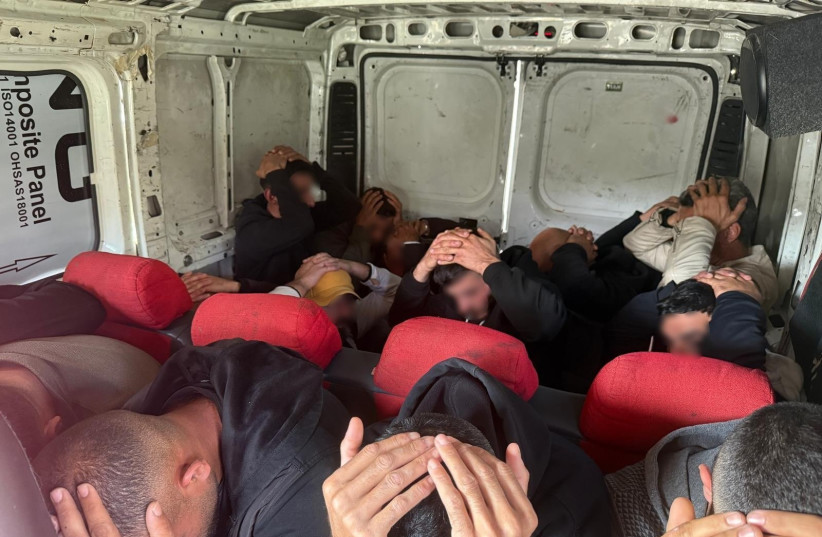
These are people trying to earn a living, to support their families, and to build some form of future – even if it means risking their lives in conditions most of us would never consider.
Which is why this video is not just an operational achievement. It is also a reminder that alongside us live millions of people with little economic opportunity, limited mobility, and almost no horizon of hope. And with them, we have an unresolved conflict.
Before October 7, roughly 105,000 Palestinians worked in Israel, primarily in construction and agriculture. After the war, nearly all of those permits were revoked. The security concerns were, and remain, real, and no responsible government could ignore them.
However, security policy cannot exist in a vacuum. It must be part of a broader strategy, and that is where Israel today falls short.
The question Israelis need to be asking is not only how to prevent the next infiltration, but where all of this is heading. What is the government’s long-term policy? What is the vision for the future between the two peoples who live in the West Bank?
What is the future of of the peoples in the West Bank?
Right now, there is no clear answer.
What does exist is a policy of expansion. Israel has moved to increase its presence in Judea and Samaria, establishing close to 100 new communities, including more than 20 built entirely from scratch. Some, like Kadim and Ganim, were evacuated as part of the 2005 Disengagement and are now being rebuilt.
At the same time, violence by Jewish extremists against Palestinians has risen, further complicating an already volatile reality.
Beyond that? Silence.
There is no serious national conversation in Israel about the future of the West Bank or our relationship with the Palestinians. There is no attempt to engage, even at a basic level, with the Palestinian Authority – flawed, corrupt, and deeply problematic as it is. Yet it remains the official representative of roughly three million Palestinians living just minutes from Jerusalem and Tel Aviv.
Compare this approach to the way Israel is trying to manage the conflict with Hezbollah and the contrast is striking. While Israel remains in conflict with Hezbollah and rockets continue to rain down on northern Israel this week, Israel entered negotiations with the Lebanese government, with the stated goal of reaching a long-term arrangement and potentially even official diplomatic ties.
How is this possible in Lebanon where Hezbollah dominates, but not in the West Bank? Part of the answer lies in American pressure. The Trump administration pushed for talks with Beirut. It has not made similar demands regarding the Palestinians.
There is a deeper reason, however. Israel cares about Lebanon in a way it currently does not care about the West Bank, at least not strategically. There is a desire to avoid another Lebanese quagmire and there is no equivalent urgency when it comes to the Palestinians.
Some argue that Lebanon is different and that its government, which is pro-West, does not support Hezbollah, but that distinction is not as clear cut as it sounds. The Lebanese government has limited control over Hezbollah, just as the PA has limited control over Hamas. The PA does not officially support them, even if it engages in deeply troubling practices like payments to prisoners and the glorification of attackers.
In other words, Israel is capable of making a distinction between a state and a hostile non-state actor when it wants to. With Lebanon it does, and with the Palestinians it does not.
The question is whether Israel cannot, or simply chooses not to. Those are two very different things.
OBVIOUSLY, NONE of this is simple. After October 7, the idea of engaging with Palestinian leadership that refuses to unequivocally reject terror is deeply unpopular, and understandably so. The wounds are still fresh and distrust runs deep.
In addition, it is clear today that a path to Palestinian statehood is much longer than previously claimed. It will take deep substantive change in general Palestinian society for anyone in Israel to believe in peace or coexistence again.
However, choosing not to engage is also a choice. When Israel wants to shape a process, it knows how to do it. When it prefers to avoid one, it knows how to do that as well.
A perfect example was what happened two years ago during the war in the Gaza Strip, when Israel refused to outline a plan and today faces a reality where Hamas remains in control of 50% of the territory.
In the years ahead, Israel will face no shortage of challenges: maintaining security, countering regional threats, shoring up support in the United States, addressing the ultra-Orthodox draft, and deepening the integration of Israeli Arabs into society. Excuses are easy to make why not to tackle any one of these issues, but that is what they are – excuses.
The difference between all of these issues and the Palestinian one is that they are debated openly in the political arena. Candidates are campaigning on them ahead of the next election and parties are drafting technical plans.
But when it comes to the Palestinians, there is nothing – no debate and no conversation. There is no real attempt to define a future that is different from the present.
That may be the most mistaken policy of all. It is an illusion to believe that three million people living a short drive from Tel Aviv can simply be ignored, and it is an illusion to think that scenes like the garbage truck are isolated incidents rather than symptoms of a deeper reality.
On the eve of Independence Day, we celebrate the extraordinary achievement of Israel’s founding, which, at its foundation, was a moment when leaders had to make difficult, historic decisions about what kind of country this would be.
Seventy-eight years later, we still face difficult decisions. Pretending a problem does not exist is not a policy; it is a choice – and it is the wrong one.
The writer is a co-founder of the MEAD policy forum, a senior fellow at JPPI, and a former editor-in-chief of The Jerusalem Post. His latest book is While Israel Slept.