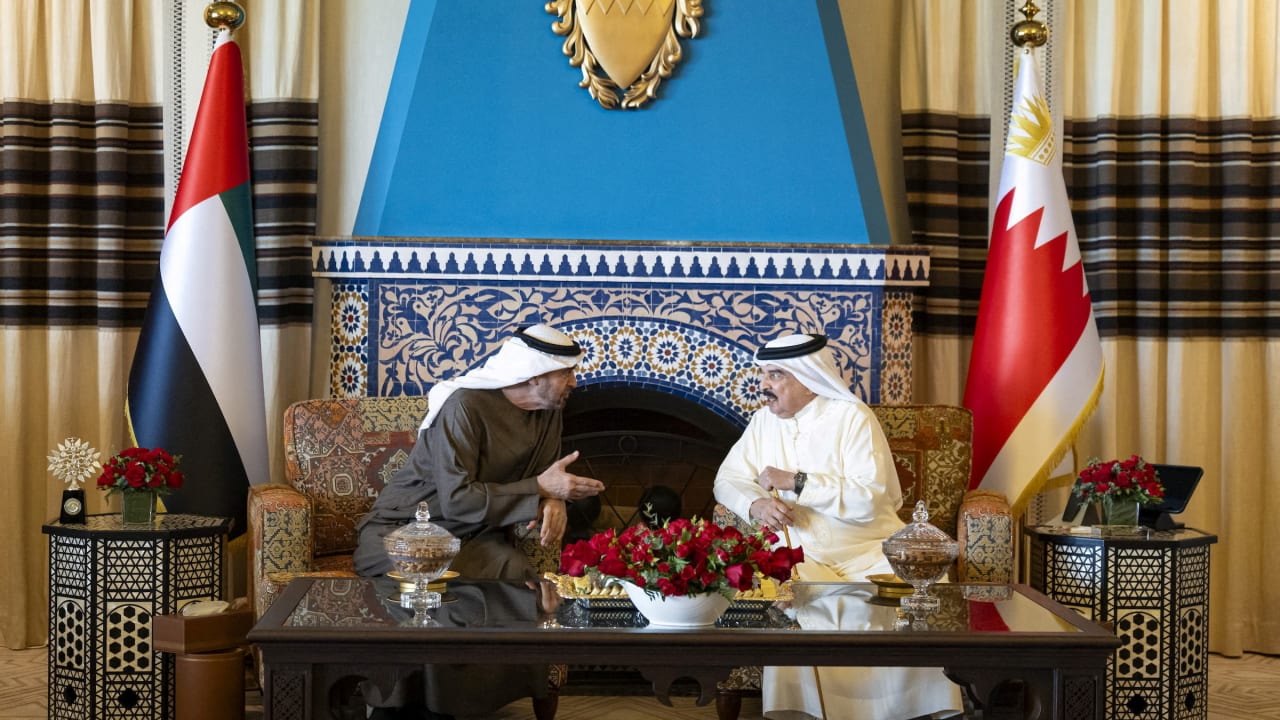
The United Arab Emirates is strengthening “security cohesion” in the Gulf, particularly with Bahrain, a new article in the UAE’s Al-Ain argues.
Bahrain and the UAE are both members of the Abraham Accords. As such, the key connections between them and the decision to work more closely together could bolster the Abraham Accords and regional security.
“In light of the blatant Iranian interference and repeated attempts to destabilize the Kingdom of Bahrain through its regional proxies and unconventional tools, the firm and deep-rooted Emirati support for Manama stands out as a strategic backing factor that reflects the unity of the Gulf position in confronting these challenges,” Al-Ain noted.
The UAE “sees Bahrain’s security as an integral part of its national security, and that the stability of the Gulf states represents a single, indivisible system, which enhances the strength of the common position in dealing with escalating threats, according to experts whose opinions were surveyed by Al-Ain.”
Bahrain has been taking measures to improve its security amid two months of conflict in the Gulf with Iran.

Iran attacked the Gulf states, especially targeting the UAE. Bahrain has sentenced five “defendants to life imprisonment, as well as revoked the citizenship of 69 people, including their families by extension.”
Bahrain is concerned about Iranian interference in its internal affairs. What that means is that Bahrain is likely concerned that Tehran is trying to infiltrate its population.
“Sheikh Abdullah bin Zayed Al Nahyan, deputy prime minister and minister of foreign affairs of the UAE, affirmed that the UAE supports Bahrain’s measures to protect its security, preserve its sovereignty and national gains, in the face of anyone who dares to threaten the kingdom’s security,” the Al-Ain article noted.
“He explained that Bahrain’s security is an integral part of the security of the UAE and the Gulf states, stressing the UAE’s unwavering support for the Kingdom of Bahrain in all the measures it takes to preserve its national security and stability.”
What should Gulf nations do next?
This is important. In the Gulf, there are many questions about what countries should do next. Iran has blockaded the Strait of Hormuz. The US has blockaded Iran. Now the US and Iran are conducting talks. Some are concerned that war could start again.
Bahrain and the other Gulf states understand the sensitivity of this stage. A former Bahrain politician said to Al-Ain that the “timing highlights the readiness of the allies to move quickly and decisively in the face of any threat, and sends a message that Bahrain’s security is an integral part of the UAE’s security, and that harming it is considered harming the Gulf system as a whole.”
An Emirate analyst also told Al-Ain that the moves Abu Dhabi is making are very important. The fear is that Iran is not only conducting aggression from “outside” with missiles, but also doing things within the Gulf states using “sleeper cells.”
“The situation is not only Bahraini, but the UAE has also been subjected to this type of aggression, both external and internal,” Al-Ain says. This kind of report in a UAE publication should be seen to reflect the feelings of the government.
The second issue is that “the Gulf represents a single security unit, and therefore the actions must be condemned, and Bahrain must be supported, because the same thing may happen in other countries in the region, and the GCC countries must reject this aggression in order to send a clear message to Iran that its actions are unacceptable.”
The UAE is seeking to support common Gulf security. However, not all the Gulf states are acting the same way. Kuwait and Oman historically have been more neutral. Riyadh is the more powerful state. Qatar is a close friend of Turkey and a major non-NATO ally.
The Gulf states are also seeking large defense deals with the US. Recent sales include approval for Patriot air defense and also the Advanced Precision Kill Weapon Systems (APKWS) for the UAE, Qatar, and Israel. Kuwait is also receiving an integrated battle command system. This is important.
“Security in the GCC countries is no longer a separate internal matter, but rather an interconnected system based on the principle of a shared destiny. Therefore, any threat to a Gulf state is viewed as a collective threat that requires a unified stance,” a former Bahraini parliamentarian told Al-Ain.
The UAE’s strong support for Bahrain is a “regional deterrent message to any attempt to destabilize the Gulf,” the report added. The argument is that in any direct confrontation, now or in the future, the countries will stand together. The argument is that the Gulf cannot be divided. The question may be whether the other states agree.
“In the same context, the former member of the Bahraini parliament said that the Emirati position is a clear and explicit deterrent message, carrying within it a warning to anyone who dares to tamper with the security of the Gulf, noting that the public and decisive support reflects the existence of a unified political will and the ability to coordinate and confront, which raises the cost of any potential hostile attempt,” the report added.