
The IDF’s 162nd Division is currently employed in the western part of the de facto buffer zone that Israel has established over the past two months, north of the international border between Israel and Lebanon. The yellow line that now separates this area from the rest of Lebanon is located around 15 kilometers from the Israeli border in the area held by that division.
The IDF chose this week to allow Israeli military correspondents their first chance to visit the buffer zone in the area held by the 162nd. The Jerusalem Post took part in the visit.
The 162nd Division in Gaza and Lebanon
The 162nd Division, which is attached to the IDF’s Southern Command, was engaged in constant combat in the period between October 7, 2023, and the Israel-Hamas ceasefire in October 2025.
Its units were deployed in their entirety to the North when Hezbollah chose to join the renewed hostilities on March 4 of this year. Since then, with the world and Israel’s attentions largely focused on Iran and the Strait of Hormuz, the division has been fighting Tehran’s proxy Shia militias in the green ascents and hills and through the villages of the border area.
The combat was fierce in its initial stages. Hezbollah’s presence in the area was limited prior to the recommencement of hostilities, but it rapidly beefed up its presence in expectation of an incursion by the IDF. In the initial period following the incursion, the infantry and armored forces of the 162nd faced determined resistance from Hezbollah. Tens of anti-tank missiles were fired daily on the advancing Israelis. The Hezbollah defenders used sustained mortar fire and FPV drones to try to slow the advance of the 162nd.
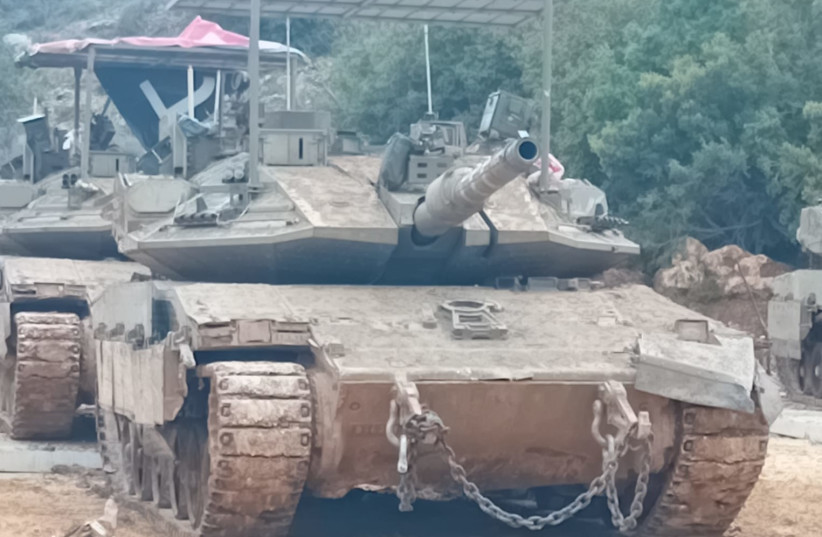
The organization’s tactics were not sufficient to prevent the establishment of the expanded buffer zone. The 162nd lost four soldiers who were killed in the course of the operation (three from the Nahal Reconnaissance Company and one from the armored 401st Brigade).
It killed 251 identified Hezbollah fighters, according to the division’s own figures.
Prior to the current 10-day ceasefire, the division found itself engaged in the Sisyphean task of clearing out remaining groups of Hezbollah terrorists still located south of the yellow line. At present, both sides are replenishing supplies and preparing for the next round.
The intention behind the establishment of Israel’s expanded buffer zone is fairly clear: to maintain the residents of Israel’s border communities out of the range of Hezbollah’s anti-tank missiles. Implicit also is the ambition to make impossible any future October 7-style rampage.
Nevertheless, the establishment of a zone of this kind does not address the wider problem of Hezbollah’s missile and drone capacities, which can, of course, be operated and launched from further north.
Aita al-Shaab, once a major Hezbollah stronghold
Ayta ash Shab, where the division hosted journalists this week, was once a stronghold of Hezbollah’s presence along the border. The IDF’s Paratroopers’ Brigade fought a fierce engagement in the town during the war of 2006. Earlier, it was located in the “security zone” maintained by Israel in the 1985-2000 period. During that time, it constituted a significant base of support for Hezbollah’s insurgency.
An obvious question regarding the newly established buffer zone is why its creators think it will escape the fate of the old security zone from which Israel ended up unilaterally withdrawing in May 2000, without quelling Hezbollah’s attacks.
At that time, the IDF found itself the target of a sustained guerrilla campaign, which maintained a steady toll of Israeli lives.
A clue to the way in which Israel hopes to avoid a similar result this time around may be found by observing Ait a Shaab. The village is not currently subject to occupation. Rather, it has been depopulated and largely reduced to rubble.
Mao Tse Tung, the Chinese theorist and successful practitioner of guerrilla warfare, recommended that an insurgent force should move among and depend on the civilian population the way that fish swim through water.
Israel, south of its new yellow line in Lebanon, evidently intends to deprive any would-be guerrilla force of this vital element of civilian support. The pro-Hezbollah villages of Ayta ash Shab and Beit Lif in the 162nd’s sector have been depopulated.
The Christian village of Debel, by contrast, remains intact and unharmed. The second element differentiating the current buffer zone from its predecessor is the IDF’s intention to maintain a far lighter footprint, avoid the establishment of large outposts, and rely on technical means to deal with any Hezbollah fighters seeking to make their way from the north towards the zone.
The soldiers of the 162nd Division were impressed by elements of the Hezbollah men’s technical prowess during the fighting in March, particularly in their employment of the FPV drones. By contrast, they found the motivation and fighting spirit of the Shia militiamen generally inferior to that of the Sunni Islamist fighters in Gaza.
Few believe that the fighting in March and April will be the last round. The tactical race for advantage between the sides continues in the rubble-strewn border villages and further north. The larger strategic issue, meanwhile, remains far from resolution.