
Iranian-backed militias in Iraq, which have carried out hundreds of attacks on behalf of Iran since the Iran War began, are suffering increased losses.
“More than a dozen members of the Popular Mobilization Forces (PMF), also known as Hashd al-Shaabi, were killed in two separate strikes targeting the group’s bases in Kirkuk and Anbar provinces in the early hours of Thursday, amid escalating regional tensions,” Rudaw Media Network, a news channel in the autonomous Kurdistan Region of northern Iraq, reported Thursday.
Numerous PMF bases have been hit by airstrikes across the rest of Iraq.
The most recent attacks targeted a PMF camp in Qaim, which is in western Iraq on the border with Syria. Ten members of the group were killed, according to reports.
The PMF is also known as Hashd al-Shaabi in Iraq. It is a group of dozens of militia brigades that were formed in 2014. Prior to 2014 most of these militias existed as independent units, and they had links to Iran.
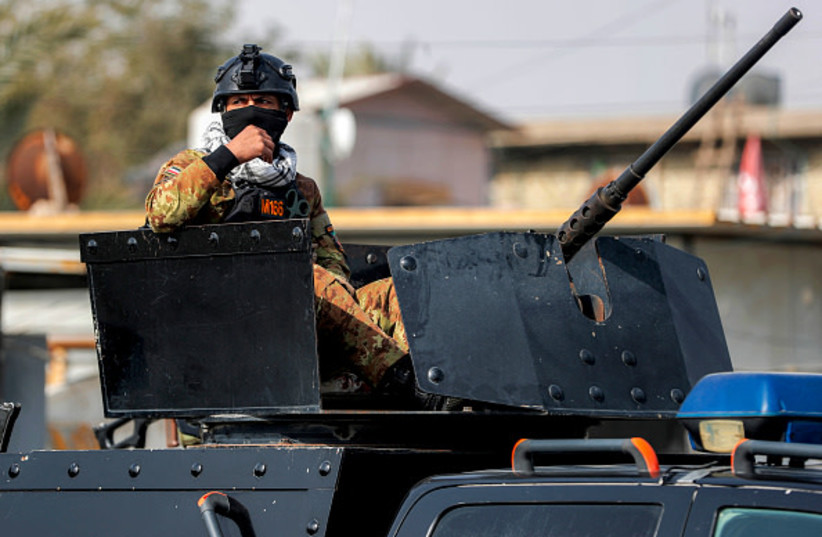
Many of them are considered terrorist groups by the US, including Kataib Hezbollah, Asaib Ahl al-Haq, Harakat Hezbollah al-Nujaba, Kataib Imam Ali, Kataib Sayyid al-Shuhada, and Harakat Ansar Allah al-Awfiya.
These PMF militias have been an Iraqi paramilitary force since around 2018, when they began receiving state salaries. This means they are part of the government and also operate quasi-independently with close ties to Iran.
The Iraqi government has expressed sorrow to the PMF over its losses. Meanwhile, it is being asked by the US and the Kurdistan Region to rein in the PMF militias and stop the attacks.
Iran-backed militias in Iraq target airports and US sites
An estimated 300 attacks by these militias have targeted military airports in Iraq, including one near Baghdad and Balad air base. They also have targeted a US diplomatic site in Baghdad, US forces in the Kurdistan Region, hotels, and Kurdish Iranian opposition groups.
In recent days, the US embassy in Baghdad has increased its warnings to US citizens in Iraq and warned about the activities of the militias.
The airstrikes come within a context. They hit PMF units near Mosul and in Nineveh plains from March 8-11.
Among the targets were the Hashd 30th Brigade, which is a unit of the Shabak minority in Iraq. The Shabak have villages in Nineveh plains, and some of them joined the PMF during the war against ISIS.
Iran has used this area in Nineveh to launch rockets and drones at the Kurdistan Region. In recent weeks, several KIA Bongo trucks have been found with rocket launchers installed on the back.
In addition, a unit of the Kataib Imam Ali has apparently been targeted near Kirkuk.
“In a separate drone strike on a PMF base in Kirkuk, at least four members of Hashd al-Shaabi were killed and around eight others were injured, according to Rudaw reporters on the ground, citing relevant sources,” Rudaw Media Network reported.
“The attacks on PMF bases come three days after US Secretary of State Marco Rubio held a phone call with Iraqi Prime Minister Mohammed Shia’ al-Sudani, during which he stressed that the Iraqi government must take ‘all possible measures’ to protect American personnel and facilities across the country,” the report said.
Six members of the PMF were also killed in strikes on March 11 near Dibs, north of Kirkuk, Rudaw reported.
“On Sunday, four PMF members were killed and eight others wounded in an airstrike in Diyala province, according to the armed group,” the report said.
Some of the PMF members killed on March 11-12 near Kirkuk were members of a Turkmen PMF unit, according to social-media reports.
Many Kirkuk residents came to a local hospital to donate blood after the strike. Many Turkmen live in Kirkuk.
The PMF is indicative of one of the ways Iran influences Iraq. They recruit locally for the ranks of some units. As such, the units are seen as protecting local areas.
Therefore, the airstrikes targeting the Shabak PMF and Turkmen tend to harm locals, even though it is the long arm of Iran that is linked to attacks in Iraq. As a result, these units suffer for Iran’s policies. This then leads to local anger after the airstrikes.
It is not clear if the airstrikes will cause Baghdad to finally rein in the militias. It is also not clear who is behind the airstrikes.
Many of the locals have blamed the US. Some have also blamed Israel or believe it is a combination of the US and Israel.