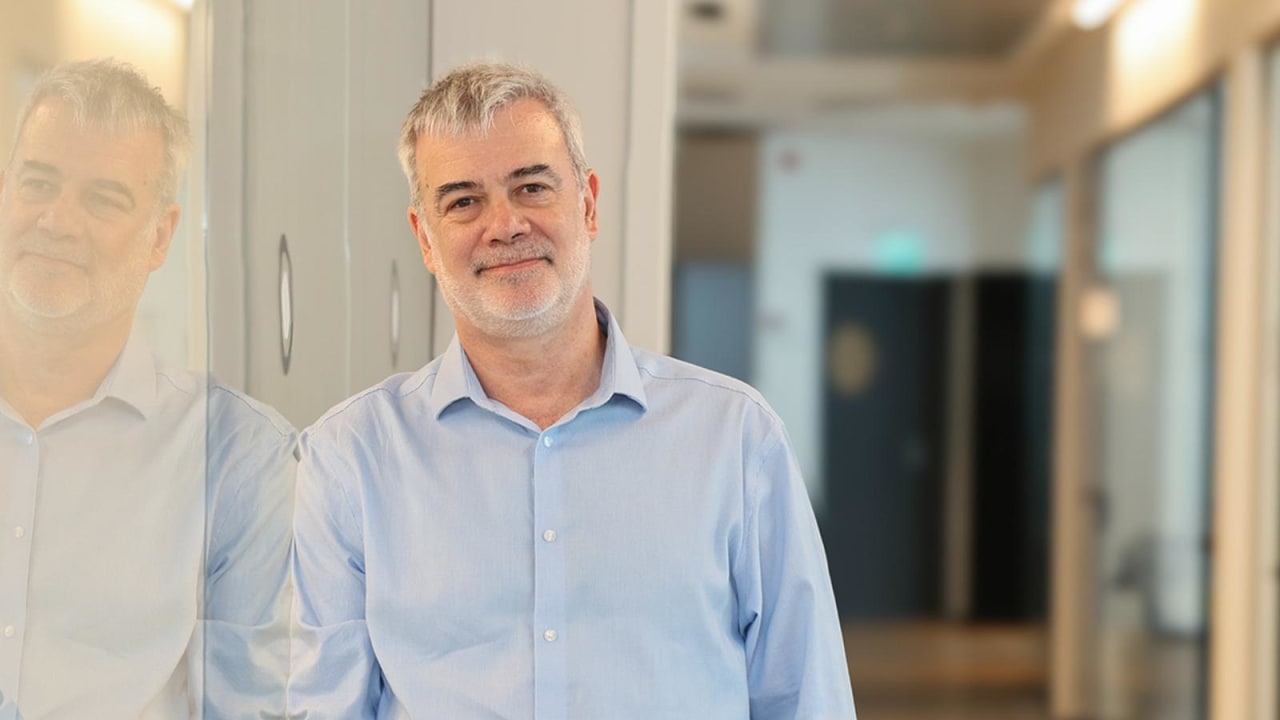
Prof. Eli Sprecher never intended to become a hospital CEO. He did not even plan to become a physician. Yet today, as CEO of Tel Aviv Sourasky Medical Center, better known as Ichilov, he leads one of Israel’s most influential medical institutions through what many view as the most demanding period in the country’s modern history.
Since taking office in November 2024, Sprecher has overseen a hospital transformed by war: treating hostages returning from captivity, receiving wounded soldiers flown directly from combat zones, relocating entire departments underground, and preparing for what he believes may become Israel’s next major public health emergency – a long-term mental health crisis.

Leadership, however, was never part of the original blueprint. “I never originally planned to become a physician,” Sprecher says. “And I certainly never envisioned myself as a hospital CEO.” His story begins far from Tel Aviv. Born in Belgium, Sprecher immigrated to Israel at 18 and entered medical school at the Hebrew University of Jerusalem. Science was always present in the background, with a biologist mother and a chemist father; it is little surprise that he describes his affiliation with science and research.
That pull toward discovery led him to pursue a PhD in molecular virology alongside medical studies. Rather than choose between research and clinical practice, he built a career around both. “Throughout my entire professional life, I lived in a state of perpetual duality. I refused to choose between the clinic and the laboratory,” he remarks. His arrival in Israel, though, was marked less by ambition than by confusion. “Speaking not a word of Hebrew, I was told that before starting medical school I had to go somewhere and sign documents,” he recalls. “I arrived, and everyone was dressed in green, I thought it was strange. It took me two years to realize that I had committed myself to military service through the Atuda program,” he says, laughing. That accidental enlistment became part of a career path that included dermatology residency in Haifa, a genetics fellowship in Philadelphia, and eventually a return to Israel, where he joined Ichilov as head of dermatology.
Administrative leadership followed gradually: vice president for patient safety, then vice president for research and development. Only later, he says, did he understand what leadership could offer. “Medicine is where we can create the deepest impact on people’s lives, and leadership is the ultimate vehicle for creating change.”

At Ichilov, that change is unfolding against the backdrop of war. Since October 7, hospitals across Israel have assumed roles extending well beyond medicine. They have become centers of national resilience, repositories of collective trauma, and institutions carrying a degree of public trust that few others retain. “After October 7, it became profoundly clear that the healthcare system is one of the strongest pillars of Israeli society,” Sprecher says. “The public trusts it deeply.”
The hospital moved quickly. “We understood almost immediately that we had to respond differently. In moments of national crisis, a hospital cannot function simply as a medical center. It becomes part of the national response.” Dedicated frameworks for acute treatment and rehabilitation were rapidly established for wounded soldiers and civilians. Hundreds of patients passed through them, and at the same time, Ichilov also revived a long-dormant asset: its heliport in central Tel Aviv. “It suddenly became a lifeline," he notes, recalling the helicopters carrying wounded patients arriving from the front lines.
Later came another mission entirely, one of the most complex and sensitive in the hospital's history, receiving hostages returning from captivity. “There was no precedent anywhere in the world,” he says. "There were no textbooks, we wrote the protocols ourselves.” The task, he says, felt larger than medicine. “We understood this was not only clinical responsibility - it was a historic responsibility.”
Among the earliest concerns to emerge was mental health. “One of the first things we recognized was that Israel was facing an unprecedented psychological crisis,” he says. The hospital quickly established trauma initiatives, including the Assif Center, while expanding international cooperation with institutions such as the famed Mount Sinai Health System. “We are combining the experience Israel is gaining now with the lessons New York learned after 9/11,” Sprecher says.
Adapting is surviving
All that said, no image has come to symbolize Ichilov’s wartime reality more than the underground hospital beneath Tel Aviv. “No CEO in Ichilov’s history ever had to decide to move an entire hospital underground,” Sprecher asserts. The possibility had nevertheless been anticipated years earlier, and a fortified emergency complex already existed underground, capable of treating more than 1,000 patients and connected directly to operating rooms and intensive care units.
“We had trained extensively,” he says. “But executing it in reality is completely different.” The first transition took seven hours, the second took five, but what surprised him most was not operational performance but patient reaction. “Conventional wisdom would suggest satisfaction would decline,” he says. “Patients were staying in converted underground spaces with difficult conditions and limited privacy.” The opposite happened - patient satisfaction scores increased. “The warmth and presence of our teams changed everything. That human connection under pressure is one of the things I am most proud of.”

Not letting an opportunity for advancement pass them by, Ichilov turned its underground environment into a testing ground for innovation. “Operating an entire hospital underground creates extraordinary logistical, epidemiological and clinical challenges,” Sprecher says.
Ichilov’s AI division, I-NEXT DATA, rapidly shifted focus toward wartime needs. One predictive system identified infection hotspots before outbreaks emerged in crowded underground wards, another helped determine which patients could safely transition to home hospitalization programs, and a third monitored elderly patients at risk of delirium - a cognitive condition exacerbated by stress and windowless environments.
“This is where artificial intelligence becomes truly meaningful,” Sprecher says. “Not by replacing physicians, but by helping them make better decisions under extreme pressure.” Technology, however, will not solve what he believes is the defining challenge ahead. “The psychological impact of this war will be enormous." Trauma, he argues, moves outward in widening circles. “It affects those who experienced violence directly, then families, then communities, then people exposed through media and social networks.”
And yet another layer that is now emerging is the resurfacing of historical trauma, and Sprecher describes people who are now reliving previous wars, and even Holocaust trauma returning. The scale is unlike anything Israel has previously faced, he believes. “There is absolutely no doubt about that, mental health is medicine.”
Psychiatry, he says, must finally move from the margins to the center. “It is no less scientific and no less urgent than cardiology or neurology.” For decades, stigma kept mental health outside mainstream medical discourse. “That era must end,” Sprecher says, "The future of mental healthcare is integration."
Psychiatric patients, he argues, deserve fully integrated care rather than parallel systems. “Our ambition goes beyond Israel,” he says. “We want to create new models that can influence healthcare systems worldwide.” Despite the pressure of the past year, Sprecher says little about fear or exhaustion.
Instead, he returns repeatedly to the people around him. “Truthfully, I am not surprised by our ability to rise to these challenges, because I know the character of the people who make up Ichilov.” Still, he notes, they continue to inspire him every single day. “I have the privilege of leading a non-trivial organization, driven by non-trivial leaders and supported by non-trivial partners.”
Above ground, Tel Aviv continues with its familiar rhythm. Below it lies another city: operating rooms beneath concrete, emergency wards without daylight, helicopters arriving overhead, physicians writing new protocols in real time. In a hospital built for scenarios once considered unimaginable, Sprecher’s understanding of medicine is now being tested: science and leadership, innovation and resilience, all held together by human connection.
Written in collaboration with Tel Aviv Sourasky Medical Center