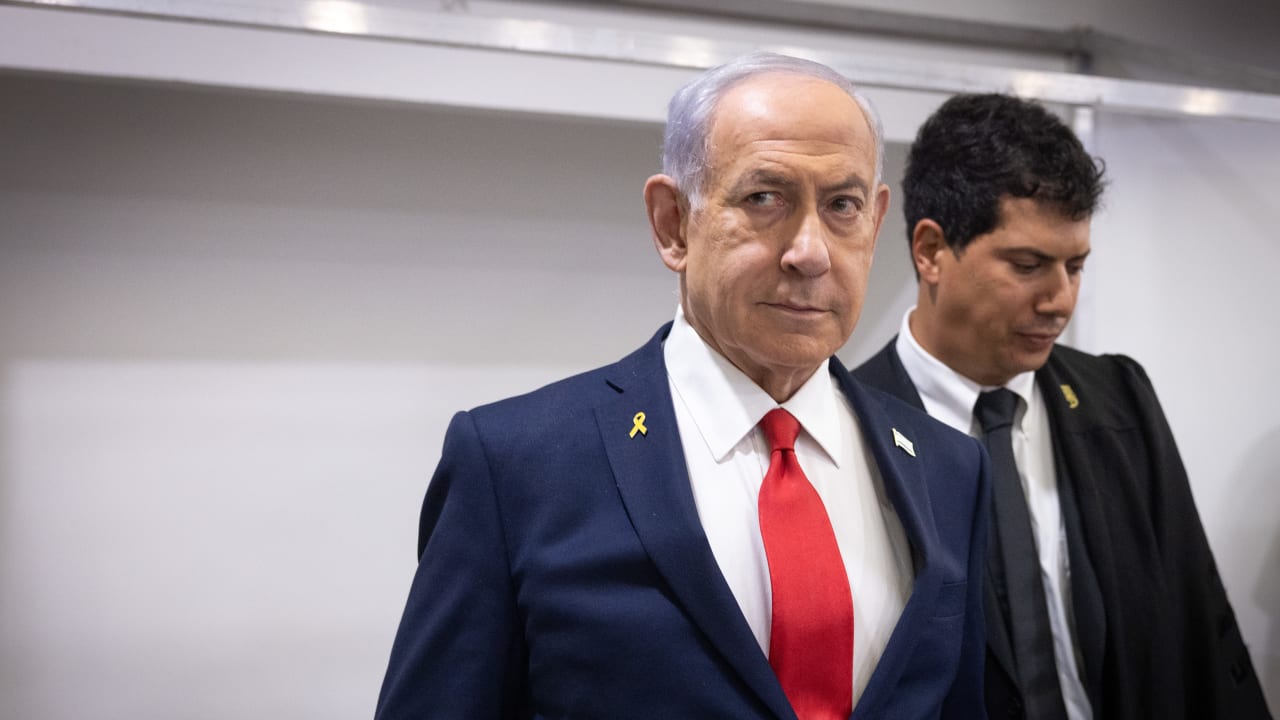
Prime Minister Benjamin Netanyahu again denied that he held a “guidance meeting” with former Communications Ministry director-general Shlomo Filber on Bezeq, as his testimony in the Jerusalem District Court was cut short by a security call at the Kirya on Wednesday.
The shortened and fragmented hearing came after the court rejected Netanyahu’s request to begin Wednesday’s testimony only at 12:30 p.m., citing his security schedule.
At the start of the hearing, Netanyahu told the judges that although his request had not been accepted, he would still need to leave court at 10:30 a.m.
“I asked, and I know my request was not accepted, to take a break until 12,” Netanyahu said. “But at 10:30 I will need to go to the Kirya, for a certain call that I have to make. I don’t know exactly how long it will take.”
Presiding Judge Rivka Friedman-Feldman replied: “Okay.”

Netanyahu left the courtroom later that morning and returned after a long break, leaving the hearing with far less time than originally scheduled.
In a filing submitted Tuesday night, Netanyahu’s attorney Amit Hadad asked the court to hold Wednesday’s hearing from 12:30 p.m. to 4 p.m., citing a “security matter” detailed separately in a sealed envelope submitted to the court and the prosecution.
The defense said that because of the tight timetable, the request was submitted before the prosecution’s response was received.
Netanyahu’s trial, which began in 2020, is now in the defense stage
Friedman-Feldman, sitting with Judges Moshe Bar-Am and Oded Shaham, rejected the request.
“After reviewing the request and the confidential material, I have not found a sufficient basis justifying the requested change in the hearing date,” Friedman-Feldman wrote. “The hearing will take place as scheduled.”
But in practice, the hearing was interrupted soon after it began.
Before the break, Bar-Am pressed prosecutor Yehudit Tirosh on whether she expected to finish her cross-examination on Case 4000, the Bezeq-Walla affair, that day.
Tirosh reminded the court that Tuesday’s hearing had lasted only about four hours and said she hoped to finish by Monday or Tuesday.
“I am interested in finishing no less than your honor,” she said.
Tirosh then returned to the central question in Case 4000: whether Netanyahu directed Filber, upon his appointment as Communications Ministry director-general in 2015, to ease the regulatory pressure on Bezeq, then controlled by Shaul Elovitch.
The prosecution argues that Filber’s conduct at the ministry later matched Bezeq’s interests on a series of key regulatory issues, including Bezeq’s landline phone services, the terms under which competitors could use Bezeq infrastructure, and the possible cancellation of structural separation between Bezeq and its subsidiaries.
Tirosh argued that Filber delayed reforms, repeatedly sought agreements with Bezeq rather than imposing decisions on it, and sent drafts to Bezeq for review without the knowledge of professional officials in the ministry.
The prosecution's position is that this conduct was not accidental, but stemmed from Netanyahu’s alleged request to benefit Elovitch and soften price reductions imposed on Bezeq.
Netanyahu rejected the claim outright.
“I did not say anything to Filber,” Netanyahu said. “I did not speak to him about this at all.”
He accused investigators and prosecutors of pressuring Filber into giving the version they wanted, saying they had “destroyed” Filber’s life, used spyware against people close to Netanyahu, and “fabricated” a date for a meeting that did not happen.
Netanyahu also said he had not spoken to Filber about the Bezeq phone-service issue – “not even one word.”
Tirosh confronted Netanyahu with his own previous statements, including his response to the indictment, in which he said Filber had updated him on ministry matters. Netanyahu said that did not mean he was involved in the regulatory details.
“It may be that he said something to me,” Netanyahu said. “It went in one ear and out the other without passing through the middle, because I have a few other things on my mind.”
Tirosh also challenged Netanyahu’s repeated claim that Elovitch never approached him on Bezeq matters since people knew he reacted harshly to requests involving a specific business interest.
She pointed to Netanyahu’s own testimony about his handling of complaints from businessman Haim Saban, who was later involved in the communications market.
Netanyahu said there was no contradiction. Elovitch, he said, did not approach him on Bezeq matters, while Saban had made a personal complaint about Filber’s conduct that Netanyahu considered serious enough to check.
Netanyahu argued that the fact he looked into Saban’s complaint showed the opposite of what the prosecution was suggesting: that he was not improperly coordinating with Filber.
Tirosh also presented several calls between the Prime Minister’s Residence and Filber on Saturday nights, which the prosecution says support Filber’s original account that Netanyahu spoke with him after the alleged guidance meeting.
Netanyahu said the calls were too short to prove their content and that it could not be known who actually spoke with Filber. He again denied that there was a guidance meeting or a follow-up call.
Bar-Am noted that Netanyahu had first said decisively that he did not speak with Filber about Bezeq, while his direct examination appeared to acknowledge that some conversation had taken place.
Hadad responded that Netanyahu had been referring to a conversation with the opposite meaning: making sure Filber was not acting in Bezeq’s favor.
The hearing came a day after Netanyahu returned to the witness stand for the first time since February 24, following a two-month pause caused by the Iran war and security developments in the region.
Case 4000 is the most serious of the three cases against Netanyahu because it includes a bribery charge.
Prosecutors allege that Netanyahu used his authority as communications minister to advance regulatory decisions benefiting Bezeq, while Elovitch’s Walla news site provided favorable coverage to Netanyahu and his family. Netanyahu denies wrongdoing.
Netanyahu’s trial, which began in 2020, is now in the defense stage. He was indicted in 2019 and has pleaded not guilty.
He began testifying in December 2024, in a first for a sitting Israeli prime minister facing criminal charges, and prosecutors began cross-examining him in June 2025.
The indictment includes three cases: Case 1000, concerning gifts from wealthy businessmen Arnon Milchan and James Packer; Case 2000, concerning alleged discussions with Yediot Aharonot publisher Arnon Mozes; and Case 4000, the Bezeq-Walla affair.
Netanyahu faces fraud and breach of trust charges in Cases 1000 and 2000, and bribery, fraud, and breach of trust charges in Case 4000.