The first consultations between President Isaac Herzog and party representatives on whom they will recommend to form the next government began at the President’s Residence on Wednesday, with three out of the four factions attending recommending Prime Minister Benjamin Netanyahu as the candidate to receive the mandate.
The Religious Zionist Party, Shas, and Zehut all recommended Netanyahu. Meanwhile, Yisrael Beytenu, led by Avigdor Liberman, recommended chairman of the Yashar party Gadi Eisenkot as the candidate to form the next government.
Eisenkot is still expected to receive the mandate from Herzog following the conclusion of consultations with all the parties, many of which have expressed their intention to recommend the Yashar leader to form the next government. The rest of the consultations are set to conclude on Thursday evening.
By law, the president is required to consult the Knesset factions before deciding who receives the task of forming a government.
The first party to meet with Herzog was the far-right Religious Zionist Party (RZP), led by Finance Minister Bezalel Smotrich.
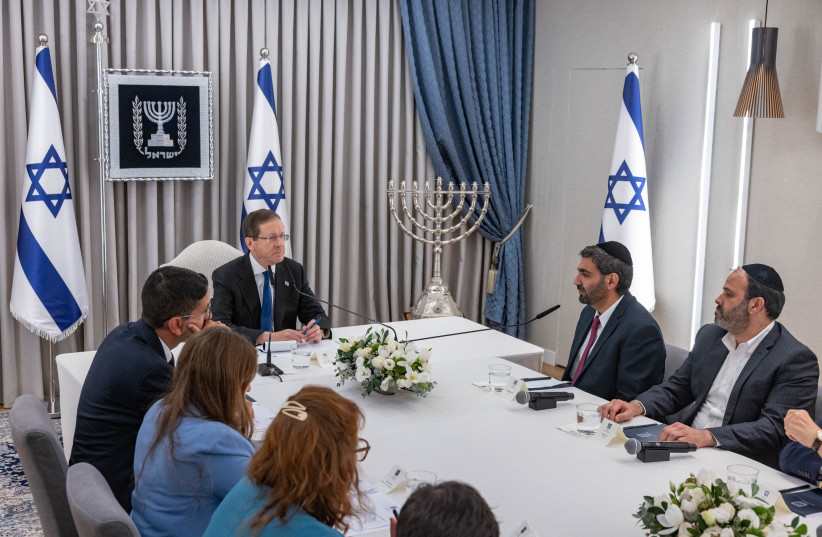
Delegations meet with President Isaac Herzog
Those in the RZP delegation that met with Herzog included Settlement and National Missions Minister Orit Strock, Itamar Eitam, and Zvika Mor.
Representatives from the haredi (ultra-Orthodox) Sephardic Shas party were next to meet with Herzog. The Shas delegation was comprised of MKs Michael Malkieli, Yinon Azoulay, Yoav Ben-Tzur, Haim Biton, and Dror Amos.
Shas, led by Arye Deri, had announced its intention to recommend Netanyahu on Tuesday, ahead of the consultations. The party has been a key partner in Netanyahu's governing coalition along with the additional haredi party United Torah Judaism (UTJ).
On Wednesday, UTJ announced that its representatives would not recommend anyone as a candidate for prime minister ahead of its consultations at the President’s Residence, ruling out the possibility of the party recommending Netanyahu, as it had previously done.
Herzog's third meeting was with representatives of Yisrael Beytenu, which recommended Eisenkot to form the next government.
Yisrael Beytenu MK Oded Forer said at the President’s Residence that “we must come together here and do everything possible during this period of negotiations to establish a good government for Israel that will address all the challenges facing us.”
Lastly, Herzog met with Zehut representatives Moshe Feiglin and Shai Malka, who also recommended Netanyahu and argued that the results of the election should be annulled.
"I know the history. You have never fully trusted the state," Herzog responded to Feiglin.
CEC approves election results given to Herzog
The CEC approved on Wednesday morning the election results given to Herzog at noon, after finding no evidence of compromised election integrity amid the ongoing Shin Bet (Israel Security Agency) investigation into suspicions that foreign entities, such as Qatar and Turkey, allegedly funneled money into Israel to influence voting in Arab communities.
The election results showed that Netanyahu’s bloc maintained its lead, securing 53 seats in the next Knesset, while the opposition bloc won 48. The Arab parties, Ra’am and the Joint List, won a record-breaking 19 seats combined.
Political deadlock could lead to another election
The political deadlock could ultimately lead to another election, although the parties may still reach an agreement through coalition negotiations. Other possible outcomes include a unity government between Netanyahu and members of Eisenkot’s bloc, or a minority government.
Along with the 48 seats won by the opposition bloc, the Arab parties' 19 recommendations would give Eisenkot 67 in total, prompting Herzog to potentially grant him the mandate over Netanyahu.
On Wednesday, Ra'am announced that it would support Eisenkot to Herzog as its candidate to form Israel's next government ahead of further consultations at the President's Residence.
Other party leaders in the opposition bloc, Naftali Bennett (B'Yachad), and Yair Golan (the Democrats) have also stated that they would recommend Eisenkot, with the aim of avoiding another election.
On Sunday, Herzog called on Israel's political leaders to accept the election results and demonstrate flexibility in coalition negotiations, warning against political entrenchment that could force the country into another election.
Consultations delayed due to security incident
The consultations were temporarily delayed after a security screening machine at the President’s Residence triggered an alert while screening visitors, which halted entry into the compound. The consultations continued, though Jerusalem District police officers, including police bomb disposal technicians, were dispatched to the scene to investigate.
Additionally, a small group of demonstrators protested outside the President's Residence just as the consultations were set to begin.
The political deadlock could ultimately lead to another election, although the parties may still reach an agreement through coalition negotiations. Other possible outcomes include a unity government between Netanyahu and members of Eisenkot’s bloc, or a minority government.
Along with the 48 seats won by the opposition bloc, the Arab parties' 19 recommendations would give Eisenkot 67 in total, prompting Herzog to potentially grant him the mandate over Netanyahu.
On Sunday, Herzog called on Israel's political leaders to accept the election results and demonstrate flexibility in coalition negotiations, warning against political entrenchment that could force the country into another election.