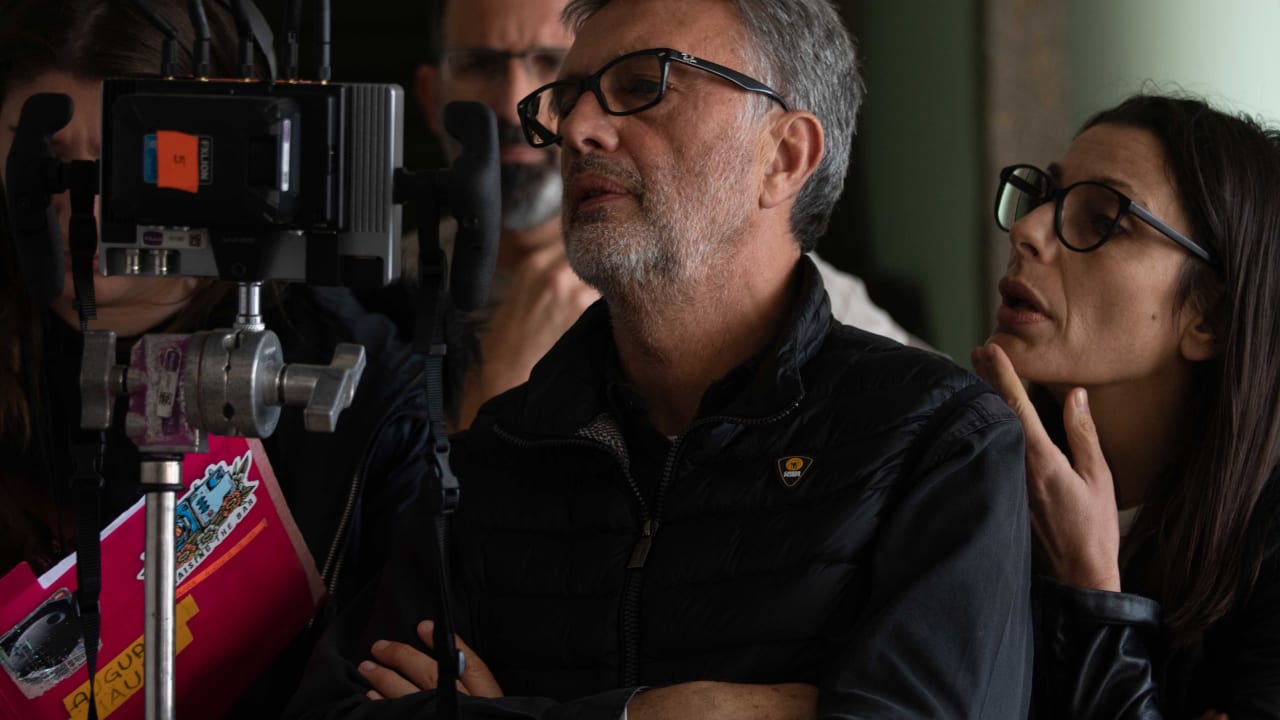
Guido Chiesa’s movie For the Love of a Woman, which is playing in theaters throughout Israel as well as in New York, Los Angeles and several other US cities, is an unusual movie on several counts.
First, it’s an adaptation of an acclaimed Israeli novel, Meir Shalev’s The Loves of Judith, and adaptations of contemporary literary novels are rare these days.
But what makes it especially interesting is that it was made by Chiesa, an Italian director, who was drawn to the novel from the moment he first read it, and who worked for years to adapt it with his screenwriter wife, Nicoletta Micheli.
Bringing Meir Shalev's novel to the big screen
“We are Italians, non-Jewish, but we fell in love with the story,” he said. “And basically, we found, in our opinion, that it was a story about the real meaning of love.”
In a time of rising antisemitism and, especially, anti-Israel sentiment, in Italy and all over the world, it was not easy to get this film made, he said, and it has not been easy to get it shown, either.

“Right now, [antisemitism] is very strong, partially because it is [part of a movement that is] anti-United States, anti-Trump, anti-America, and anti-Western world, generally speaking.
“On top of it, I discovered there is a lot of antisemitism hidden in the psychology of our society. It still is there,” said Chiesa.
His films include Johnny the Partisan and Working Slowly (Radio Alice), both of which were shown in competition at the Venice Film Festival.
“I found Israeli society, with all the difficulties, the dramas, the tragedies, and the complexity, still full of life. There is still something going on,” he said, noting the widespread protests against judicial reform that reflect deep divisions in Israeli society around the time the movie was filmed in 2022 and early 2023.
“I still believe in complexity. Complexity is what human beings are made of, and we should support it, not be scared of it.”
Shalev’s novels, which have been translated into more than 25 languages, are very popular in Italy, and The Loves of Judith was brought to his attention by the Italian company Colorado Film Production, which produced the movie with Vivo Film and RAI Cinema.
Although he thought it was a wonderful book, he and Micheli struggled to adapt this very literary novel to the screen.
“[The story] is kind of lost in a million things, which is part of the literature. It is very hard to bring that into movies, but there is the backbone of a great story there,” he said.
The book uses magic realism to tell a complex story of a powerful, mysterious woman, Yehudit (Ana Ularu), who arrives at a moshav in the Jezreel Valley in the 1930s.
There, she captivates three very different men: Moshe (Alban Ukaj), an embittered widower and father who raises cattle; Yaakov (Marc Rissmann), a nerdy poet who is married to the most beautiful woman on the moshav; and Globerman (Serhiy Kysil), a wealthy merchant who thinks he can buy and sell his way to happiness.
All three men find that Yehudit refuses to commit to any of them and remains completely independent. When she has a child, no one knows who the father is, and all want to claim it, taking part in the boy’s upbringing, a very unconventional scenario in any era.
The movie foregrounds a character who is only mentioned in the book, Esther (Mili Avital), a girl born in Israel who was taken to America as a young child.
The movie opens in the US in the 1970s, when Esther’s adoptive mother dies and leaves a letter for her, advising her to go to Israel to discover the true story of her childhood.
Esther, who is at a crossroads in her life, takes up the challenge. In Jerusalem, she meets Zayde (Ori Pfeffer), a self-deprecating ornithology professor with a rare disease, and she feels an immediate connection to him.
With his help, she delves deeper into the clues her adopted mother left her, and her story connects with Yehudit’s.
Once they decided to make Esther a major character, they knew they had found the key to telling the story.
“From that moment on, people reading the script said, ‘Oh, yes, that’s a story.’ We also found a way to get into the movie, because in a way, Esther is us, us making a movie.”
Filming in Israel before Oct. 7
CHIESA MET Shalev, who died in 2023, while scouting locations in Israel. The director called him “a very strong character. He wasn’t an easygoing person.”
Shalev told Chiesa that he believed in giving directors a free hand in adapting his works: “He said, ‘Change it all. Cut, transform it. Do whatever you want with it.’”
Yet when Chiesa showed him the screenplay, “He was very disappointed, because we took away some of the things that he thought were essential to the book.
“A lot had to do with the magical aspects of the book, which were very hard to put in a movie and very distant from our perspective.”
Still, the director invited Shalev to visit the set when the movie was filming, but he was already too ill to come and died before he could see the finished film.
Filming the entire movie in Israel would have been too costly, Chiesa said. “So, we shot in Sicily, in a village, for the 1930s part.
“For the 1970s part, we shot partly in Sicily, in some areas of Sicily, and then we shot in Israel – in Jerusalem, in a kibbutz not too far from Tel Aviv, and in the Negev. We shot the final part of the film not too far from Masada.”
The director used an international cast that included many Israelis. In addition to Avital and Pfeffer, Moni Moshonov and Menashe Noy have small roles. The cast features actors from all over Europe, including Romania, Germany, Serbia, Moldova, and Switzerland.
He finished shooting the film in early 2023, and editing on it was done less than a month before the October 7 attack on Israel and the outbreak of war.
'We want to go against the wind'
After that, “Festivals didn’t want to touch the movie, not only in Italy but all over Europe. In January 2025, an Italian company called Fandango saw the movie and said, ‘We want to distribute it.’
“They had just made a movie [Come Closer] by Tom Nesher, who is the daughter of [veteran Israeli director] Avi Nesher... They were kind of like, ‘We want to go against the wind. We want to try.’”
The movie won the Best Film Award at the Bari International Film Festival, and they decided to release it in Italy in May 2025.
When he presents the film, he said, he tries to avoid talking about politics, “not because I am ashamed of it or scared of it, but because immediately it becomes a sort of identity card. You are on one side or the other side. Then the slogans start: ‘Free Palestine,’ ‘Long live Israel.’ That is not the point.”
He said that he hoped audiences around the world would embrace the story, both for its universal resonance and its grounding in biblical lore.
“In a way, Esther’s story is the story of all of us. We all have tragedies in our families. We have complications in our families.
“We have strange stories happening to us, and it affects generation after generation. We carry the weight of the world… That is our lives. It has been like that from the beginning,” he said.
“I am a great fan of the Bible. The Bible has it all inside. Think of Joseph and his brothers. You have it all there... One thing I liked a lot about Shalev’s books is his knowledge of the Bible.
“That is something I think is very deeply rooted in most Israeli people and most Jewish people. That is something I admire a lot.”