Yashar party leader Gadi Eisenkot is expected to receive the mandate to form a government from President Isaac Herzog on Thursday, after receiving 67 recommendations from consultations Herzog held throughout the week with all the parties that will serve in the incoming Knesset.
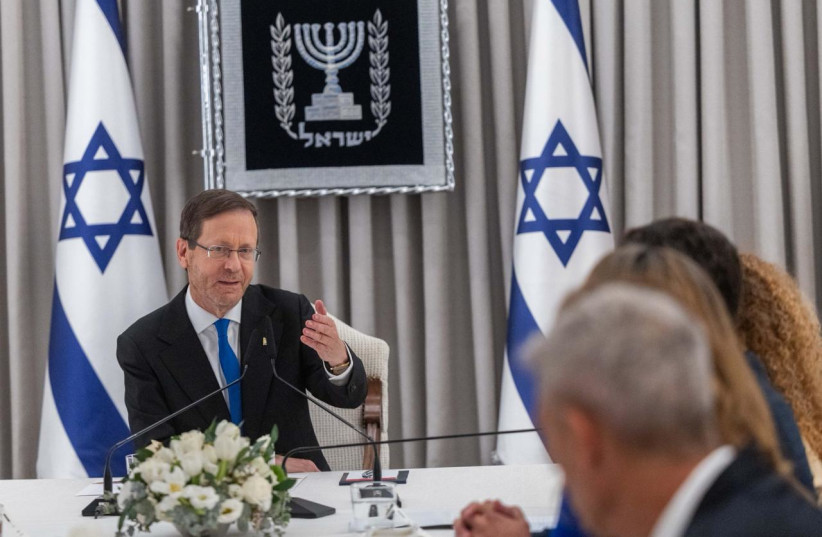
Following the consultations, Herzog announced that he would grant the mandate to one of the candidates on Sunday, adding he intends to meet with several party heads in private over the weekend to "leave no stone unturned to bring about the formation of a good, stable government for the people of Israel."
Eisenkot received the backing of both Arab parties, Ra’am and the Joint List, although their recommendations do not commit them to ultimately joining his coalition.
When questioned by Herzog about the possibility of forming a unity government, which would include Netanyahu, the Yashar delegations insisted they would first work to form an "emergency national government" to address the "damage" that had been done by Netanyahu's administration.
Along with the 48 recommendations from the opposition bloc, the Arab parties' 19 seats give Eisenkot 67 in total, prompting him to have the advantage of receiving the mandate over Netanyahu.

The election results showed a political deadlock in which no bloc received a 61-seat Knesset majority, making the path to forming the next government unclear. Netanyahu’s bloc secured 53 seats, while the opposition bloc won 48. The Arab parties, Ra’am and the Joint List, won a record-breaking 19 seats combined.
All parties from the opposition bloc seeking to oust the prime minister -Yashar, Naftali Bennett’s B’Yachad, Yair Golan’s the Democrats, and Avigdor Liberman’s Yisrael Beytenu recommended Eisenkot.
Meanwhile, in Netanyahu’s bloc, the parties that recommended the prime minister included Likud, National Security Minister Itamar Ben-Gvir’s Otzma Yehudit, Finance Minister Bezalel Smotrich’s Religious Zionist Party (RZP), Moshe Feiglin’s Zehut, and Arye Deri’s Shas.
The haredi (ultra-Orthodox) United Torah Judaism (UTJ) party, a longtime coalition partner of Netanyahu, declined to recommend a candidate for prime minister.
UTJ's decision to abstain comes amid reported tensions between the haredi party and Netanyahu, and it benefits the opposition bloc seeking to replace him. Opposition party leaders have recently signaled greater openness to including haredi parties in their coalition.
Ra'am supports Hamas disarmament, Abbas tells Herzog
During the talks, Ra’am leader Mansour Abbas said the party supports the full disarmament of Hamas, which is one of the four principles Eisenkot has set out as conditions for joining his coalition.
"Arab society, and I as an individual, as well as Arab citizens as a whole, we are a bridge. Let’s not destroy that bridge. Let’s not turn us into supporters of terrorism or traitors," Abbas said in response to a question about denouncing Hamas as a terror organization.
The Arab party has sought to establish itself as a viable coalition partner.
Democrats leader Yair Golan has called on the opposition bloc to partner with the Arab parties, which would give it a 67-seat majority amid the ongoing political deadlock following the election. However, other leaders in the opposition bloc have drawn a red line against forming a coalition with the Arab parties.
Later on Thursday, during consultations with representatives of Bennett's B'Yachad party, MK Merav Cohen rejected any option of a unity government with Netanyahu when asked by Herzog, arguing that "You don't do business with scorpions.
"During the COVID-19 pandemic, I served in a unity government, and instead of doing good for my country, I ended up harming it," Cohen said.
"No unity with people who hold fascist worldviews," MK Ram Ben-Barak added.
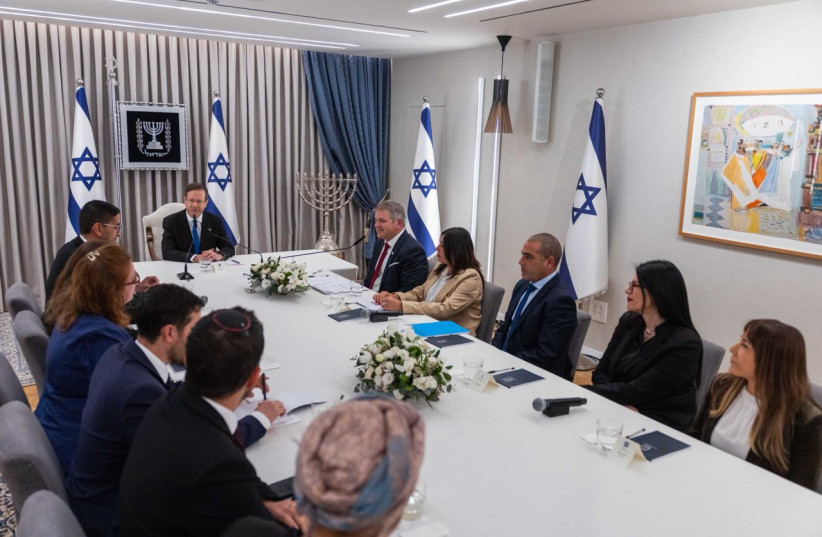
In Herzog's final meeting with the Likud delegation, Transportation Minister Miri Regev argued that the mandate should go to Netanyahu as the leader of the largest party.
The delegation further insisted that it would be "dangerous" for a coalition to rely on support from the Joint List, which they claimed supported terrorists.
"The change bloc wants change in support of terror," coalition whip MK Ofir Katz said.
Incoming MK Talik Gvili, mother of slain hostage Ran Gvili, said she felt hurt that opposition parties would be more willing to sit with "people who support those who killed our children" than with Likud. "I feel like I'm in miluim; I'm here to finish the work Ran began; here to end our enemies," she said.
The political deadlock could ultimately lead to another election, although the parties may still reach an agreement through coalition negotiations. Other possible outcomes include a unity government between Netanyahu and members of Eisenkot’s bloc, or a minority government.
Party representatives from Likud and Netanyahu’s outgoing coalition claimed that the elections were stolen during Oztma Yehudit and Zehut’s consultations with Herzog.
The claims referred to the ongoing Shin Bet (Israel Security Agency) investigation into suspicions that foreign entities, such as Qatar and Turkey, allegedly funneled money into Israel to influence voting in Arab communities.
What happens next?
Despite the investigation, the Central Elections Committee (CEC) has ratified the results of the Knesset elections and stated that no harm to the integrity of the elections took place.
The consultations are part of the process through which Herzog will determine which Knesset member has the best chance of assembling a governing coalition and securing the support of at least 61 lawmakers.
Under Basic Law: The Government, the candidate selected by Herzog will have 28 days to form a government, and the president may grant an extension of up to 14 additional days if necessary.
If the candidate fails to form a government within the allotted time, informs Herzog that the effort has failed, or presents a government that fails to win a confidence vote, the president must decide within three days whether to assign the task to another MK or inform the Knesset speaker that he sees no possibility of forming a government.
A second candidate would then have 28 days to establish a coalition, without the possibility of an extension.
If the second attempt also fails, or Herzog decides not to appoint another candidate, a 21-day period begins during which at least 61 MKs can jointly request that the president assign the task to a particular lawmaker. That candidate would have 14 days to form a government.
Should all attempts fail, the Knesset would be dissolved, and another election would be held. Until a new government wins the Knesset's confidence and takes office, the outgoing government remains in place in a caretaker capacity.
The Knesset is expected to be sworn in on November 10, regardless of any government or coalition talks.