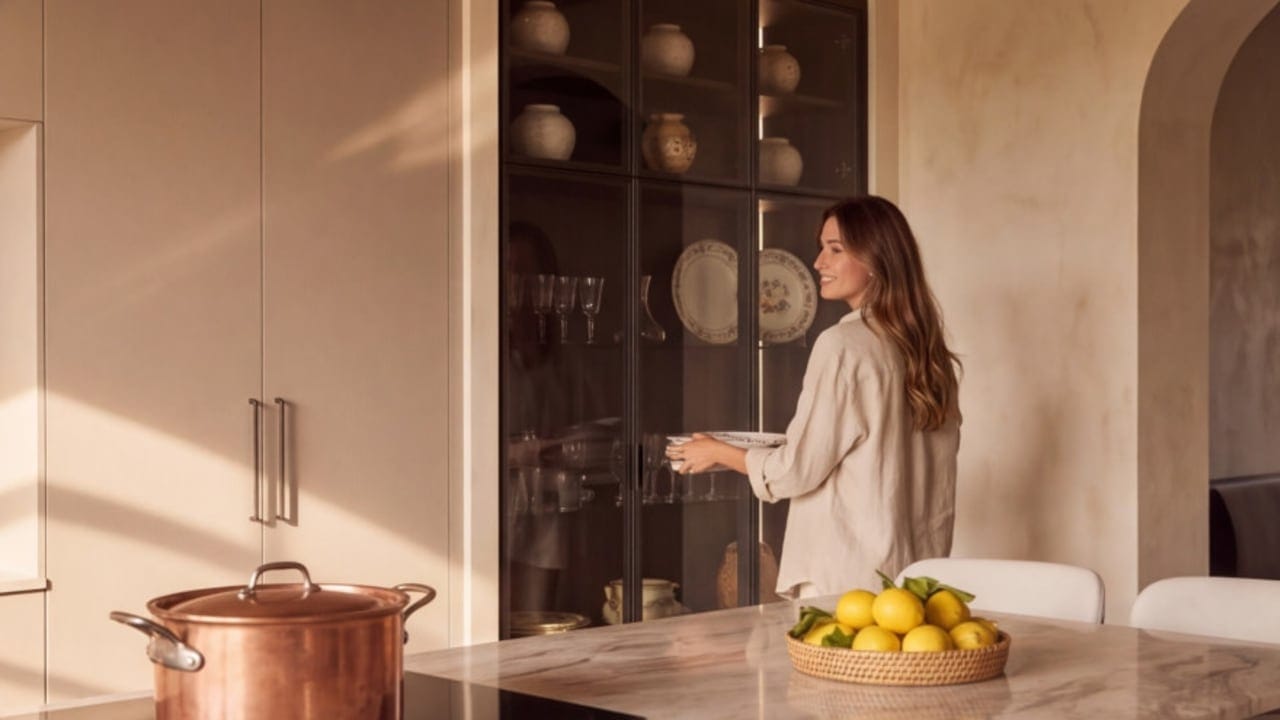
In a private home in Nahalal, a kitchen was recently designed that reflects a prominent trend in interior design in recent years: The blending of different styles into a single harmonious space that is not bound to one clear definition.
The project was carried out as part of a design process by Delkoub, a company specializing in carpentry design and kitchen manufacturing, and was born from the homeowner’s personal inspiration. She asked to recreate a kitchen she had seen in a showroom, almost down to the smallest details. However, the actual process required full adaptation to the space, the needs, and the daily lifestyle of the home.
The result is a kitchen based on clean modern lines, yet infused with a warm and soft character that allows it to integrate naturally into a home with a rural feel.
Balance Between Materials and Color
The balance between the two worlds is achieved through a precise selection of materials and tones. A color palette in Sahara shades, along with brown-tinted glass and soft finishes, creates a look that softens the modern lines and gives them depth and a more homely atmosphere. Instead of a contrast between styles, a single layered design is created that successfully contains both in a continuous way.

Comprehensive Home Planning
The planning was led by Inbal Keidar Karmel, the lead kitchen designer at Delkoub, who accompanied the project throughout its entire process - from the kitchen itself to all areas of the home. The goal was to create a unified design language that continues across the different spaces and forms a connection between functionality and aesthetics.
During the work process, the project faced a significant challenge when the contractor left the site during the war period. Despite this, the planning and execution continued with close supervision and precise management of the work stages.
The work included planning all carpentry details in the home - cabinets, vitrines, storage solutions, and transitions - with the aim of creating a consistent language throughout the house.

In the kitchen, acrylic-finished fronts were integrated, cabinet interiors in coordinated tones, drawers and hinges in dark shades, brown glass, and additional carefully selected elements. Every detail was designed to be part of the whole rather than stand on its own.
The kitchen reflects a broader trend in the design world, where the boundaries between styles are becoming more flexible. Here, modern and rustic do not compete with each other, but exist together within the same space. The result is a kitchen that manages to be precise and functional on the one hand, but also warm and pleasant on the other - creating balance rather than a single definitive design statement.