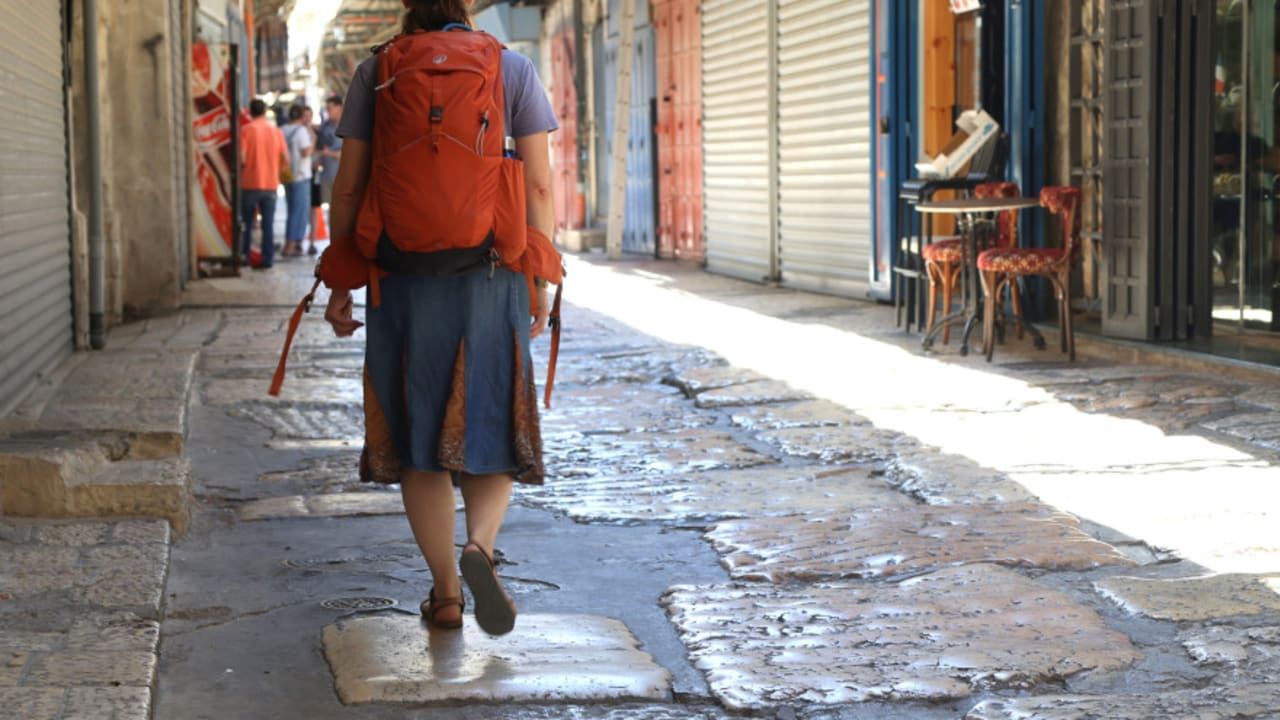
Every day, thousands of tourists, pilgrims, and residents walk down the Christian Quarter Road in Jerusalem's Old City, many unaware that they are stepping directly on Roman-era stones. This week marked the beginning of one of the most complex phases of the Old City accessibility project: The ancient flagstones will be dismantled, documented, and reinstalled in a new layout designed to make the western side of the street accessible for wheelchairs and strollers.
Stones that have already 'moved house' once
This is not the first time these ancient stones have been relocated. In 1977, as part of an initiative to restore the Old City markets, archaeologists Shlomo Margalit, Doron Chen, and Giora Solar exposed the remains of an ancient street roughly 60 centimeters beneath the surface. Paved with massive stones measuring one by two meters and roughly 50 centimeters thick, the route was identified as part of the medieval Patriarch's Way. At the time, the stones were raised to modern street level so visitors could walk upon them.
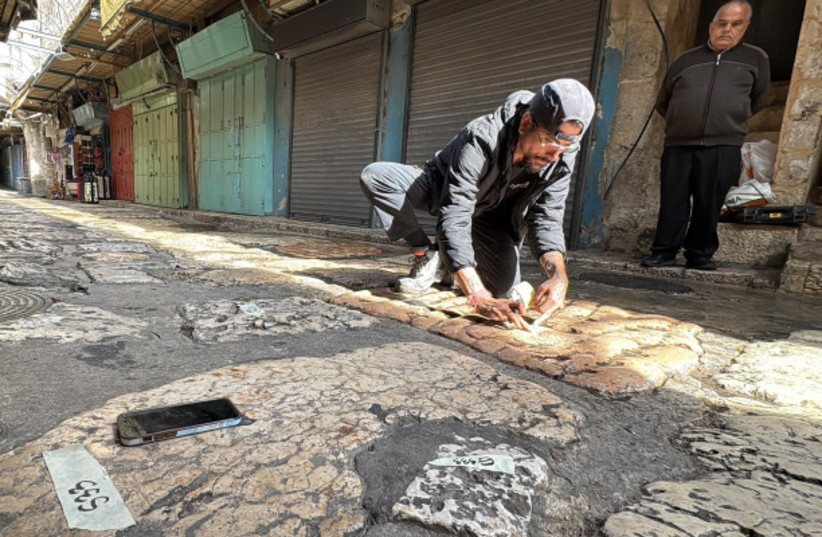
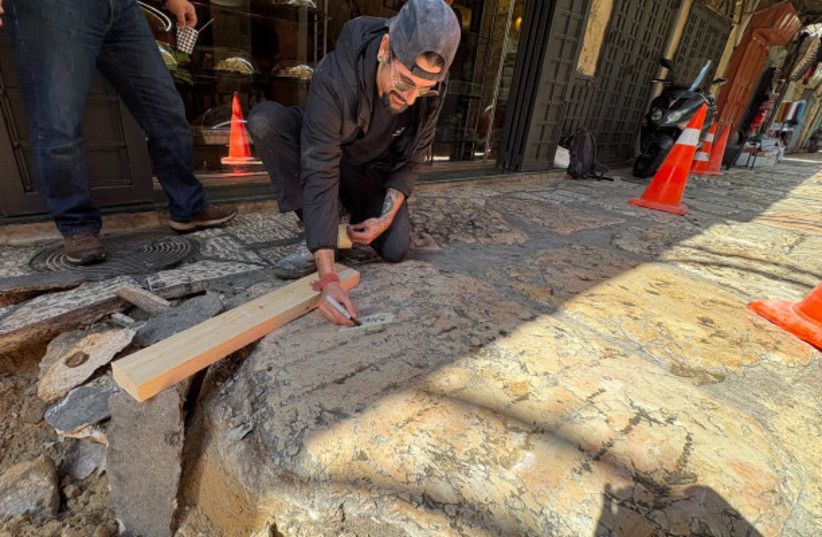
Now, nearly 50 years after that initial restoration, the Israel Antiquities Authority (IAA) has mapped approximately 50 Roman paving stones along the street that require conservation - about half of which are in fragile condition. Per IAA guidelines, the entire pavement will be dismantled, with each stone meticulously numbered, measured, and documented before being temporarily removed from the site. Following a full assessment, officials will determine whether each stone is reinstalled or placed into storage. The returned stones will be laid along a 1.5-meter-wide strip on the street's eastern side, while the western side will receive smooth paving suitable for wheelchairs. Concurrently, underground water and electrical infrastructure will be replaced, and street facades and awnings will undergo restoration.
The project is led jointly by the Jerusalem Affairs and Heritage Ministry, the Accessibility Department of the Jerusalem Municipality, and the Israel Antiquities Authority, with execution handled by the East Jerusalem Development Company (PAMI).
"This unique project, which combines modern accessibility on top of thousands-of-years-old paving, is part of the vision to turn Jerusalem into the most accessible city in the world," says Shimon Albom, Director General of the Jerusalem Affairs and Heritage Ministry
"Precisely in a place with such immense historical and religious depth, we have a duty to ensure that this history is open and accessible to everyone," says Mayor Moshe Lion. "We are doing so while strictly preserving the stones, the alleyways, and the thousands-of-years-old heritage."
Six kilometers of alleyways
The Christian Quarter Road is merely the latest segment of an overarching initiative spanning more than 15 years. Since 2009, approximately six kilometers of Old City alleyways within the walls have been rendered accessible, including major thoroughfares such as the Via Dolorosa, Street of the Chain, and David Street. A portion of the work was accelerated during the COVID-19 pandemic when the normally crowded alleyways were clear of visitors.
To date, roughly NIS 80 million has been invested in the comprehensive project, excluding separate infrastructure upgrades carried out by utility bodies like Hagihon and the Israel Electric Corporation. Along the Old City’s steep stairways, approximately five kilometers of handrails have been installed alongside newly constructed ramps and accessible public restrooms.
An estimated 40,000 residents live inside the Old City walls, roughly 4,000 of whom live with disabilities. However, the accessibility campaign is equally tailored for international visitors. Globally, there are around one billion people with disabilities; according to PAMI, tourists with disabilities spend, on average, twice as much as regular tourists because they almost always travel with a companion and tend to stay longer.
Alongside physical infrastructure upgrades, two free digital applications are supporting visitors. Accessible JLM enables step-free navigation through the Old City in eight languages and has been downloaded by over 140,000 users since launching in 2019. Meanwhile, STEP-HEAR assists visually impaired visitors via approximately 60 audio-guided navigation points across the city in 11 languages.