
On particularly nice weekends, it is difficult to avoid traffic jams on the way to nature outings; but even within the nature reserves themselves, the large volume of hikers from across the country creates heavy congestion on marked trails. Is the solution to create more trails? Ostensibly, it is not a major challenge: Mark a route on the ground and allow hikers to pass through. However, for the animals living in the area, a new trail can change the rules of the game. A new study examined what it means for wildlife when a trail is marked in an area that was not previously open to hikers, offering tools that can help authorities make informed decisions regarding trail development.
"Planning new trails is a very complex issue," explains Zehava Siegel, an ecologist for the Negev Highlands in the Southern District of the Israel Nature and Parks Authority. "There is no solution of 'input data and receive a result'; it is a matter of balance - how much need there is for a new route versus ecological preservation."
People hike, among other reasons, to connect with nature, and this connection also motivates a desire to protect it. Yet a paradox exists: Visitors arrive with the goal of seeing animals in their natural habitat, whereas for the wildlife, human presence constitutes a disturbance. The challenge is to enable people to hike without harming the animals' habitat. "Our goal is to achieve a small footprint and smart tourism management through limits on hiking days, hours, and the like," says Siegel. But how can one know how many hikers constitute "too few" or "too many"? How far must trails be located from animal habitats to minimize disturbance? And what does trail planning near sensitive habitats entail?
A new trail in the field
To answer these questions, a research team from the Sde Boker campus of Ben-Gurion University of the Negev, under the guidance of Prof. Oded Berger-Tal and in cooperation with the Israel Nature and Parks Authority, conducted an experiment across six desert areas in the Negev and the Arava. While previous studies primarily examined existing trails where animals might have already become accustomed to human presence, this study selected areas within nature reserves that were not open to the public, aiming to examine the response of animals in areas where they were unaccustomed to hikers.
In each of the areas, the researchers created four one-kilometer trail sections with varying levels of hiker activity, ranging from zero to 48 passes by hikers on the trail each day. For a week, groups of energetic volunteers from the Environmental High School at Sde Boker walked back and forth along the trails to simulate an "active trail." A total of 288 cameras placed at various distances from the trails recorded wildlife before, during, and after the disturbance.
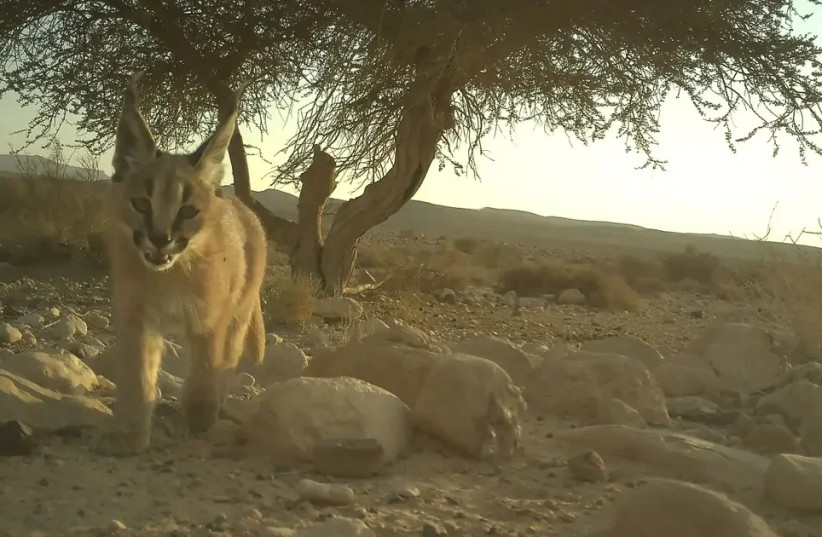
The results, presented at the 54th Annual Conference for Science and the Environment, showed that different animal species did not react in the same way. Some species moved away from the trails, a pattern that was even more prominent during high hiker activity. For certain species, such as the Dorcas gazelle, higher numbers of hikers corresponded to lower presence near the trail. Some species even shifted their activity hours to nocturnal activity. Other species, by contrast, remained near the trail area and were even attracted to it.
"There are species whose behavior is flexible, allowing them to be more tolerant of humans," explains lead researcher Dr. Yuval Zukerman, a postdoctoral researcher in the Department of Desert Ecology at Ben-Gurion University's Sde Boker campus. "Caracals, for example, hunt by ambush and depend on vegetation; therefore, a disturbance on a trail may affect them more. Wolves, on the other hand, can hunt in a wider variety of places."

These differences help guide decisions regarding which species to protect in each reserve. "In a perfect world, one could apply many restrictions and rules inside a reserve and thereby protect all species, but there must be a balance between the hiker experience and species preservation," says Zukerman. Therefore, prioritizing species depends on the location, the species living there, and their ecological importance.
The trail itself takes up only a few meters, but its impact can extend tens or even hundreds of meters around it. Consequently, the location of the trail is of great importance, particularly in the desert, where water, shade, and vegetation are concentrated in limited areas. As the world warms and additional regions become drier, the questions being examined today in the Israeli desert may become relevant for nature reserves in other parts of the world as well.
Reversible disturbance: Animals return when hikers leave
Despite the observed changes in animal behavior, it appears that for at least some of them, these changes are only temporary. The study found that after the use of the new trails ceased, the activity patterns of some animal species returned to levels similar to those prior to the disturbance. For trail planning, this means it is important to know not only how many people arrive, but also when, for how long, and where in the reserve they hike. Thus, before marking a new trail, it is important to know which species are present in the field and how they use the space. The disturbance can then be managed through route planning and limits on hiker numbers, hours, and days of activity.
"Even trail usage can be predicted and planned in advance," says Zukerman. "A circular route, for example, is expected to attract more hikers than a linear route. Certain areas can also be kept permanently closed, or closed temporarily during sensitive periods such as nesting season." Trail planning must connect research with the knowledge accumulated in the field by ecologists, rangers, managers, and decision-makers. The goal is not necessarily to open new trails, but to find a way to allow the public to hike while minimizing ecological disturbance.
Siegel notes that she is currently promoting additional ideas that may help, such as using permit-only trails - those open exclusively to hikers who purchase a special permit - or improving shuttle access to existing trails. "We are opening our minds to more options that will create variety for hikers without opening new trails," she says, adding in conclusion that as demand for hiking grows, a broader toolkit will be needed: "We will find more ways to engage the public in hiking in places without disturbing wildlife, and we will use additional tools besides adding routes. Ultimately, it is important to remember that without people hiking in nature, there is no nature reserve."

This article was prepared by Zavit – the news agency of the Israeli Society of Ecology and Environmental Sciences.