On Holocaust Remembrance Day, the entire country seems to pause and hold its breath.
In ordinary years, a siren pierces the air, and the country falls still for a minute of remembrance. Time itself appears to stop between two heartbeats. As these lines are written, however, it remains unclear whether the siren will sound this year, even with the two-week ceasefire.
Almost every Israeli who has finished high school has visited Auschwitz-Birkenau. The sprawling barracks, the endless barbed wire, and the ghostly train tracks have become a symbol for the entire Holocaust. Yet Europe is dotted with other sites, less famous but no less tragic, where immense horrors unfolded. One of them lies outside Riga: Rumbula Forest. Here, the earth seems to hold its breath, reluctant to speak of what it has witnessed.
Riga is a popular tourist destination. An elegant northern city, with cobblestone streets, ornate Art Nouveau buildings adorned with intricate floral façades. In spring, tulips bloom in the squares, their bright colors a defiance of history’s darkness. Locals linger over their drinks, laughing, reading, living, as if the past were another country far away.
Yet, outside the city center, the landscape changes. The city fades, houses grow fewer, and the road slips into a dark forest of tall pine trees. The wind moves through the high needles like an old whisper. The air is heavier here, almost sentient, carrying faint scents of pine and damp soil. It feels as if the forest itself remembers every footstep, every scream, every life lost.

Forgotten memories of 25,000 Jewish men, women, and children
These days, as the world watches the war in Ukraine, the massacre at Babi Yar near Kyiv is often mentioned. But horror is not unique to one place. Here too, near Latvia’s capital, a similar mass murder occurred. Beneath the quiet soil of Rumbula Forest lie some of the largest mass graves in the world, graves that hold the memories of 25,000 Jewish men, women, and children.
In the summer of 1941, the Germans concentrated Riga’s Jews in a ghetto on the city’s outskirts. Entire streets were compressed into a reality of hunger and fear. Jews from Germany were also brought here, uprooted from homes and routines. People who had been doctors, teachers, writers, and tailors. People with dreams, morning rituals, and keys to homes that no longer existed. Mothers clutched children who trembled not just from cold but from fear that seemed to sink into bone and marrow.
In November, the Germans cleared the northeastern section of the ghetto, calling it the “Small Ghetto.” Able-bodied men were sent for forced labor, while many of the elderly, the sick, and the children in the main ghetto were shot in the head.
About 10 km. away lies Rumbula Forest. At the time, it was far from the city, though today, Riga’s outermost houses almost touch its edge. The Nazis ordered Soviet prisoners of war and local collaborators to dig four enormous pits. Shaped like inverted pyramids. Each pit was roughly 35 meters across, more than the length of an Olympic swimming pool, and five meters deep, as tall as a two-story house. These “pools” were not aimed to be filled with water, but with blood and bodies. Standing at the edge, one sees not a grave, but a raw wound carved into the earth.
On November 30, 1941, at 4 a.m., German troops and their Latvian collaborators stormed the ghetto. Survivor Max Kaufmann described that night in his diary: thousands of drunken soldiers burst into apartments, doors kicked in, windows shattered, children thrown from upper floors. The streets filled with screams, a human storm that rattled the city. The violence was surreal, a terror that seeped into memory like poison.
That morning, thousands of Jews were marched to the forest. It was a northern winter. The cold was not merely a temperature; it was a sensation that pierced the bones like a thin needle of ice. Snow crunched underfoot, and each breath emerged in small white clouds, as if the body itself were trying to escape. Many collapsed. Not from bullets, but from exhaustion and cold. Others were beaten to keep walking.
At the pits, victims were lined up in rows of 11. The shots rang out short and dry. One body fell, then another, then another. Layer upon layer, human beings stacked like rough stones. By nightfall, the pits were filled with about 12,000 bodies.
Eight days later, on December 8, the Germans returned and led the remaining Jews to the same forest. They were murdered in the same systematic way. Only three Jews survived to tell the tale.
TWO YEARS later, as the tide of war turned, the Germans attempted to erase the evidence. Jewish and communist prisoners were forced to reopen the pits, pulling decomposed bodies from the earth and burning them on enormous pyres. Members of the Einsatzgruppen later claimed much of the killing had been carried out by local Latvian auxiliaries, revealing the tangled layers of complicity and moral collapse.
In the 1960s, Jews rediscovered the graves. Low stone fences were built around each, and large markers were placed. During the Soviet era, a black stone monument was erected, bearing “Victims of Fascism” in Latvian, Yiddish, and Russian. Yet the word “Jews” and the names of the perpetrators did not appear.
Only after the Soviet Union collapsed did public memory slowly emerge. Along the path, small stones bearing the Star of David and the years 1941-1944 were placed. At the forest’s heart, a seven-branched menorah rises four meters high, surrounded by hundreds of small stones arranged in a Star of David, many engraved with victims’ names. Small names against a vast, silent woodland.
The sight chills the bones, yet a measure of comfort comes from knowing we are no longer powerless. Today, under the protection of the IDF, if Latvians were to dare repeat what they did in 1941, we would make Riga look like Gaza or Tehran.
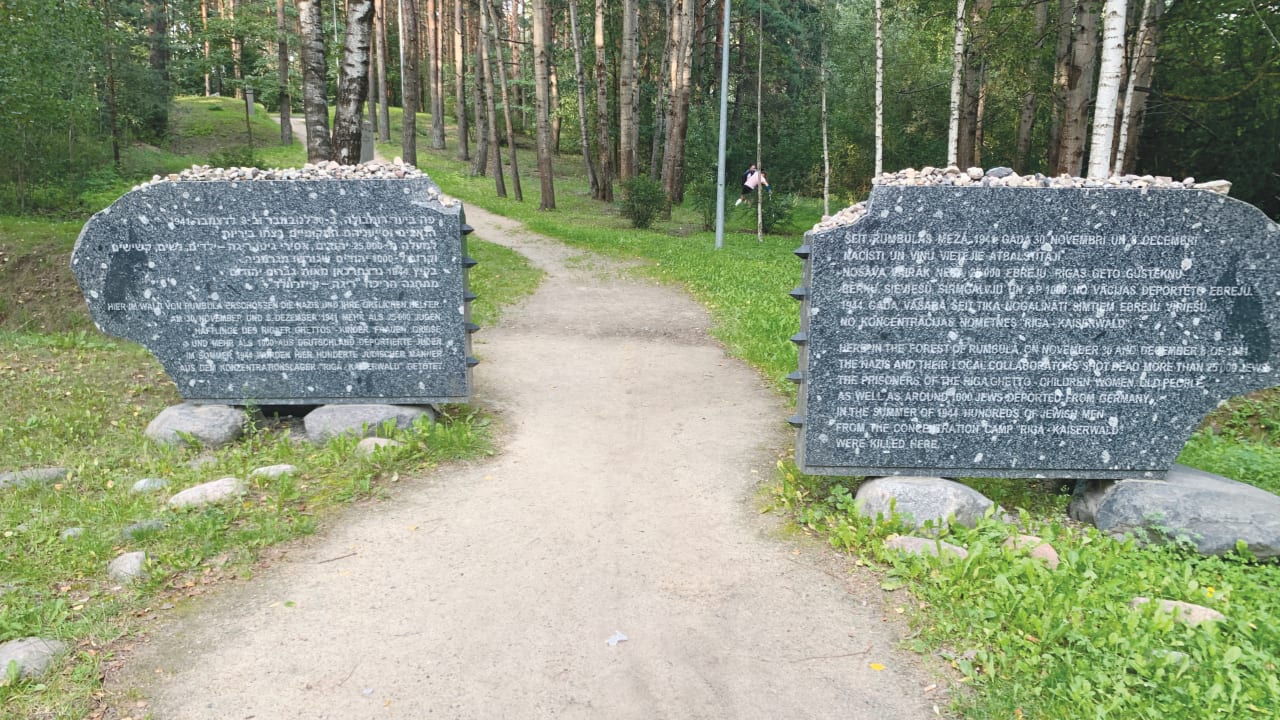
Each November, a memorial ceremony is held here, attended by Jews from Riga and Israel, along with Latvian officials and members of the diplomatic corps. In 2005, Israel’s president, Moshe Katsav, attended. In his honor, a black memorial stone was placed at the entrance, commemorating the Jewish victims in Hebrew, English, and Latvian.
The guest of honor at the 2016 ceremony was Latvia’s president, Raimonds Vejonis, who, for the first time, officially acknowledged Latvian participation in the murders: “Today we honor 25,000 Jews brutally murdered in Rumbula Forest by Nazis, with local forces also participating. It is unimaginable that in just two days, fellow citizens were executed in numbers equal to an average Latvian town. For many years, these events were silenced.”
Sometimes history itself demands courage.
A testimony to history’s bend toward justice
Standing in Rumbula today, the light barely penetrates the tall pines. The ground is soft, littered with dry needles. The wind whispers faintly between the trees. At moments, it feels as though the forest itself is speaking, carrying memories no monument could fully hold. I stood by the memorial and quietly recited Kaddish and “El Maleh Rahamim.” Even a whisper here sounds like a shout.
Later, I decided to walk the last stretch back toward the city, along the very path Jews had marched to the pits. I asked my driver to wait in the new neighborhoods. Alone, I walked in the cold. The road was astonishingly quiet. Occasionally, a distant car passed, but mostly all I heard was the crunch of my steps. I tried to imagine that march: thousands of people, children, the elderly, terrified, their breath rising in white clouds, not knowing where they were going.
Some places make history feel like pressing against your skin, chilling your marrow. Rumbula is such a place. Here, one understands how fragile civilization is, how quickly it can snap. Yet one also realizes resilience is possible. That a Jew can stand here today, kippah on his head, walking freely where our brothers were murdered, is a testimony to history’s bend toward justice.
Sometimes, one must stand in the darkest places to understand how essential light truly is. When tourism returns, Riga will again attract Israeli visitors. Those who come to the city should take the time to visit this forest. It is not a comfortable visit. Some places are not meant for comfort. They are meant for remembrance. Places where the earth itself remembers.
The Latvian government invests in Riga’s tourist sites, through signage and guidebooks, but Rumbula remains hidden from casual view. The memory here is too raw, too heavy, and perhaps that is why it is absent from brochures.
To find it, search Waze for Maskavas iela 471, Rumbula.
The author is the editor of the blog jewishtraveler.co.il.