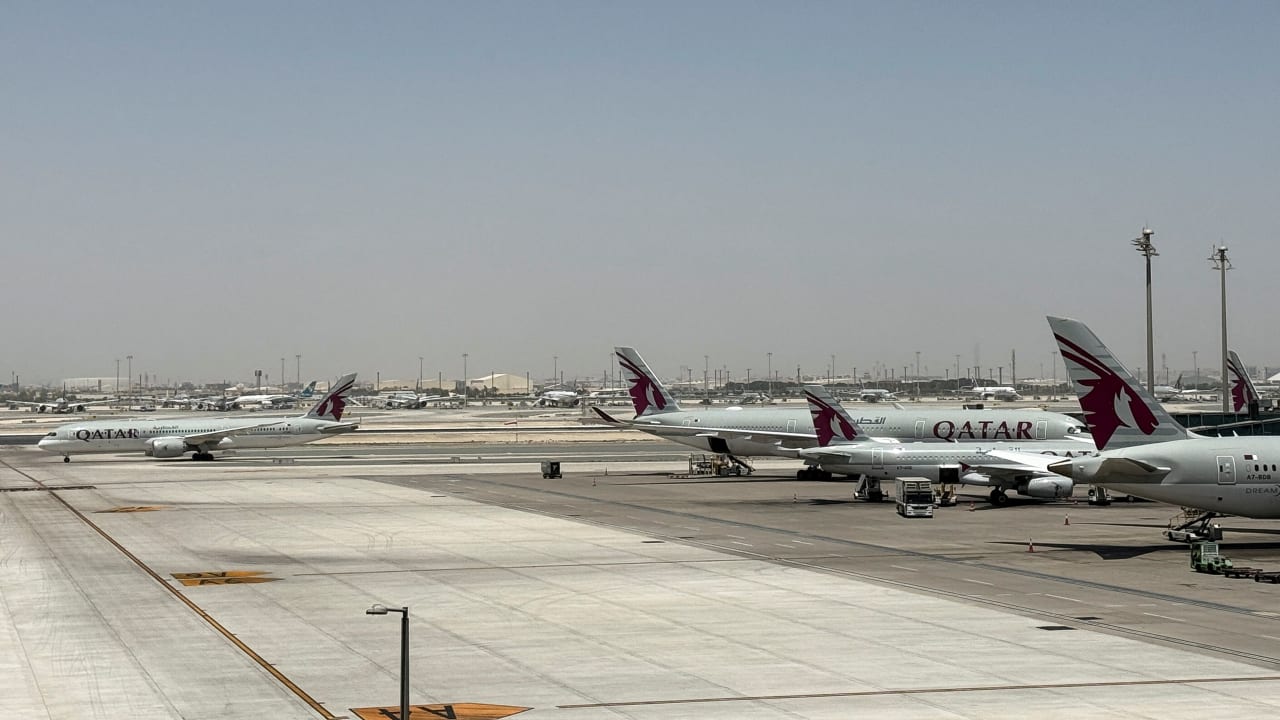
Qatar Airways moved around 20 of its wide-body aircrafts to Teruel Airport in Spain seeking safe haven from the conflict in the Middle East. “Due to the current situation in the region and the subsequent disruptions to flight operations, Qatar Airways has moved some of its aircraft to selected airports outside Qatar. This is a temporary measure and the aircraft will gradually be returned to use as operations normalize,” the company said.
Teruel is one of Europe’s largest aircraft maintenance and storage centers, with space for around 250 large aircraft—or up to 400 narrow-bodies—and ongoing expansion projects that include new hangars and an extended apron. It operates without regular passenger traffic, allowing secure, long-term parking. Its location and infrastructure are central to the calculus. Its dry, salt-free climate minimizes corrosion and maintenance costs.
The planes relocated to Spain include Airbus A330s and A350s and a Boeing 747. Airport director Alejandro Ibrahim noted that additional arrivals are planned.
92 percent of flights canceled
Iran's retaliatory attacks in the Middle East have prompted airspace restrictions, diversions, and recurring closures. Aviation data indicate the scale of the disruption: since fighting began on February 28, Qatar Airways has canceled nearly 92 percent of its flights, making it among the airlines most affected by the war, according to HuffPost Spain.
Other operators have responded differently. Emirates has pursued a more aggressive recovery, running more than 350 daily flights through Dubai and scaling up with demand. Beyond the Gulf, Russian ministries and aviation authorities say they are working to restore flights with Middle Eastern countries as soon as possible in coordination with regional regulators.
Spain has also moved to cushion its economy against fallout from the conflict. Fuel prices are set to drop via a VAT reduction to 10% and a cut in the hydrocarbon tax, with potential savings of up to 30 cents per liter (0.30 per liter). Direct aid of 20 cents per liter (0.20 per liter) of professional diesel will support transport workers, farmers, ranchers, and fishermen. Energy-intensive industry will receive subsidized electricity tolls of up to 80% and expanded financing lines for agri-food and fishing.