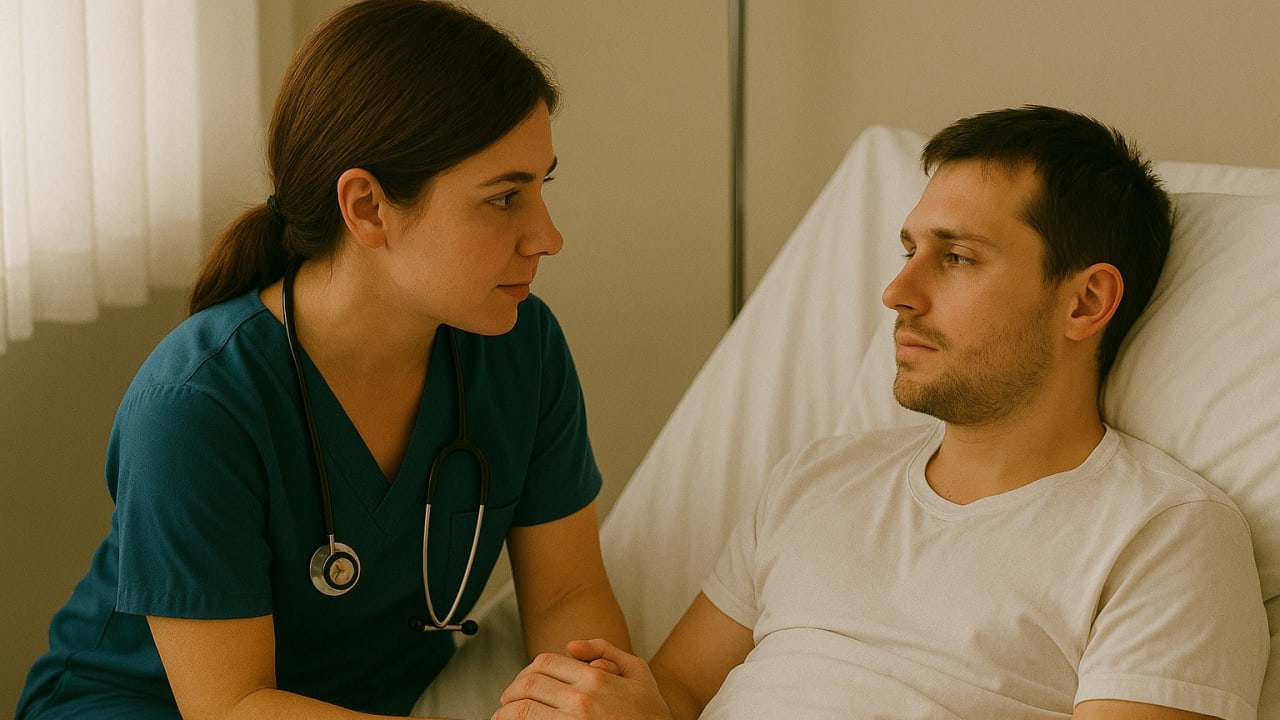
I work as a certified interfaith hospice chaplain in Jerusalem hospitals and old age homes. I also serve as mayor of Mitzpe Yeriho. The two roles share a calendar and little else.
In the hospital, the assignment is the person in the bed. A Jew, a Christian, or a Muslim, a parent whose children have filled the hallway. A man who wants a psalm, a woman who wants silence.
Fear sits in the room before any visitor does. Meaning arrives later, if it arrives at all, and it arrives in the language the dying already speak.
Jerusalem puts those rooms in the same corridor. The city treats the sick without asking first for a political speech. Families of every faith stand at the same vending machines and wait for the same doctors. The slogans that travel so easily on posters and podiums look thin once you have sat with a dying stranger and listened to a son bargain with God for one more week.
Hospice begins where the person already is. That is the first rule of the work. You do not enter a room to relocate a soul to your preferred address. You learn the names of the children. You notice who cannot look at the bed. You ask what the patient needs in this hour. Water. A prayer. A hand. A rabbi, a priest, an imam. Sometimes only the window.

Politics runs in the opposite direction. It measures success by movement. A slogan is written to pull a crowd from here to there. A campaign treats a human being as raw material for a future that already exists in the speaker’s mouth. The voter who will not move is a problem to be solved. The neighbor who remains unconvinced is a failure of messaging. The work becomes a project of relocation.
Death refuses that project. A body in its last days will not be recruited; it will not adopt your framework because the framework is elegant. It will not become a symbol because the symbol would photograph well. The person in the bed is already at the only destination that matters, and the only honest company is the company that stays.
Fear has a texture you cannot debate. It shows in the way a husband straightens a blanket that does not need straightening. It shows in the adult child who talks too fast about logistics because logistics can still be managed.
Faith, when it comes, is rarely a speech. It is a verse muttered in the original tongue. It is a hand on a forehead. It is the decision to stay the night.
Family is the other constant. I have watched Jewish families argue about a feeding tube and then sing. I have watched Christian families keep vigil with a rosary worn smooth. I have watched Muslim families fill a small room with quiet recitation and the smell of coffee brought from home.
The differences are real. The fear is shared. The love is shared. The wish that the person in the bed would open both eyes again is shared among all people and all faiths.
Slogans about “the other” collapse in that air. The other has a name. The other has a daughter who slept in a chair. The other has a history that will not fit on a banner. Sitting there does not require you to surrender your people, your land, or your memory. It requires you to tell the truth about the person in front of you. That truth is smaller than a platform and heavier than a chant.
Municipal work has its own gravity. Housing, roads, parks, security. A town needs decisions. A mayor cannot wait for every resident to arrive at the same conclusion before the water line is laid.
Even there, the better hours look more like hospice than a rally. You start with the family that already lives on the street. You start with the fear they brought to the meeting. You do not begin by telling them their fear is the wrong size.
The country around us is loud with people who want other people relocated, spiritually, politically, geographically. Relocated into agreement. Relocated into shame. Relocated into a future drafted without them.
Hospice taught me the cost of that habit. A dying person who is argued with becomes smaller. A dying person who is met becomes, for a short time, fully present.
Bringing hospice values to the Knesset
I have no program to export from the hospice floor to the Knesset. The rooms are too particular for that. What travels is a discipline. Meet the person where that person already stands. Ask what is needed now. Leave the grand design in the hallway. Keep the moral seriousness. Change the register.
Meaning at the end of life is rarely invented by the visitor. It is recovered. A life is gathered up in stories the family already knows. A grudge is named. A blessing is given. A silence is kept because speech would be a theft. None of that can be scheduled by a party. None of it will trend.
The difference between sitting with a dying stranger and talking about a population is the difference between a face and a category. Categories are useful for policy. Faces are what a human being has left when policy has finished talking.
I have sat with faces from three faiths in this city and watched the same last work get done. The work of staying. The work of telling a mother she can rest. The work of letting a man die as himself.
Politics will keep trying to move people. That is its nature. It wants a result by Tuesday.
Hospice has no Tuesday. It has this afternoon, this breath, this family crowded around a bed in Jerusalem.
If public life borrowed even a fraction of that patience, the slogans would get quieter. The rooms would get more honest. The living would remember that the person across from them is already somewhere, and that the first duty is to arrive there, too.
The writer is a certified interfaith hospice chaplain in Jerusalem and the mayor of Mitzpe Yeriho, where she enjoys spending time with her family.