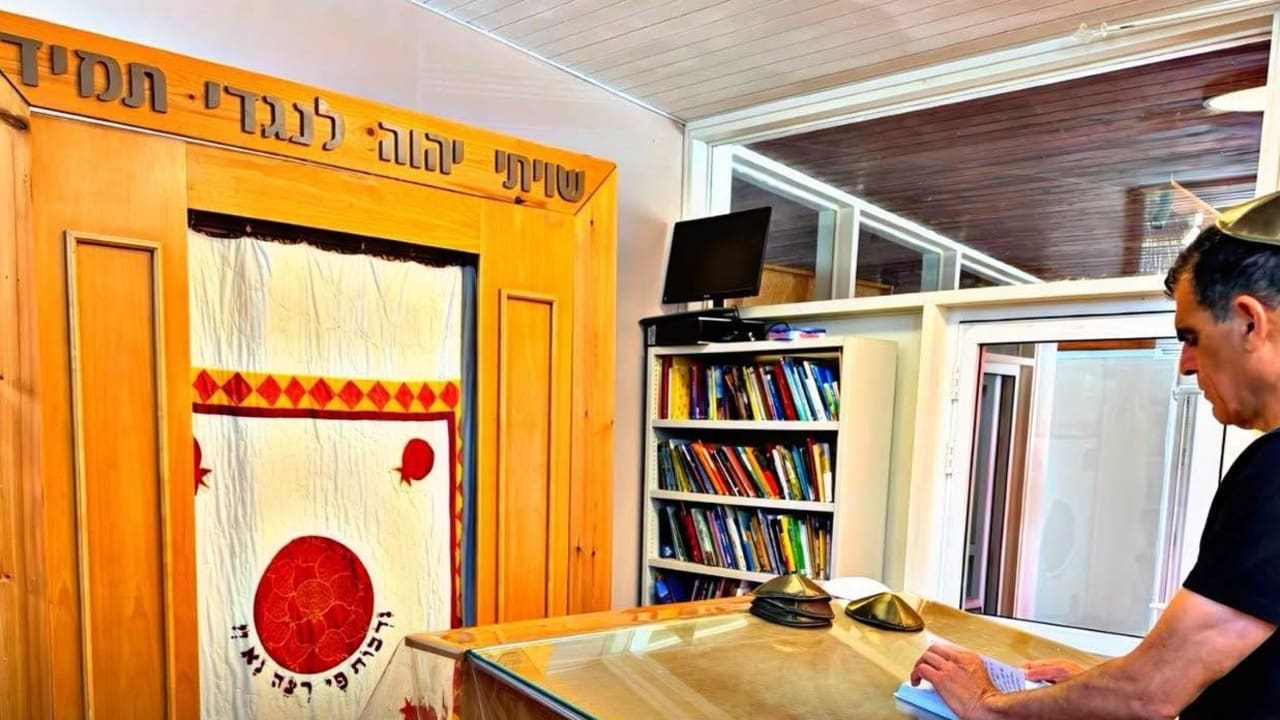
This is not the day’s main headline, but it should be. Take a look at what is happening right now in Kibbutz Kissufim, step by step.
First of all, the members of Kissufim are coming home. On October 7, 2023, twelve kibbutz residents and six Thai workers were murdered. Kibbutz member Shlomo Mansour was abducted to Gaza and murdered that same day. Dozens of homes were destroyed, and public buildings were burned to the ground. Devastation. And now, after more than two years, comes rebuilding.
Most of the community had been living temporarily in the town of Omer. Now, Kibbutz Kissufim chairman Lior Carmel has announced that 90 percent of the residents have decided to return, and that the kibbutz will also welcome new families who would like to join them. Agriculture, education, infrastructure: everything is coming back to life.
“The kibbutz that once looked like a disaster zone now looks like a construction site,” one of its younger members told me this week.
But something entirely new is happening as well. The young kibbutz member sent me moving photographs.

“Seventy-five years have passed since our parents founded this kibbutz, and this week, for the first time, a synagogue was inaugurated here. We decided that we are coming back, but that we also want to come back stronger.”
The ceremony was led by Rabbi Ariel Igra of the nearby community of Shlomit.
“We are brothers,” he said. “The moment you reached out and asked for help establishing the synagogue, I knew exactly what we could do.”
And this was Shlomit’s extraordinary contribution to Kibbutz Kissufim:
On October 7, four residents of Shlomit were killed after setting out to defend the nearby community of Pri Gan. They fought off the terrorists and saved the community. In their memory, a beautiful new synagogue was recently built in Shlomit.
“We were delighted to donate the furnishings from our previous synagogue to our friends in Kissufim,” Rabbi Igra told me. “But only during the ceremony did I tell them who had built and restored them. Our friends, the heroes Reuven Sasportas and Bechor Sweid, may their memories be a blessing, who fell in battle on Simchat Torah, were the ones who refurbished the bimah and the Torah ark. Today, that bimah and Torah ark stand in the new synagogue in Kissufim.”
When Rabbi Igra finished telling the story, one of the Kissufim members approached him, visibly moved.
“Do you see this menorah, which we placed here in the synagogue?” he asked. “It was made by my friend Shlomo Mansour, may his memory be a blessing.”
But it turns out that the Torah ark from Shlomit has an even longer history. Rabbi Igra continued: “The ark came to Shlomit from the synagogue of the small community of Shalev in Gush Katif. Eliraz Peretz lived in Shalev, where a synagogue had been established in memory of his brother, Uriel Peretz, may his memory be a blessing. Later, Eliraz himself was killed in battle in the Gaza Strip.
“When the community was tragically destroyed during the 2005 Disengagement, the synagogue’s Torah ark eventually found its way to Shlomit. Just think of it: an ark from a synagogue in the destroyed communities of Gush Katif has now arrived at the first synagogue ever opened in Kibbutz Kissufim.”
The synagogue dedication continued with the first, deeply moving Mincha service. At the entrance to the new synagogue, a mezuzah was affixed to the doorpost. One of the kibbutz members recited the blessing and then added the blessing of Shehecheyanu.
Rabbi Igra said to him: “Let us stop and think about how meaningful these words are. For me, as a resident of Shlomit; for all of you, whose community’s name, Kissufim, means longing; and for your return to this place. You are the representative of the entire kibbutz as you recite Shehecheyanu.
“My blessing to you is that before long, we will be affixing another mezuzah to a new and larger building, because this synagogue will no longer have enough room for all the new worshippers.”
And then the words of the blessing rang out: “Blessed are You, Lord our G-d, King of the universe, who has granted us life, sustained us, and enabled us to reach this moment.”
Amen!
5 points about the Ari HaKadosh
1. This coming Sunday, July 19, the 5th of Av, will mark the passing of the Ari Hakadosh, Rabbi Yitzhak Luria. One of the greatest Kabbalists, he immersed himself in the secrets of the hidden Torah in the city of Safed, and passed away in 1572 at the age of 38. He made the Zohar a central text in Jewish learning, and in the course of time, it would have a seminal influence on the Hasidic movement.
2. The Ari Hakadosh explained that the secrets he revealed and the heights of understanding that he reached were due mainly to the joy he experienced when performing the commandments of the Torah. In other words, he did not perform the commandments solely out of obligation, but rather due to the happiness and excitement that come when basking in the Infinite Light through fulfillment of God’s will.
3. His students related that he could have accessed heavenly guidance when studying the Zohar, but he preferred to study and toil without assistance, reaching the highest levels of understanding through his own efforts.
4. He left behind very few writings and Rabbi Chaim Vital, his venerable student, published most of his master's teachings. However, we do have three songs for Shabbat written by the Ari Hakadosh himself: "Azamer Bishvachin" (I will sing His praises) for the Friday night meal, "Asader LeSeudata" (I will prepare the feast) for the Shabbat morning meal, and "Bnei Heichala" (Princes of the Palace) for the third meal toward the close of Shabbat. In these three liturgical poems, there are profound hints as to the essence of Shabbat.
5. He inserted many lofty devotional prayers and esoteric meditations into his prayer book, but there is one line that he added, also written on his gravestone, that all of us can understand. Before beginning the morning prayers, he asked that we say the following: "I hereby take upon myself to fulfill the mitzvah of 'And you shall love your fellow as yourself."
This Motzei Shabbat, you are invited to light a candle in his memory and to bring one of his practices, teachings, or songs into your life.
Shabbat of Vision
This Shabbat, which comes before the Ninth of Av, has a special name: Shabbat Chazon (Shabbat of Vision). It is named after the Haftarah, the reading that is read after the Torah reading, and begins with the words, "The vision of Isaiah son of Amotz.” Our commentators say that on this Shabbat everyone can imagine their own vision, personal and national; our deepest hopes and dreams.
On Shabbat we will begin a new book in the Torah, the fifth and final book of the Pentateuch, Deuteronomy (Devarim). The entire book is Moses’s farewell speech to the people of Israel. He reminds us of the long journey in the desert, and prepares us for a holy life in the Land of Israel.
Want to read more by Sivan Rahav Meir? Google The Daily Thought or visit sivanrahavmeir.com