
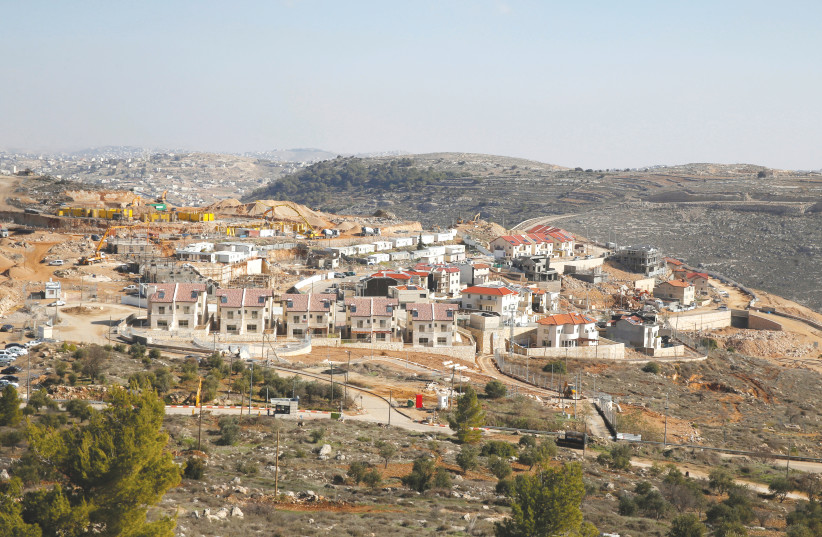
Back in May, Italy, the UK, France and Germany informed Israel that it needed to put an end to “settlement activity.”
Their joint statement called the areas in which this settlement activity was taking place the “occupied territories, including the E1 area project” east of Jerusalem that, as they stated, “would effectively cut off the West Bank from East Jerusalem.”
They were also perturbed that “the situation in the West Bank has deteriorated significantly,” with “Settler violence is at unprecedented levels.” The “entrenchment of Israeli control” is “undermining stability and prospects for a two-state solution.”
Furthermore, they demand Israel “respect the Hashemite custodianship over Jerusalem’s Holy Sites and the historic status quo arrangements.” The clincher in their diplomatic anger is that “International law is clear: Israeli settlements in the West Bank are illegal.”
As Professor Sharon Pardo of Ben-Gurion University of the Negev suggested at the independent media Euroactive site on June 12, Europe is obsessed with Israel. The “EU should ask why Israel occupies so much space in its diplomatic imagination and whether that hyper focus reflects balanced diplomacy or an entrenched double standard.”
I would add to his observation that France and its settlement presence in New Caledonia should attract more attention, and if the EU were more involved in Turkey’s occupation and settlement of Northern Cyprus, a resurgent Neo-Ottoman Empire might be prevented from arising.
A top agenda item for today’s Left – be they socialists, Marxists, progressives or just plain liberals – is “Jewish settlement in the occupied territories.”
In this post-colonial period, “settling” has been framed as an illegal action, usually perpetrated by Europeans on black and brown peoples, which is part of colonizing. However, even the very much quoted Geneva 49 Article does not include the term of settling.
There is, though, another international law document that does. It is the Mandate for Palestine, adopted by the League of Nations in 1922. The decision to reconstitute the Jewish national home was made unopposed by some 50 nations after the 1919 Versailles Peace Conference set the matter in motion and after it was confirmed at the San Remo Conference in 1920.
Its Article 6 reads: “The Administration of Palestine…ensuring that the rights…of other sections of the population are not prejudiced, shall…encourage…close settlement by Jews on the land…” Jews, then, possess a guaranteed internationally recognized right to settle in its historic homeland.
Zionism was not the establishment of a “spiritual center”, a hovering “light to the nations” or an improved socialist paradise that would outdo the Soviet Union. It was foremost the realization of the idea of the Return to Zion.
Settling the land not only was a vision, not only was it a mitzvah – a religious commandment – not only was it a simple necessity to create a place for Jews to live, but it was, and continues to be, the essence of Jewish national identity.
Settling the land, or, more properly, resettling the Land of Israel, is the natural right of Jews, who have been living on this land for over 3,000 years, a land incorporated into its national psyche and performance in religious and cultural rituals and customs, its literature, its language, and its value as being the homeland where Jews can be free and develop according to its own decisions, with all that entails.
We should recall that on the evening of April 11, 1948, members of the Zionist Actions Committee discussed in Tel Aviv the end of the Mandate framework and a future independent state.
At that meeting, Zalman Shazar employed the phrase, “the nation will claim its inheritance…as its natural right.” Indeed, Israel’s Declaration of the Establishment of the State begins, “Eretz-Yisrael was the birthplace of the Jewish people. Here their spiritual, religious and political identity was shaped.”
While contemporary youth, their college professors and the "influencers" on social media seem to find a sense of joy in their anti-Zionist antics, even pillorying a real estate promotion clip for apartments in Herzliya starring Gwyneth Paltrow, we know they are simply disguising their antisemitism.
Zionism is not European colonialism, and it wasn’t created at the end of the 19th century.
Zionism existed the moment Avram left his father’s house to go to the Land of Moriah. It existed when the Children of Israel left Egypt to return to the Land of Israel, when the exiles of Babylon returned to Zion.
Zionism is Jewish national identity
Zionism is not at all modern. It is a definition of the Jews’ national identity from our beginnings. Without the Land, almost half the commandments would not exist.
Zionism is the belief that the Jewish people’s religion and culture, its national soul, cannot be complete without a national territory and is some 4,000 years old.
A “Zionist Movement” was created in 1897 with Theodor Herzl in a long line of organizational attempts to regather the Jews in their national territory.
This included when the Bilu immigrants banded together in 1881. It existed in 1860 when Rabbi Tzvi Hirsch Kalischer and the Jewish Company for the Settlement of the Holy Land initiated their efforts.
It existed when the pupils of the Vilna Gaon arrived in 1810, in1777 when some 300 hassidim came from Russia, as well as when, in 1561, Joseph Nasi obtained from the Sultan permission for Jews to settle in Tiberias.
It was alive when Nachmanides settled in Acre in 1267 and when Rav Zeira returned to the Land of Israel from Babylonia in the 4th century CE, three hundred years before Arab invaders appeared in Judea.
For over 3,000 years, continuously, Jews return to their land and resettle it. It is what Jews do.
The writer is a researcher, analyst, and commentator on political, cultural, and media issues.