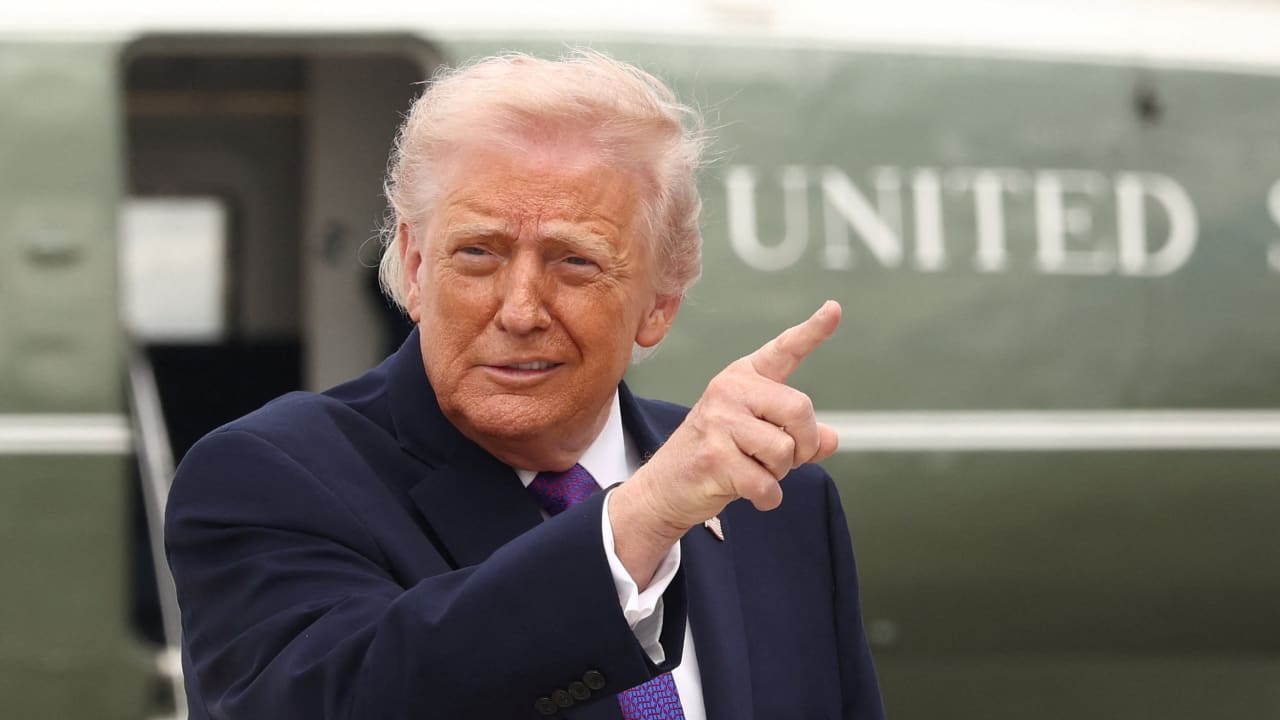
Will US President Donald Trump give the green light for an attack on Iran? As of Wednesday afternoon, no one truly knows. It is possible that he will and it is equally possible that he will not. That is the prevailing assessment today in virtually every capital across the Middle East. As one regional official told me this week: “We are waiting like everyone else.”
One Israeli newspaper went so far as to publish a ridiculous story this week claiming there is a “50% chance” Trump will order an attack. Besides setting a new low for journalism, it would be fascinating to hear the editorial discussion that preceded publication. If there is a 50% chance he attacks, that also means there is a 50% chance he does not. In other words, instead of simply admitting that the newspaper and its reporters have no clue, they chose to package uncertainty as revelation. Apparently, “anything can happen” now qualifies as exclusive reporting.
Still, while no one knows what Trump will ultimately decide, there are several facts we do know, and these matter.
The first is that Trump does not want to attack Iran. What is pushing him toward contemplating military action is Tehran’s refusal to agree to a deal that would end the standoff. Trump would prefer a diplomatic arrangement – at this stage, perhaps even one that is fundamentally flawed – over another American military campaign in the Middle East. If the Iranians were willing to compromise, particularly on the issue of their estimated 460 kilograms of highly enriched uranium, there would likely be a path to a deal.
Israel, for example, would oppose an agreement that only removes the uranium stockpile but leaves Iran with the ability to enrich uranium. But even that limited compromise currently appears beyond reach. Tehran is refusing to offer Trump any type of respectable exit ramp.

The second fact is that Israel really wants Trump to strike. And by Israel, I do not only mean Prime Minister Benjamin Netanyahu, though he certainly has real political reasons for wanting another round of attacks. Netanyahu has spent almost three years promising Israelis “total victory” in the wars that erupted after October 7. Yet, as elections draw closer, he still lacks a clear image of victory that he can present to voters. A successful American strike that either accelerates the regime’s collapse or forces Tehran into a better deal would allow him to tell a far better story ahead of the election.
But politics is only part of the equation.
Iran's economy is in shambles. Inflation is rampant, the rial has collapsed, and energy exports have slowed to a trickle, with ships barely departing Kharg Island, Iran’s key export terminal. While the regime continues to posture – including absurd threats to charge American technology companies for using Internet cables lying on the floor of the Strait of Hormuz – Israeli military planners increasingly believe the regime is more vulnerable than it appears and that a new attack could be all that is needed.
Their assessment is that targeted attacks on Iranian energy infrastructure could be the blow that either pushes the regime to collapse or forces it to accept a deal it currently rejects.
And then there is the third fact – perhaps the most important of all: Iran feels emboldened.
To understand why, one has to look not only at Iran but at the broader regional set of proxies that it leads. What is being felt today in Tehran is also being felt in Gaza, in Lebanon, and in Yemen. Hamas, Hezbollah, and the Houthis all believe that while they have suffered devastating blows, they have nevertheless survived confrontations with some of the most powerful militaries in the world and that this is the main story.
In Gaza, Hamas leaders have repeatedly told international mediators that they see no reason to disarm. Their argument is that they endured two years of nonstop Israeli military operations and remain standing. They continue to recruit fighters, they continue to manufacture weapons, and despite Israel’s tactical successes – like the elimination on Friday of Hamas military commander Izz ad-Din al-Haddad – the organization is still in control of 50% of Gaza.
Iran feels the same. For 40 days, it endured unprecedented attacks from two of the world’s most powerful militaries and survived. The regime is still there, its command structure still functions, and reconstruction is already underway at missile bases and nuclear sites. As a result, Tehran believes that it can do to Trump what he is trying to do to them – pressure him into a compromise.
This alone is possibly the strongest argument why Trump should strike. Iran and its proxies need to understand that survival is not victory. They need to understand there are consequences. If that lesson is not made clear, the consequences will extend beyond this current conflict and tragically lead soon to another one.
Under the current circumstances, an attack would send a message that there is a price to ignoring America, there is a cost for escalation, and policies of terror and uranium enrichment will not be tolerated.
So what will Trump do? The honest answer is that nobody knows, including possibly the president himself. Which means that, for now, the region waits – hoping that whatever decision is made ultimately leads to the best possible outcome for the people of Iran, for the Gulf states, for Israel, and for the entire world.
Pro-Israel books are disappearing from bookstore shelves
I was in London this week for a few meetings, and as I often try to do, I stopped in a bookstore. This time it was Daunt Books, one of London’s oldest and finest. As expected, and perhaps unsurprisingly given the current climate, the Middle East section was front and center.
Prominently displayed were books accusing Israel of genocide (Omer Bartov’s Israel – What Went Wrong and Genocide in Gaza by Avi Shlaim), books about alleged Israeli war crimes in Gaza (Ungrounding: The Architecture of Genocide by Eyal Weizman), books about the so-called occupation (I Saw Ramallah by Mourid Barghouti), and of course Peter Beinart’s latest book (Being Jewish After the Destruction of Gaza) about his problem being Jewish while watching the Jewish state defend itself.
What was nowhere to be found? Rachel Goldberg-Polin’s When We See You Again. It didn’t make a difference that the book was number one on the New York Times bestseller list. While Israel Slept, the book I wrote with Amir Bohbot, was obviously not there as well. The one exception was Eli Sharabi’s Hostage, which I almost missed since it was on a different bookcase.
When I asked the bookseller why they didn’t carry Goldberg-Polin’s book, he said that maybe it was because what is popular in America is not necessarily popular in the UK. Maybe. The problem is that this was a hard argument to accept considering the other choices.
This is not a lone example, and it is important to recognize that this – whether in London, New York, Paris, or Sydney – is by design. Bookstores like this one don’t curate books for intellectual diversity or genuine scholarship. They curate to promote a narrative. While some people want to claim the choice of books is about business, this is not the case. It is about something simpler – a refusal to provide a stage to what can be perceived as a Zionist voice.
When I was younger – and probably more naive – I used to think bookstores were meant to provide readers with a range of titles that could get people to think, encourage debate, and expand minds. Now, too many seem interested in something else entirely: narrowing them.
The writer is co-founder of MEAD and a senior fellow at the Jewish People Policy Institute. He is the former editor-in-chief of The Jerusalem Post. His newest book, While Israel Slept, is a national bestseller in the United States.