
This Thursday night ushers in Jerusalem Day – Judaism’s most minimalist holiday – let’s call it J-Day! – lacks a defining home ritual – even Shavuot has learning and cheese-cake. Moreover, it’s increasingly defined by a polarizing Old City march – the right soft-pedals the boorish behavior of a few, the left ignores the good intentions of the many.
One secret of Jewish survival has been having rituals all Jews can observe, capturing each holiday’s eternal, unifying meaning, from lighting Shabbat candles to eating matzah. J-Day is too important to be so ritually neglected – and thus often ignored.
This J-Day, Israelis should vow to visit Jerusalem’s holy trinity of Jewish rootedness: The David Citadel Museum, the City of David excavations, and the Western Wall – including the Tunnels and the Davidson Center.
Jews abroad should make “JerusAlbums” – online albums celebrating their first visit to Jerusalem, or a relative’s first visit, or the first images they ever encountered of the holy city.
Jerusalem Day ostensibly commemorates the reunification of Jerusalem, 59 years ago, during the 1967 Six Day War. But it celebrates much more. It celebrates King David’s decision to make this city the Jewish people’s forever capital 3,000 years ago.
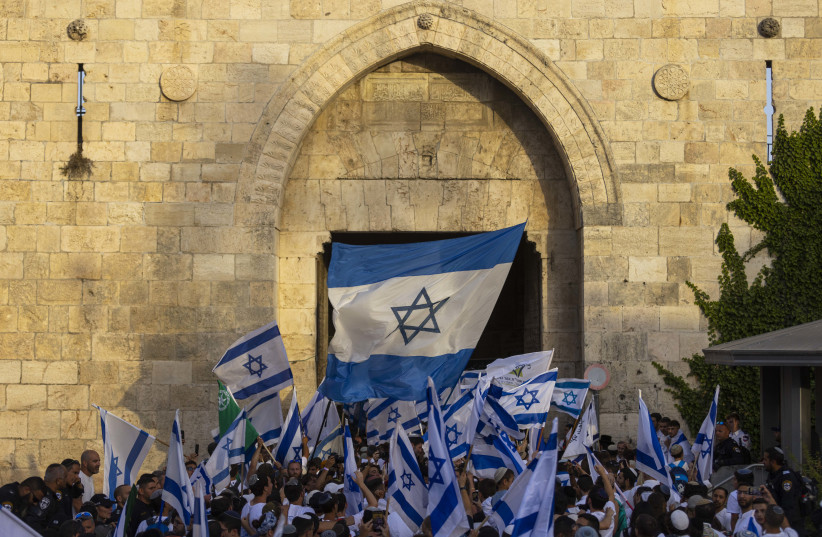
It carries the story of the Jewish people’s deep ties to their homeland and their roller-coaster ride through history, culminating in today’s ongoing marvel of Jewish sovereignty, the State of Israel.
With Israel-bashing and Zio-whacking an increasingly popular global sport, simply marking this moment, toasting this city, refutes the haters without being defensive or apologetic.
It’s hard to convey the majesty and magic of this city, the largest city by area, with over 1.1 m. people, growing 4.1% annually. It’s one of the developed world’s youngest cities, with a third of Jerusalemites under 18.
People have lived here for 7,000 years – archaeologists have unearthed homes and tools from 5,000 BCE. Today, with one of three residents working for non-profits, Jerusalem is Civil Society Central, not just the capital of Israel and the Jewish people.
The character of Jerusalem
A proud Jerusalemite-by-choice, I feel blessed to call this city “home.” My Jerusalem is commuting through history, passing within one mile: the 2,700-year-old First Temple burial caves where the oldest known surviving biblical text – the priestly blessing – was found behind today’s Menachem Begin Center; the Old City’s Walls; Montefiore’s 1857 windmill; the rebuilt house Herzl visited in 1898; and Jerusalem’s City Hall.
My Jerusalem is my British friend who doesn’t wear his kippah in London but wears it here “because Jerusalem is a holy city.” My Jerusalem is jogging past an Arab woman in hijab, as she’s pushing her baby stroller, and breaks into a huge, proud smile when I say “hello.”
My Jerusalem is our mayor, Moshe Lion, who keeps the streets clean and leads prayers magnificently. My Jerusalem is watching soldiers leave Sunday morning, and return Friday – while seeing friends keep supporting the families of eight fallen soldiers and murdered victims since October 7 in our neighborhood alone. And, my Jerusalem is enjoying over 300 sunny days annually, without Tel Aviv’s humidity – or Montreal’s frost.
Highlighting just one archaeological discovery made since J-Day 2025 captures Jerusalem’s significance. Shortly before the Tisha B’Av fast, mourning the destruction of the First Temple in 586 BCE and Second Temple in 70 CE, archaeologists near the Western Wall, working with the Davidson Center and the City of David, discovered a brass coin from 69 CE – the fourth year of the First Jewish Revolt against Rome.
The inscription reads “LeGe’ulat Zion” – For Zion’s redemption – that mystical name of a mountain that defines the entire city, which the Bible mentions 152 times.
The ancient Hebrew script surrounds a goblet – evoking the kiddush prayer sanctifying wine that Jews say every Sabbath. The flip side features one lulav – a palm frond – and two etrogim – the special citrus – also beautifying the Sukkot festival.
Consider how many stories, values, insights, hopes, and dreams that little coin carries! We can’t name the people who held it, who used it, either as currency or to communicate who they were, what drove them, and the freedom they craved. We don’t know whether they were annoyingly optimistic like me or despairingly pessimistic like too many around me today.
Experts speculate that emphasizing “redemption” reflects their sense of doom, contrasting with earlier coins proclaiming “For Zion’s liberation.” It could be a broader mood shift. Maybe it’s more idiosyncratic.
Amid many doubts, we do know that this little coin with its very big message survived.
We also know that they hoped to redeem Zion then – amid impending historic disaster – and we’re redeeming Zion now. They were rooted in the land of Israel, the faith of Israel, the people of Israel, the traditions of Israel, as we are today.
They connected Jewish religious holidays, the Jewish people, the Jewish land – without making all these modern distinctions – religion, faith, nation, people, homeland, state. It all harmonized together. And they, like us, yearned for a better, safer, kinder world.
Rabbi Yitz Greenberg observes that Israel’s founding has added joyous holidays to Jews’ sometimes too-mournful calendar. Even better, Jerusalem Day and Independence Day break the mostly depressing period of counting the Omer. That recalibrates us, now that we live in better times, with a Jewish army protecting our thriving Jewish state.
Jerusalem has long exuded hope, faith, purity, pride, and possibility. It’s time to make Yom Yerushalayim a highlight of the Jewish year, with special rituals capturing just how Jerusalem enriches our lives, no matter where we live.
The writer is an American presidential historian and Zionist activist born in Queens, living in Jerusalem. Last year he published, To Resist the Academic Intifada: Letters to My Students on Defending the Zionist Dream and The Essential Guide to October 7th and its Aftermath. His latest E-book, The Essential Guide to Zionism, Anti-Zionism, Antisemitism and Jew-hatred, was just published and can be downloaded on the website of JPPI – the Jewish People Policy Institute.