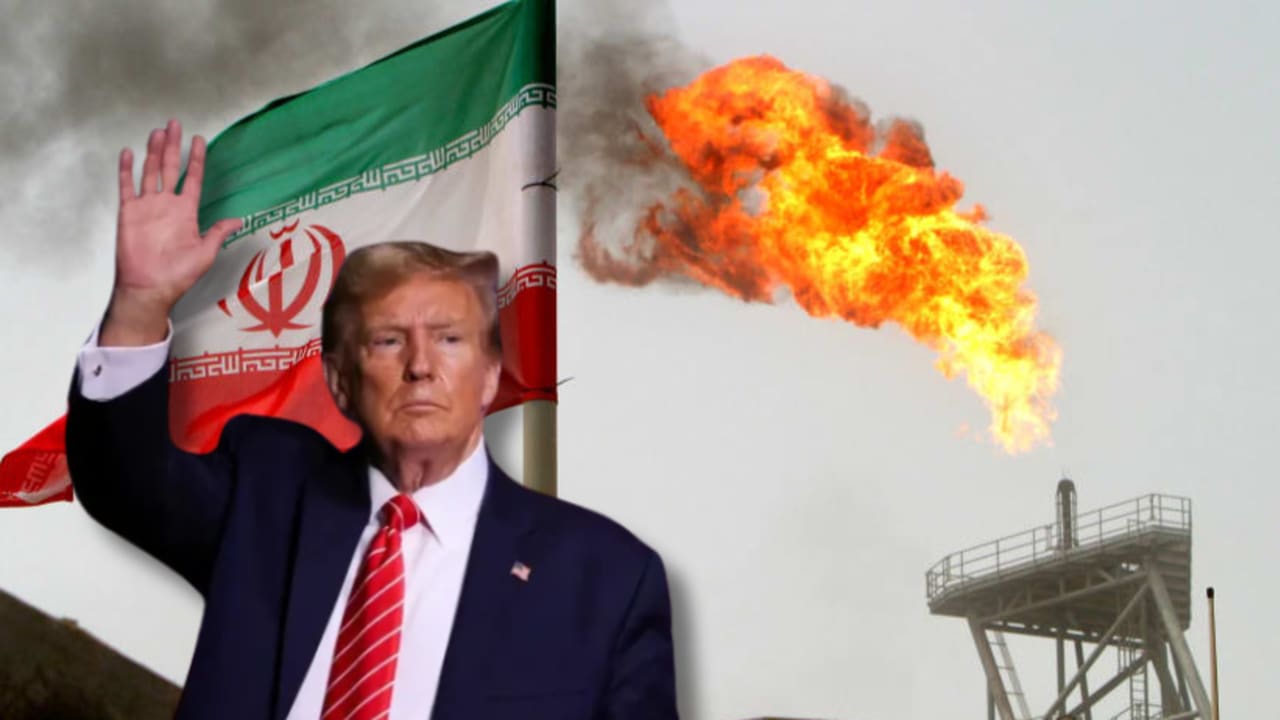
Seyed Hossein Mousavian’s recent essay on the US-Iran deadlock, published in Foreign Affairs, presents itself as a work of strategic analysis, yet upon closer examination, it reveals something more deliberate: a carefully structured narrative that seeks to recast perception as reality.
Cloaked in the language of deterrence, crisis, and the looming shadow of war, the argument does not so much illuminate the dynamics between Washington and Tehran as it attempts to redefine them.
At its core lies a subtle but consequential inversion – one that attributes American restraint to Iranian strength, while systematically obscuring the deeper forces shaping both.
To understand the flaw in this reasoning, one must begin not with rhetoric, but with strategic intent. US President Donald Trump has, throughout his tenure, demonstrated a consistent reluctance to engage in large-scale military confrontation.
This restraint, however, is not a concession extracted by Tehran’s deterrent capabilities, as Mousavian suggests, but a calculated decision grounded in the recognition that war – particularly in the Persian Gulf – carries disproportionate economic, geopolitical, and domestic costs.

The avoidance of conflict, therefore, reflects not fear of Iranian power, but a strategic preference for coercion without entanglement. Economic pressure, not military escalation, becomes the instrument of choice precisely because it is seen as a more efficient path to strategic leverage.
Yet Mousavian’s argument hinges on reversing this causality. By presenting American prudence as evidence of Iranian resilience, he constructs an image of strength that dissolves under scrutiny.
Iran in a deteriorating state
For no serious assessment of state power can ignore the internal condition of the polity itself. Iran today is not a system defined by stability, but by accumulation of strain: a deteriorating economy, institutional fragmentation, and a widening crisis of legitimacy that has repeatedly manifested in nationwide unrest.
The bloodshed of the November 2019 Iranian protests, followed by persistent waves of dissent – many led by women and younger generations – points not to a regime consolidated in authority, but to one increasingly reliant on coercion to sustain it.
These are not peripheral variables; they are central indicators of fragility. To omit them is not merely to simplify reality, but to reconstruct it.
From the vantage point of Princeton University, Mousavian adopts the posture of analytical balance while advancing a distinctly asymmetrical moral framework. Civilian casualties attributed to the United States are foregrounded with precision, while the regime’s own record of internal repression and transnational violence recedes into near invisibility.
This is not neutrality; it is selection. And in that selection lies a deeper recalibration of legitimacy – one that shifts the axis from accountability to power, from representation to control.
Nowhere is this more evident than in his effort to normalize figures such as Mohammad Baqer Qalibaf by placing them alongside Western political actors like JD Vance. Such juxtapositions are not rhetorical accidents, but instruments of reputational translation.
They seek to confer a veneer of international credibility upon actors whose authority is rooted not in institutional legitimacy, but in their proximity to the machinery of coercion.
To suggest that their participation in negotiations signals seriousness is to misunderstand the nature of the shift taking place within the regime itself.
What is being observed is not the strengthening of diplomacy, but its displacement – an increasing transfer of strategic agency from civilian interlocutors to security figures, where negotiation becomes less a process of resolution than an extension of control.
This same logic extends into Mousavian’s proposal for a regional enrichment consortium, presented as a constructive pathway toward de-escalation. At first glance, the framework appears to offer a compromise – embedding enrichment within a multilateral structure under international oversight.
Yet such an approach risks confusing form with substance. The central issue is not the architecture of supervision, but the credibility of compliance.
A system whose nuclear trajectory has long been marked by opacity and strategic concealment cannot be stabilized through procedural redesign alone.
Even under the auspices of the International Atomic Energy Agency, verification mechanisms remain contingent upon political will – a variable that has proven persistently uncertain.
What is presented as a confidence-building measure may instead function as strategic insulation, preserving capability while diffusing pressure, and extending ambiguity under the cover of institutional legitimacy.
Within this broader narrative, even the invocation of potential crises – the disruption of global energy flows through the Strait of Hormuz, the specter of regional war – serves a distinct rhetorical function.
These scenarios are not introduced merely to inform, but to constrain – to elevate risk in a manner that narrows the perceived space for policy choice.
The implication is clear: that pressure is inherently destabilizing, and that accommodation, however uneasy, remains the only viable path. In this way, analysis gives way to persuasion, and persuasion to a form of strategic advocacy that seeks to transform uncertainty into concession.
What ultimately emerges from Mousavian’s essay is not a dispassionate examination of the US-Iran impasse, but the articulation of a broader effort to reinterpret weakness as strength, and constraint as leverage.
By amplifying the external projection of power while minimizing the internal erosion of legitimacy, the narrative does more than misread reality – it seeks to reshape it. And in doing so, it reveals less about the actual balance between Washington and Tehran than about the enduring attempt to translate political necessity into analytical credibility.
In the final analysis, the danger of such arguments lies not merely in their conclusions but in their method. When strategic discourse becomes untethered from empirical reality, it ceases to illuminate and begins to obscure.
The Iranian regime does not persist because it has resolved its contradictions, but because those contradictions have yet to fully converge. To mistake this suspended state for resilience is to misunderstand the trajectory of events.
And to elevate such a misreading into the realm of policy is not simply an intellectual error – it is a strategic risk, one that confuses the management of decline with the presence of strength, and in doing so, blurs the very distinction upon which sound statecraft depends.
The writer is the senior news editor at Iran International.