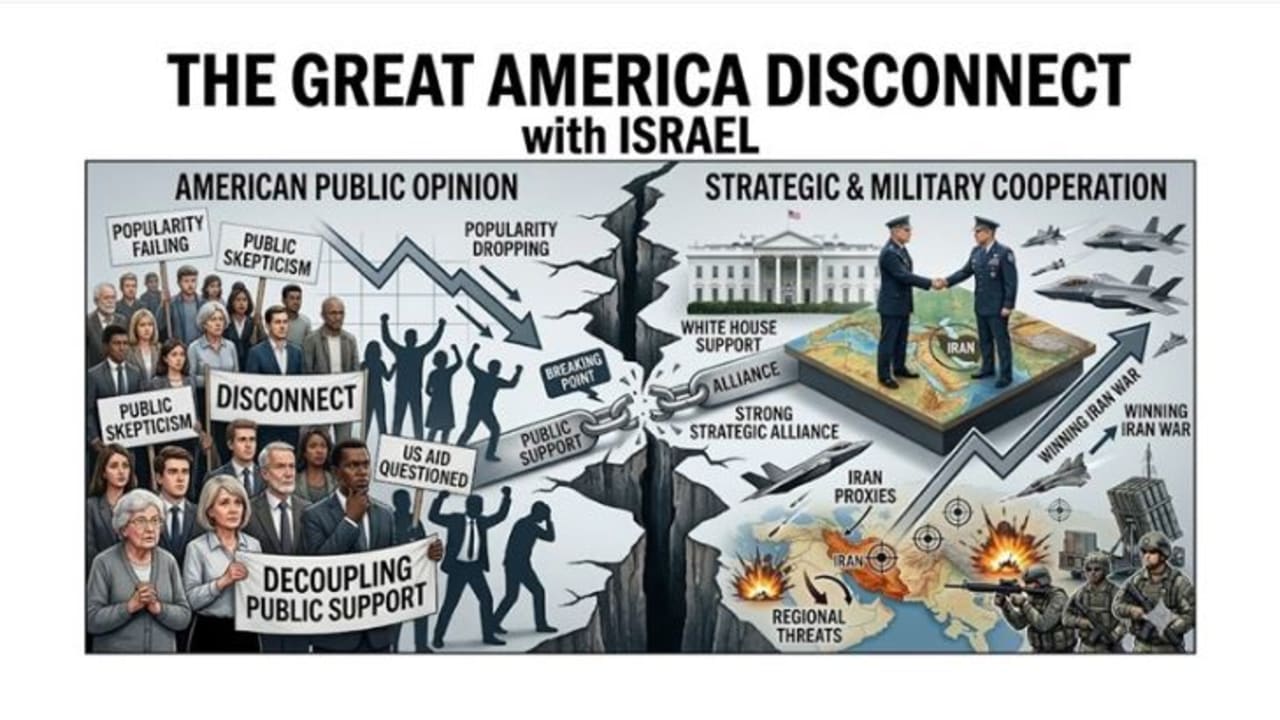
The halls of power in Washington DC have rarely echoed with such full-throated, uncompromising support for the State of Israel. From the Oval Office to the high-ranking echelons of the Pentagon, the Trump administration has framed the US-Israel partnership not merely as a strategic necessity but as the cornerstone of American foreign policy.
Recently, the new UK ambassador to the United States went as far as to label the US-Israel bond as the truly “special” relationship, pointedly elevating it above even the historical ties between Washington and London.
Yet, as we peer past the diplomatic galas and high-level military briefings, a staggering and terrifying discrepancy emerges. While the White House and its team are “unbelievably complementary” of the working relationship, the foundation of public support that once sustained this alliance is crumbling across almost every demographic sector in the United States. We are witnessing a historic “decoupling” where the military-industrial complex is in lockstep with Israel, while the American people are moving toward the exit.
The military mirage
The disconnect is perhaps most jarring when one listens to the voices of American service members and defense intellectuals. Influential figures like Pete Hegseth, Dan Caine, and Bret Cooper have been vocal in their praise of the “amazing” Israeli military and intelligence support currently bolstering American security. For the average American, the opinion of their servicemen and women has traditionally carried immense weight.
Logically, if the American military – an institution still broadly respected across age groups – is in awe of and praises Israel’s partnership, one would expect public favorability to follow suit. Instead, the opposite is happening.

Even as the president makes disparaging remarks about traditional allies like France, the UK, and Germany for not “doing their part” in global security, those very countries enjoy significantly better public relations in the US than Israel does. Israel is providing the tech, the intelligence, and the frontline defense, yet it is being viewed in an increasingly poor light.
Israel must also reframe the aid debate in hard American terms. Compared with the scale of US and Western support to Ukraine, roughly $127 billion in direct US support by one major estimate, and far more when broader war-related spending is counted, Israel’s annual $3.8 billion package is not a comparable burden.
It is a high-return strategic investment: intelligence, battlefield-tested technology, missile-defense innovation, regional deterrence, and a forward-positioned ally that helps America project power without deploying large numbers of American troops.
The Republican fracture: A generational cliff
The most alarming data comes from within the Republican Party – the group once considered the “unshakable” base of Zionism. While support remains high among the older guard, the shift among young Republicans is a statistical earthquake.
Recent polling reveals that Republicans aged 18-34 are far less sympathetic to Israel than their parents or grandparents. Sympathy levels for Israel among this younger cohort sit at a meager 24%, compared to 52% for those aged 35 and older.
This 28-point gap is not a minor fluctuation; it is a fundamental realignment. Even among Evangelical Republicans – once the bedrock of Christian Zionism, the split is a devastating 32% of youth versus 69% of the older generation.
The justification for Israel’s defense is also under fire. Only 22% of Republicans aged 18-34 view Israel’s ongoing operations in Gaza as justified self-defense, whereas 52% of those 35 and up still hold the line.
Perhaps most concerning for the long-term strategic alliance is that 51-53% of younger Republicans now oppose renewing US aid commitments, favoring cuts instead. Among those under 45, a staggering 74% support reinvesting those aid dollars back into domestic American programs.
The strategic communications battlefield
How did a president who is arguably one of the greatest “media masters” of all time, who has praised Israel “left and right,” end up presiding over a rapidly shrinking pool of public popularity for America’s best ally? The reasons suggest that Israel is losing a “long game” played by its detractors who are now enjoying the fruits of their labors.
Is it the money and influence of Qatar, Saudi Arabia, Russia, and China that is tipping the scales? Qatar is not merely a wealthy diplomatic player. It owns and funds one of the most effective propaganda machines in the world: Al Jazeera.
The network says it reaches more than 430 million homes in over 150 countries; by comparison, CNN averaged about 573,000 US primetime viewers in 2025, while Fox News averaged around 2-3 million depending on the period measured. That is not a normal media imbalance. It is a strategic communications battlefield, and it is one where Israel is currently outgunned and outmaneuvered.
While Israel is a leading hi-tech partner keeping America at the edge, its adversaries are winning the war of narratives in the palm of the American voter’s hand.
The Democratic Party has moved so far that some factions appear competitive with Hezbollah in their anti-Israel stance. But when even the Republican Party, beyond just the isolationist fringes of Tucker Carlson or Candace Owens, shows a “dramatic” drop-off in support, the alarm bells should be deafening.
The Narrative Deficit
We cannot ignore the personal impact of leadership or the shift in moral framing. Benjamin Netanyahu’s favorability has plummeted to a net plus 2 among young Republicans, a ghost of the plus 40 favorability he enjoys with those over 35.
For many young Americans, the decline in support for the nation of Israel is inextricably tied to their negative view of its prime minister, which is being further undermined by his detractors at home.
Furthermore, the next great test may not be Gaza or Iran, but Lebanon. If Israel concludes that it has no choice but to do in Lebanon what it was forced to do in Gaza, dismantle embedded Iranian proxy infrastructure inside civilian areas, the military logic may be sound, but the media framing will be brutal.
Major Western outlets will not lead with Hezbollah’s strategic entrenchment; they will lead with destruction, displacement, and civilian suffering. Israel may again win the battlefield while losing the screen.
A house divided and exported
And this pressure will only intensify as Israel moves toward elections. Every domestic Israeli argument, hostage policy, Gaza, Lebanon, Iran, judicial reform, Netanyahu, the opposition, the role of the IDF, the role of the courts, will be exported instantly into the American media ecosystem.
Israel’s internal political divisions will not remain internal. They will become content, ammunition, and narrative fuel in the US battle over Israel’s legitimacy.
This generational decline is both a result of and a catalyst for a much wider, more visceral debate in America about nationalism and whether US interests remain compatible with its old alliance commitments.
Young Republicans are moving in a direction that is less automatically pro-Israel and more conditional, cost-conscious, and suspicious of elite foreign-policy consensus. If the “special relationship” is only special to the ambassadors and the generals, but a burden to the taxpayers and the youth, it will not survive the decade.
Israel may be winning with Washington, with the Pentagon, and even on the Iran battlefield. But if it loses the American public, especially the rising, influential next generation of Republicans, it may discover too late that strategic victory without narrative legitimacy is only a temporary victory.
Therefore, the Trump administration and the Israeli government must prioritize this issue and find a way to speak to the “America First” generation, or the “special relationship” may soon become a relic of the past.
The author is experienced global strategist and can be reached at globalstrategist2020@gmail.com.