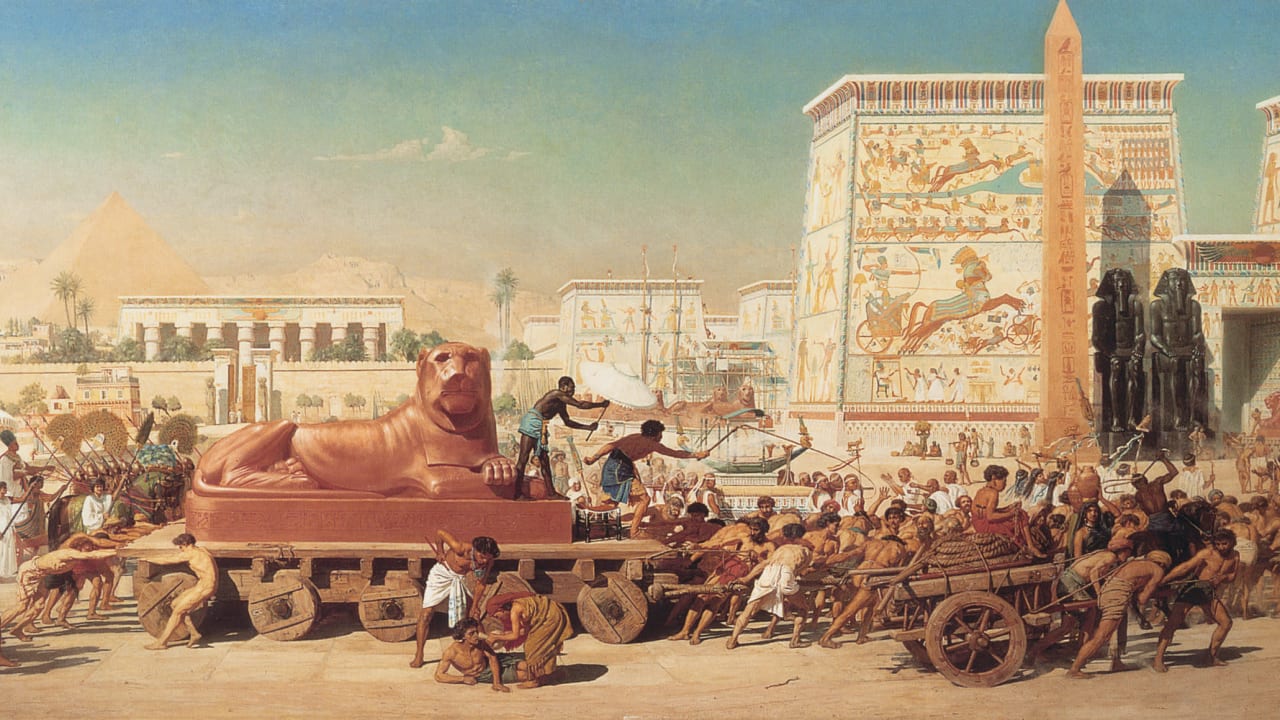
The Hebrew Bible repeatedly compels us to remember that we were both slaves and strangers in the land of Egypt. In multiple passages, that memory is central to the exhortation to build a society based on justice and caring for others. “Do not oppress the stranger, for you were strangers in the land of Egypt” is a constant refrain in the Torah. Biblical and rabbinic texts envision it as part of the national character of Israel not to treat others as others have wrongfully and brutally treated us.
For more stories from The Media Line go to themedialine.org
At the Seder this year, we will again read two paragraphs that seem to flow one from the other but actually originate in two different sources and contexts.
The Haggadah and history
The paragraph near the beginning of the Haggadah, describing how five rabbinic masters of the Mishnaic period sat for the Seder in the Judean city and learning center of Bnei Brak and told the story of the Exodus from Egypt all night long, is apparently original to the Haggadah, a work finalized in the eighth century CE. This is according to the research of 20th-century commentator E.D. Goldschmidt, who found that while the story may echo earlier rabbinic traditions about sages meeting in a different setting, the exact wording first appeared in the Haggadah.
The paragraph that immediately follows also mentions speaking of the Exodus from Egypt at night and begins with a statement by one of the rabbis cited in the previous paragraph, Rabbi Elazar ben Azariah, explaining why we do so. It seems to continue the earlier conversation, especially since another of the first paragraph’s rabbinic masters, Ben Zoma, is quoted as well.
Yet the nighttime referred to in the first paragraph is specifically that of Passover Eve, while the night of the second paragraph is every night of the year. In fact, the dispute recorded there between Ben Zoma and the sages concerns why we recite the third paragraph of the Shema, which mentions the Exodus from Egypt, at night as well as during the day, all year long. That only becomes clear when one reads the source in its original Mishnaic context, Mishnah Berachot 1:5, from which the editors of the Haggadah took it.

Drawing on a biblical verse in Deuteronomy, Ben Zoma argues that the Torah’s language implies that the obligation to speak of the Exodus in the Shema applies both by day and by night. The sages argue that the more relevant distinction is between current existence and future redemption, with the well-known Seder night retort that the requirement to mention the Exodus applies both in this world and in the days of the Messiah.
Still, that is not the end of the argument according to the Babylonian Talmud. In Berachot 12b, Ben Zoma then challenges the sages with the idea that scripture also teaches that any future redemption of the Jewish people would inevitably replace the Exodus from Egypt as the central paradigm for Jewish liberation. The sages then respond that the Exodus from Egypt will always remain paradigmatic of Jewish redemption, but that it does so by teaching the primary idea of what it means to overcome the broader condition of subjugation to world empires and powers.
History did not end the Jewish conversation about Egypt when the Northern Kingdom of Israel fell to the Assyrian Empire. We did not stop talking about Egypt when Judah fell to the Babylonian Empire. We did not stop talking about Egypt when the Persian Empire almost exterminated the Jews. We did not stop talking about Egypt when confronted with the oppression of Antiochus and the Seleucid Greek Empire. Perhaps the sages were saying that they were not about to stop understanding the Jewish struggle with world empire through the lens of Egypt and the Exodus when it came to their own reality, in which a brutal Roman Empire had destroyed the Temple and would later rename Jerusalem and Judea, foreshadowing a long and difficult exile.
Redemption from Roman-imposed exile also would be spoken of through the language of the Exodus from Egypt, and such redemption was meant to remain an implicit aspiration on the night of the Seder.
Perhaps that is what the sages were discussing in Bnei Brak: the possibility of the Jewish people taking history into their own hands under Roman rule. Some have read the scene against the backdrop of the approaching Bar Kokhba revolt against Emperor Hadrian, though the evidence for that remains suggestive rather than conclusive.
What matters is that they did so by speaking about the Exodus from Egypt all night long. Perhaps the Haggadah masterfully juxtaposes these two paragraphs in order to place the night of the Seder, and the particulars of a second-century historical reality, in the broader ongoing context of the Jewish imperative to challenge brutal empire and to see that challenge as connecting our origin story of coming out of Egypt with our aspirations for a future world in which the brutality and overreach of imperial power fall away for everyone.
Accordingly, we live through an annual cycle of holidays that focuses us on the struggle with empire: Passover through Purim, with Hanukkah and, for that matter, Tisha B’Av, all move us to understand the various dimensions of overcoming, enduring, accommodating, and overturning the power of empire.
The idea of the Jewish people, as it develops from its origins in the Passover story through the prophetic vision of being “a covenantal people to enlighten the nations” (Isaiah 42:6), is never meant to be about taking over the world through force and power but about remaining sovereign as one people among many peoples, with territory limited to defensible borders but influence that is transnational in bringing the light of its teachings to all. What we garner from the Passover story, and from the imperative to remember the Exodus and retell it in its many contours, is that we are meant to be the anti-Egypt, a force in the world that counters the abuses of tyrants and hegemonic impulses, a constant reminder that we do not do to others the hateful things they have done to us.
The Jewish people does not always live up to this. We are, in the end, merely human. But we try, in light of the fact that there are certain others in the world who mean us grave harm. There is, after all, the sojourner, the ger, whom we are compelled to welcome into the covenantal eating of the Passover offering. But there is also the alien, the nechar, who is excluded. Both appear in the same biblical passage about performing the Passover rite throughout the generations in Exodus 12:43-48.
At the same time, seeing our current reality through these various lenses is compounded by the realization that there are existential benefits to connecting with great world powers that befriend us and whose values seem aligned with our own. We do that at a certain risk, no matter how necessary it might seem. The Islamic Republic of Iran is a modern-day Egypt, not satisfied with being one people among many. It operates with a world-conquering theology that we cannot abide.
The struggle that Israel and the United States have embarked on against Iranian hegemony speaks to the age-old imperative to counter Egypt. The United States, though, has its own internal tension between being a republic and being a new kind of empire, especially when what might amount to an imperial policy on the part of the United States catalyzes imperious behavior on the part of the American executive. The Jewish people made a deal with Rome in the second century BCE in order to finish off the Seleucid Greeks, just as Rome was realizing its imperial designs to the detriment of its republican origins. That had its downside in the long run. It is necessary sometimes to kiss the ring, but we should be mindful of the risks.
The writer is managing director of the Areivim Philanthropic Group and president of the Steinhardt Foundation for Jewish Life.