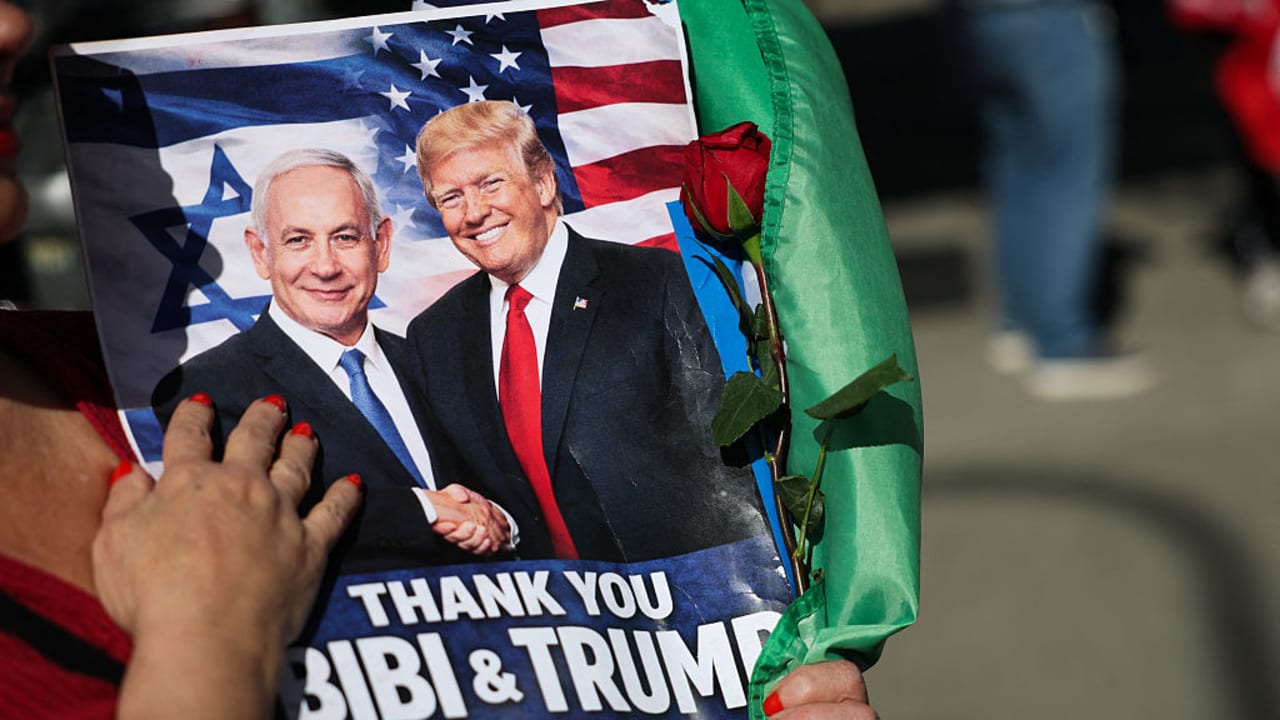
"There are no facts,” said Friedrich Nietzsche, “only interpretations.” That certainly goes for Donald Trump’s cryptic announcement Monday concerning the future of the attack he unleashed on Iran.
Yes, many responded to the presidential tweet as if they had helped its author type its full-capped words. One claimed it was the beginning of a magnificent retreat, another said it was a ruse. A third said Trump is disappointed with the lack of an Iranian uprising, a fourth said he now plans to let Iran’s regime survive like Venezuela’s, and a fifth said “on the contrary, the mullahs’ days are numbered and the tweet is designed to sow discord in their midst.”
This writer refuses to join this guessing game. Donald Trump has proven he is unpredictable, inconsistent, impatient, impressionable, and impulsive. One has to doubt whether he himself knows what his next move will be when he announces such a decision’s approach.
It follows that from a Middle Israeli viewpoint, the question right now is not what America will do in the short term, but what Israel should do in the long term. And the answer is that the past month’s events lead to one military imperative, one political aim, and one diplomatic opportunity; a grand opportunity, one that is as precious and fragile as it is achievable and long overdue.
Military's goal is to destroy IRGC capabilities
The military imperative is to castrate the Revolutionary Guards.
The organization that has dominated the Islamic Republic’s economy, politics, and security establishment emerges from this month’s events as Iran’s exclusive ruler.

The Israeli imperative in this regard is to rob this organization of the tools with which it does whatever it does. This means bombing its arms shipments, warehouses, and barracks; targeting its meetings, consultations, and assemblies; and sabotaging its financial activities. Its work should be made increasingly difficult to carry out, and joining its ranks a matter of personal risk.
The reason is simple: it’s us or them. For decades, this outfit has said and shown that it seeks Israel’s destruction. Any Israeli government will have to take its fanaticism as a given. That is also why, if the US will ultimately tolerate some kind of nuclear program or missile production, Israel will have to continue targeting them.
That is the military aim. The political aim should be a redone Iran. However, that this should be the aim does not mean it can be the plan. These are two different things. Seeking a liberated Iran means that as long as Iran is hijacked, Israel will have to take its enmity as both given and lethal. As for engineering its hijackers’ downfall, that’s beyond Israel’s abilities.
As this column has noted repeatedly over the years, Israel tried this trick once, in Lebanon in 1982. The results were catastrophic and traumatic. This is a task for a superpower, and Israel isn’t a superpower. It will also never be one.
Not only is Israel not a superpower, it is also marginal within its region. Yes, its military is larger, better equipped, and more intensely trained than many other armies, but in terms of its territory, population, and religion Israel is marginal in its region. And that is where this war’s biggest opportunity lies.
Iran spreads war far beyond Israel
Iran's war effort, whether preconceived or improvised, has targeted a plethora of victims besides Israel, all of which will never forget Tehran’s aggression.
Spewing its fire along a rim arching from Turkey and Cyprus at Europe’s hip, to Diego Garcia halfway between Madagascar and Singapore, Iran has attacked no fewer than 12 sovereign countries.
It follows that what has been seen here as an Israeli-Iranian collision is, in fact, something far bigger. This is not about Israel. It’s about Shi’ite messianism, and that is how it should be understood – culturally, militarily, and diplomatically.
Culturally, this is part of a global, long-term effort by a set of triumphalist crusaders to provoke the rest of civilization. Israel has been for them what European Jewry was for Nazi Germany: the warm-up act, a target that could be harassed with impunity, while the real targets delude themselves that this enemy isn’t theirs, that once fed a few Jews, it will let everyone else be.
Militarily, everyone must now understand that this regime, after having mass-murdered its own people, will readily attack others elsewhere, if only adequately armed: even a European Union member like Cyprus, even powers like Britain, whose territory has not been attacked since 1982, and even Islamist Turkey, which has not been attacked since the Greek invasion of 1922.
Then again, Turkey, Cyprus, and Britain were secondary targets in Iran’s assault. Tehran’s massive attack targeted the Arab world, hitting Saudi Arabia and seven of its neighbors with more than 500 ballistic missiles and 2,000 drones.

All these countries are now, in effect, in a military alliance with the Jewish state. Having fired at its Arab neighbors more than four times as many projectiles as it fired at Israel, the “anti-imperialist” mask has come off the Iranian regime’s face, unveiling an anti-Arab face.
This is very far-reaching stuff. It’s the kind of experience that refutes longstanding assumptions and rearranges veteran priorities. Israel never was the anti-Arab menace that anti-Israeli propaganda portrayed. Iran indeed is such a threat, as millions of Arabs now learned while braving Iranian fire for no fault on their part.
Military cooperation between Iran’s Israeli and Arab targets is already believed to be regular and close – so much so that IDF Chief of Staff Lt.-Gen. Eyal Zamir reportedly spoke personally with his colleagues along the Gulf as they sustained Iran’s attacks.
This military commotion should ignite diplomatic momentum. The ayatollahs may or may not survive the calamity they wrought on their country, but if the mullahs’ violence bolsters Arab-Israeli peace, nothing will better commemorate their revolution’s defeat.
www.MiddleIsrael.net
The writer, a Hartman Institute fellow, is the author of Ha’Sfar Ha’Yehudi Ha’Aharon (The Last Jewish Frontier, Yediot Sefarim 2025), a sequel to Theodor Herzl’s The Old New Land.