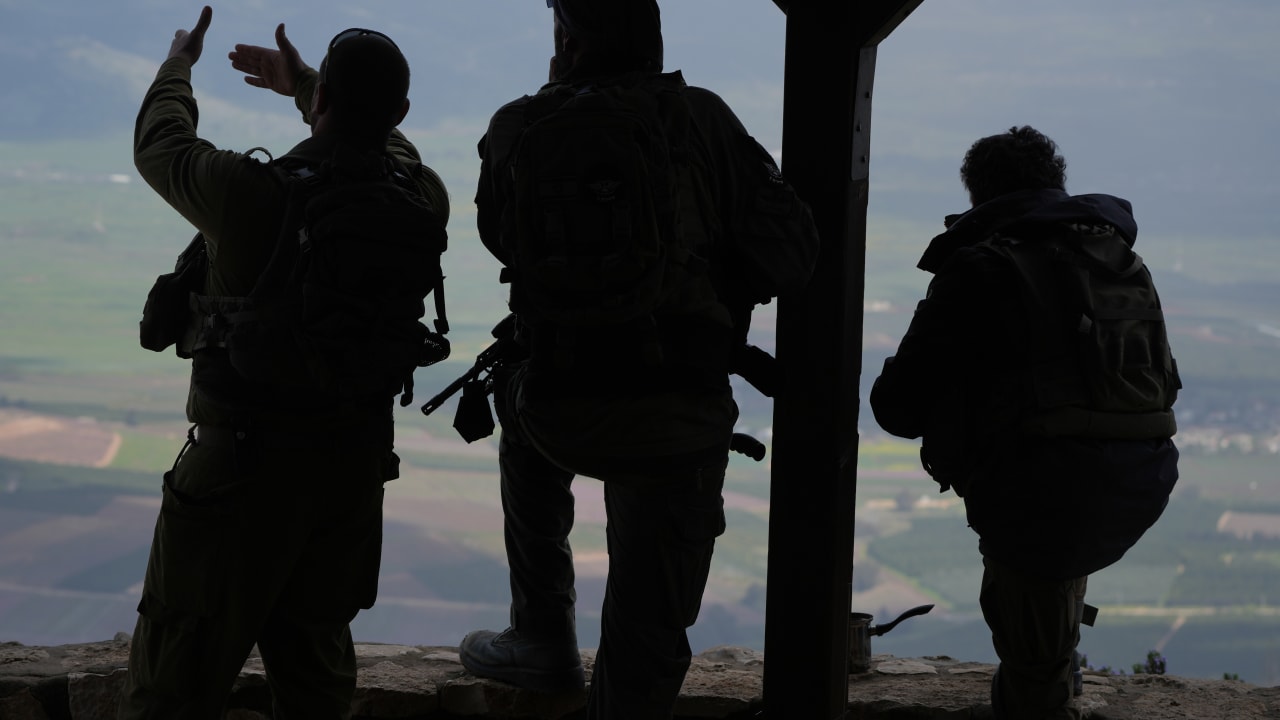
“Do you see those lights of the community over there? That’s Moshav Zar’it,” the company commander whispered into the radio as we made our tired way between the high rocks of Lebanon on our way back to the outpost. “That is why we conduct these ambushes again and again in the wadis that lead toward the community.”
Israel’s northern border is not merely a line drawn on a map: It is the meeting point between two opposing worldviews. On one side stands a state seeking to live in peace and to guarantee the security of its citizens; on the other stands a military arm of the Iranian regime whose very purpose is to threaten that state’s existence.
After the Second Lebanon War, UN Security Council Resolution 1701 established a clear principle: Southern Lebanon was to be free of Hezbollah weapons. In practice, however, the exact opposite occurred under the watchful eye of the Lebanese government and the conveniently blind eye of UNIFIL. The area between Israel’s northern border and the Litani River became a dense and sophisticated Iranian terror zone designed to threaten a murderous invasion of the Galilee.
Tens of thousands of rockets were positioned in villages and wadis, in homes and warehouses rented to Hezbollah by residents of southern Lebanon. Anti-tank systems were deployed along the routes leading from there into the Galilee. Advanced underground compounds were constructed for Hezbollah’s Radwan forces, units trained for one clear mission: infiltrate Israeli territory and capture communities in northern Israel.
In other words, the international arrangement collapsed. More precisely, it functioned as a time capsule that allowed the terrorist group to strengthen itself and build its military power for the next war.

Hezbollah remains a threat
Even the heavy blows Hezbollah has suffered in the current war have not pushed the organization out of southern Lebanon or caused it to change its objectives. On the contrary, it has persisted in fighting and has viewed the conflict as an opportunity to strike Israel.
If any doubt existed before October 7 regarding the danger from the north, that doubt has now vanished. The conclusion has become clear to anyone willing to see reality: as long as Hezbollah remains present south of the Litani River, the existential threat to the residents of the Galilee remains immediate and tangible. The murderous ideology supported by Iran will not disappear nor will Tehran alter its goals, even if it suffers significant military losses.
This understanding is not a philosophical insight but a practical conclusion. It compels Israel to determine clearly what strategic reality must exist during the war and, no less importantly, the day after it.
What options does Israel have?
In practice, Israel faces two options.
The first is to continue managing periodic rounds of conflict with a terrorist organization that strengthens itself between wars, while attempting to extend the time between each confrontation. This option effectively preserves and legitimizes the reality of recent years, one that enabled Hezbollah to recover, expand, and grow stronger.
The second option is to change the geographic and military reality by pushing Hezbollah beyond the Litani River and eliminating the villages in the zone between it and Israel’s northern border, thereby significantly reducing the threat of a ground invasion into the Galilee.
The Litani River represents a natural boundary with clear topographic significance. The river, Lebanon’s longest, runs from east to west and forms a natural barrier between southern Lebanon and the rest of the country.
Creating a security zone up to the Litani is not a territorial aspiration: It is a basic security necessity born from the proven inability of the Lebanese Army and UNIFIL to monitor the area and enforce Resolution 1701 of the UN Security Council.
The same logic guided Israel’s capture of the Golan Heights during the Six Day War, after years in which Syrian forces had repeatedly attacked communities such as Degania and other settlements in the area. Defensive depth in southern Lebanon would significantly reduce the risk of a surprise attack against the residents of the Galilee.
Alongside the creation of a defensible border, an additional strategic principle is required: maintaining an open campaign against Hezbollah and the continuous pursuit of its operatives throughout the theater until its military capability is dismantled.
Anyone who truly wishes to prevent a Fourth Lebanon War must understand that repeated rounds of fighting with a terrorist organization are a formula for its strengthening, not its destruction.
Ending the war at the Litani line is therefore not merely a tactical objective: It is a fundamental condition for guaranteeing the security of northern Israel’s residents and enabling them to return to safe, peaceful, and thriving lives.
The writer is a retired IDF commander and the CEO of the Israel Defense and Security Forum (IDSF). He served as deputy brigade commander, battalion commander, and commander of the Southern Command infantry training base, responsible for preparing IDF soldiers and commanders for general combat in the Gaza Strip, including during Operation Protective Edge. Despite being wounded in combat, he also served as a special operations officer in Central Command, responsible for classified operations carried out by an elite IDF unit across the West Bank.