
He thought there would be a hole in the building. There was no building.
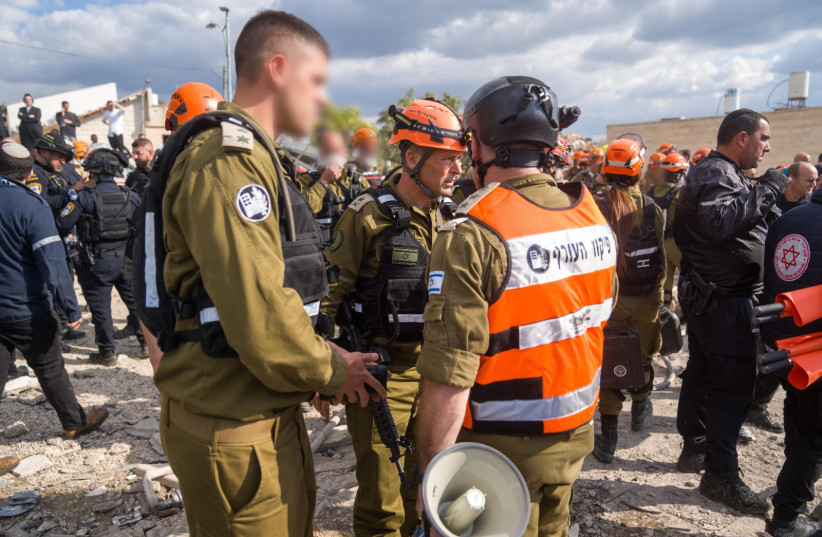
Rabbi Josh Broide, a Florida-born community leader who made aliyah from Boca Raton several months ago, drove to Beit Shemesh on day two of Iran’s ballistic missile assault.
He wanted to see the damage himself. What he found stopped him cold.
“You get there and you realize: there is no building,” he told me. “The surrounding buildings are damaged. Cars blown up. Roof tiles shattered down the block.”
He paused. “A man at the scene didn’t speak English. He had three words: boom, boom, boom.”
Iran’s assault killed multiple Israelis and triggered the call-up of an estimated 100,000 reservists. It was only day two. For Broide, his wife Simone, their 11-year-old, and a teenager days from her 16th birthday – it was their first war as Israelis.
Learning under fire
Broide is still learning the rules. He missed the reorganized Purim megillah readings – by the time he found the right WhatsApp group, every local gathering was full.
Sirens went off at the supermarket.
He stood in the aisle, watched other shoppers sprint, and followed.
“Do you bring your groceries into the safe room or leave them?” he said. “We just did what everyone else did.”
For 25 years in South Florida, Broide was the man with answers – Youth Director, Teen Rabbi, Outreach Rabbi, and award-winning community builder. Now he is the newcomer. Taking it day by day.
“Don’t have a grand master plan,” he said. “Things change very quickly here.”
Purim and Persia
The attack landed on Shabbat Zachor, the Shabbat before Purim, when Jews read the Torah’s command to remember Amalek. Broide heard the reading in someone’s living room. A siren went off mid-chant.
“Modern-day Amalek. Modern-day Persia. Modern-day Iran,” he said. “It was hard to avoid the connection.”
Israel’s military response came on the eve of Purim, the holiday that commemorates a Jewish victory over a Persian empire that sought their destruction. The symbolism was not lost on anyone.
“I teach this story every year,” Broide said. “You tell students it happened 2,500 years ago, and it’s hard to connect with. And then you get a very tangible refresher course.”
Words for American Jews
Broide has a message for Jewish communities back in the US. He chose his words carefully – until recently, he was one of them.
Celebrate Purim, he said. You should. But don’t forget what is happening here.
“Even when it looks like Israelis are having fun, there is still the reality that a rocket could destroy someone’s building tonight. A hundred thousand reservists just got called up. Hold both of those things at once.”
He marveled at Israeli resilience. After a night of near-constant sirens, he expected a shuttered country. Instead: pizza shops open, supermarkets packed, neighbors in the street. “You never feel more safe,” he said, “and yet the reality is completely the opposite.”
No turning back
Does he have regrets? Not one.
“We are so happy we made aliyah,” Broide said. “There is no turning back. We are living in historic times, and we are fortunate to be here for them.”
His daughter turns 16 next week. Purim is tomorrow. Above Beit Shemesh, for now, the sky is quiet.
Over the years, I have seen it again and again: the people of Israel are resilient like no other. It does not matter if you just stepped off the plane or have lived here your whole life.
You push forward. You dream big. You build families, drive innovation, and celebrate your holidays with joy – even when the sirens have only just gone quiet.
That is what the Jewish people do. It is in our history. It is in our DNA. We survive. We thrive. We show the world – proudly – who we are.
Am Yisrael Chai.
The writer is a nonprofit fundraiser, video journalist, and growth strategist focused on Jewish storytelling, advocacy, and community mobilization.