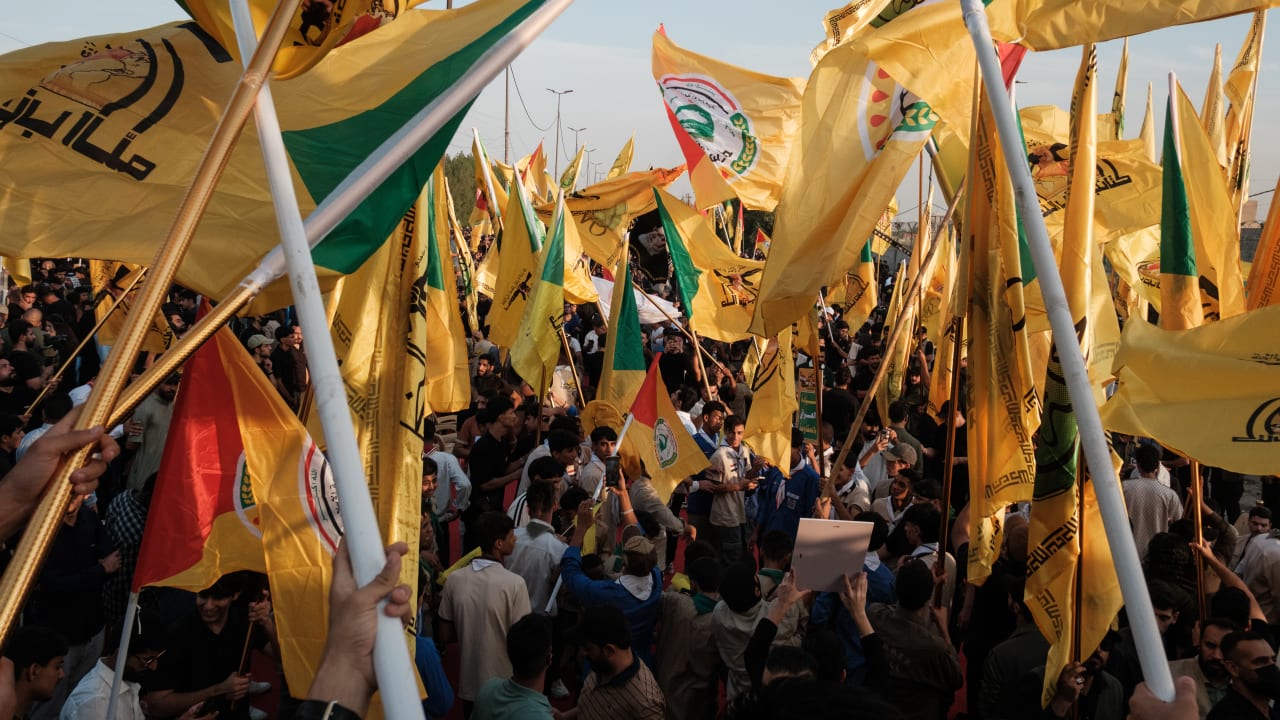
A mysterious explosion struck an ammunition depot in Baghdad from the Popular Mobilization Forces (PMF), an umbrella group of a number of Iranian-backed militias in Iraq, on Saturday. The Iraqi military and government are investigating the blast, which injured five PMF members.
The reports in Iraq are that a “resulting from the explosion of a cache of damaged ammunition inside one of its headquarters east of the Canal in the capital, Baghdad, has been brought under control, confirming that the final toll of the incident resulted in minor injuries to five personnel,” the PMF said.
Iraq’s state media said that “the Popular Mobilization Forces Commission confirmed on Saturday that preliminary investigations into an explosion at one of its headquarters in eastern Baghdad indicate it was caused by an internal malfunction, with no evidence of an external attack.” Iraq is therefore trying to downplay the idea that this site was struck by a munition, framing it as an accident.
Explosion was the result of internal malfunction, not a targeted attack
A statement from the PMF Commission, received by the state Iraqi News Agency (INA), noted that "preliminary investigations by the Ministry of Interior’s forensic evidence unit indicate that the explosion at one of the PMF’s headquarters was the result of an internal malfunction, and there is no indication of any external targeting."
Iraq’s Prime Minister has ordered an investigation. The Iraqi Security Media Cell stated, said that "the Prime Minister and Commander-in-Chief of the Armed Forces, Ali Falih al-Zaidi, has directed the formation of an investigative committee to determine the circumstances of the explosion of an ammunition stockpile inside a Popular Mobilization Forces headquarters, located east of the Canal in the capital, Baghdad."

The Media Cell, an official government account, also noted that the prime minister “emphasized the urgency of completing the investigation work to determine the precise causes of the incident, while taking all necessary safety measures and procedures to prevent the recurrence of such incidents in the future.”
Explosion viewed with suspicion in Iraq
The explosion will be viewed by some as suspicious. This is because it’s not the first of its kind. In the past in Iraq there have been explosions at arms depots. This has also happened in Syria. Is it all accidents, local people ask? They wonder whether something may be behind the explosions.
Iranian-backed militias have become a powerful force in Iraq over the last two decades, playing a role in the country's security and politics. Many of the groups, including Kataib Hezbollah, Asaib Ahl al-Haq and the Badr Organization, have longstanding ties to Iran's Islamic Revolutionary Guard Corps (IRGC). Badr was founded in Iran in the 1980s, while Kataib Hezbollah emerged around 2007 and Asaib Ahl al-Haq in 2006. These groups expanded their influence after the 2003 US invasion of Iraq, with some attacking American forces.
A turning point came in June 2014, when Grand Ayatollah Ali al-Sistani issued a fatwa calling on Iraqis to defend the country against ISIS. The mobilization helped create the Popular Mobilization Forces (PMF), known as Hashd al-Shaabi. Although the PMF includes numerous factions, Iranian-backed groups became the leaders within its ranks. The PMF was subsequently incorporated into Iraq's official security structure. Many of the groups have been sanctioned by the US as terrorist groups. They increased their attacks on US forces in Iraq in 2019 and 2020.
In 2019, a series of explosions rocked PMF weapons depots across Iraq. Some incidents were blamed by the militias on Israeli and American airstrikes. The explosions highlighted concerns about militia stockpiles and Iranian weapons transfers. It was reported in 2018 and 2019 that Iran had moved ballistic missiles to the militias.
Following the Hamas attack on Israel in October 2023, Iranian-backed factions launched numerous drone and rocket attacks against US forces in Iraq and Syria. Operating under the Islamic Resistance in Iraq (IRI) umbrella, they also claimed attacks targeting Israel throughout 2023 and 2024.
The militias have remained a challenge for Baghdad. In 2026, Iraqi Prime Minister Ali al-Zaidi pledged to bring weapons under state control. Baghdad later revised the September 30 disarmament deadline, as several powerful factions refused to surrender their arsenals. Baghdad claims it will rein in the militias by June 2027.