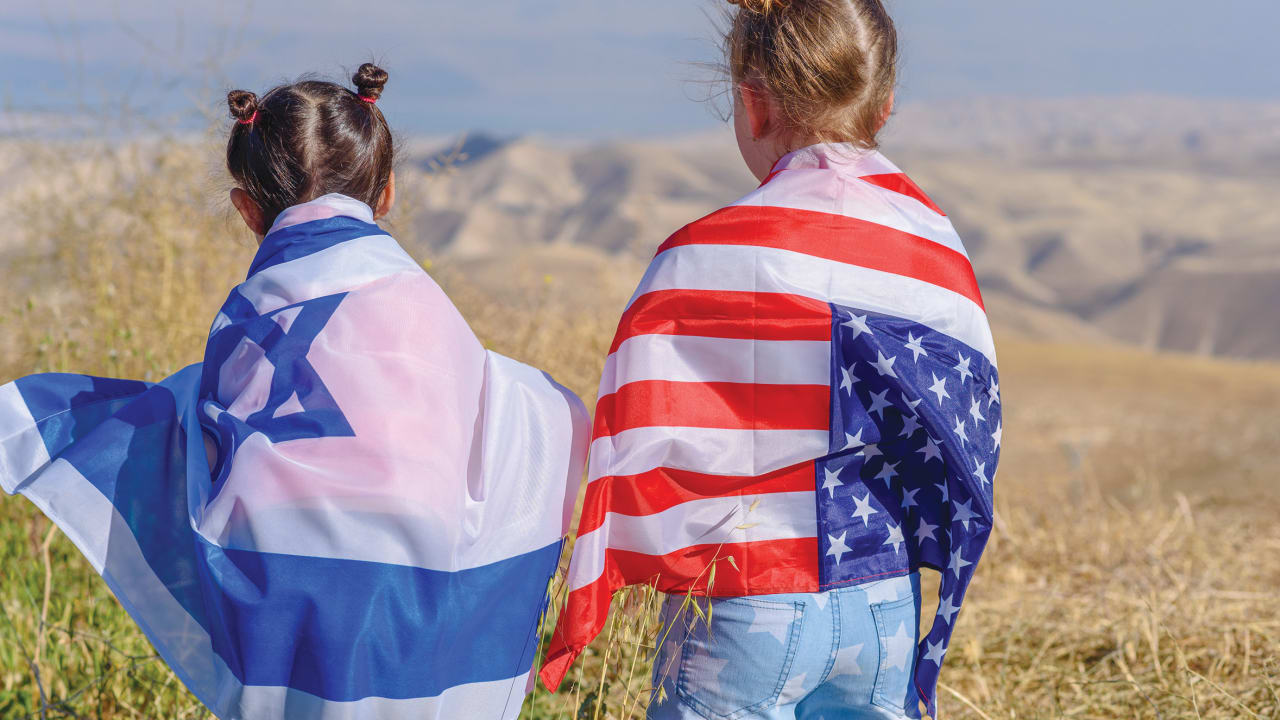
Passover marks our liberation from two centuries of slavery and persecution. It was the first time we faced an attempt to annihilate the Jewish people, and God delivered us. It was the first, but not the last.
Beyond our liberation, Passover marks the moment we were born as a nation. In our earliest beginnings, as described in the Book of Genesis, we saw ourselves as a family, at most a clan of 70 souls. During the years of slavery, our numbers grew dramatically, but without freedom we had no national identity. Scattered as slaves, we could hardly imagine ourselves as a single cohesive people.
The night of Passover inaugurated us into nationhood. That night launched one of the most remarkable phenomena in human history: a nation that has endured ever since, despite repeated attempts to eliminate it and despite conditions that make sustaining national identity almost impossible. As we gather around Seder tables across the world, we celebrate Jewish peoplehood and our nation’s enduring ability to preserve its identity through the trials of history.
Defining a nation
The Torah began shaping Jewish national identity by defining the Jewish people as a collective. In commanding the Passover sacrifice, the Torah speaks of the participation of the entire kahal and eidah of Israel. These terms formed the vocabulary through which Jewish identity was defined.
Rabbi Joseph Soloveitchik noted that these two terms reflect two different dimensions of Jewish peoplehood. An eidah describes a community of fate, people bound together by shared history and circumstance. A kahal refers to a community united by common vision, ideals, and covenant. On the night of our exodus, we were reminded that Jewish identity rests on both foundations: shared historical destiny and chosen mission. These were among the earliest terms used to describe Jewish peoplehood, though they would certainly not be the last.

The House of Israel
Eventually, we settled the Land of Israel and built Jewish sovereignty around the Temple in Jerusalem. However, after repeated betrayals, we were expelled from Jerusalem. It became far more difficult to imagine Jewish destiny once we were driven from the land that embodied that destiny.
Two prophets who spoke to the experience of exile, Jeremiah and Ezekiel, repeatedly described the Jewish people as a house, using the term “Beit Yisrael” to define our collective identity. The image of a house carried several layers of meaning. It reminded us that we once possessed an actual structure that stood at the center of Jewish life, the Temple in Jerusalem, and that one day we would return to rebuild that sacred house. The term “Beit Yisrael” also evoked the House of David and recalled our lost sovereignty.
More broadly, the language of a “house” reminded exiled Jews that our story had begun as a family in the Book of Genesis. Family identity, unlike political sovereignty or physical territory, can travel across lands and generations. For Jews confronting the trauma and uncertainty of exile, the phrase “Beit Yisrael” carried deep resonance. It reminded us that even far from our land, we remained members of a single enduring house.
Knesset Yisrael
A few centuries later, after we were expelled from Jerusalem a second time, Jewish life entered a very different historical reality. Many Jews had never lived in the Land of Israel or experienced life around the Temple. The earlier expression “Beit Yisrael” was therefore less resonant for a population that had never known Jewish life centered around the Temple or within a sovereign state.
In this context, a new term began to appear in the writings of the sages: “Knesset Yisrael,” or the “assembly” of the Jewish nation. The phrase captured a different form of Jewish existence. Even after exile, we continued to gather, now in smaller communities that sustained Jewish continuity. We assembled physically in the synagogue, or beit knesset, for prayer, and we lived within self-contained Jewish communities that preserved our customs, culture, and family lineage.
On a deeper level, the phrase also reflected a spiritual idea. Even when individual Jews no longer experienced direct dialogue with God, the collective Jewish people still stood before Him. Rabbinic literature is filled with conversations between God and Knesset Yisrael.
Knesset Yisrael became the national soul of the Jewish people, a collective personality that continued our covenantal conversation with God.
Additionally, the word knesset, “gathering,” also carried a quiet hope that one day the scattered gatherings of exile would give way to a full national reunion in our homeland.
Though scattered across lands, we still gathered as one people.
Klal Yisrael
As history continued to unfold, another term emerged to describe broader Jewish peoplehood: “Klal Yisrael.” This expression begins to appear in the medieval period. By then, the Jewish people were far more scattered than they had been in the centuries immediately following the destruction of Jerusalem by the Romans. In that earlier period, Jews were largely dispersed around the Mediterranean Basin and the broader Levant. By the Middle Ages, Jewish communities had spread across Europe, as well as throughout the Islamic world.
In such circumstances, the image of “knesset,” a gathering, became harder to sustain. Jews were no longer assembled in one region or even within a single cultural sphere. The more abstract term “Klal Yisrael,” referring to the total body of the Jewish people wherever they might reside, became increasingly meaningful.
All of these terms captured the remarkable miracle of Jewish peoplehood. Without the normal trappings of national identity, such as land, flag, currency, or sovereignty, we still maintained a powerful awareness that we were one people. That identity stretched across generations and continents. Each Passover renews that awareness and celebrates the enduring bond that continues to unite the Jewish people.
A living nation
This question of how we describe Jewish peoplehood reminded me of a speech I heard a few weeks ago in which the speaker repeatedly referred to Jewish collectivism, using the terms “Knesset Yisrael” and “Klal Yisrael.” It struck me that at this stage of history, the terminology itself may need to shift. We have returned to our homeland, and there now exists an actual people that embodies Jewish peoplehood. For the first time since the era of the First Temple, most Jews live in the Land of Israel.
Events in this land increasingly represent the Jewish people as a whole. The surge in antisemitism tied to events in Israel is projected onto Jews across the world, whether they live in Israel or attribute religious or historical significance to renewed Jewish sovereignty. At the same time, millions of Jews who do not live in Israel shape their Jewish identity through their connection to this land. The land and the people who live for it have become the living center of our people.
We once again have a nation in its land. We now have Am Yisrael. We have a real community of people who have committed their lives to strengthening our collective experience and our shared future. Every Jew, regardless of ideology or level of religious observance, is part of this collective project. Continuing to rely on abstract terms such as “Knesset Yisrael” or “Klal Yisrael” can lift Jewish peoplehood out of lived reality and recast it in theoretical terms.
Terminology matters because it shapes how we understand our reality. If we continue to speak only in the language of Knesset Yisrael or Klal Yisrael, we overlook the unfolding reality of Am Yisrael, a living nation gathered in its homeland, carrying the hopes of Jews across the world while struggling to secure its sovereignty and future.
Am Yisrael chai.
The writer, a rabbi at the Hesder Yeshivat Har Etzion (Gush), was ordained by Yeshiva University. His latest book, Reclaiming Redemption, Vol. II: Faith, Identity, Peoplehood, and the Storms of War, is available at mtaraginbooks.com