
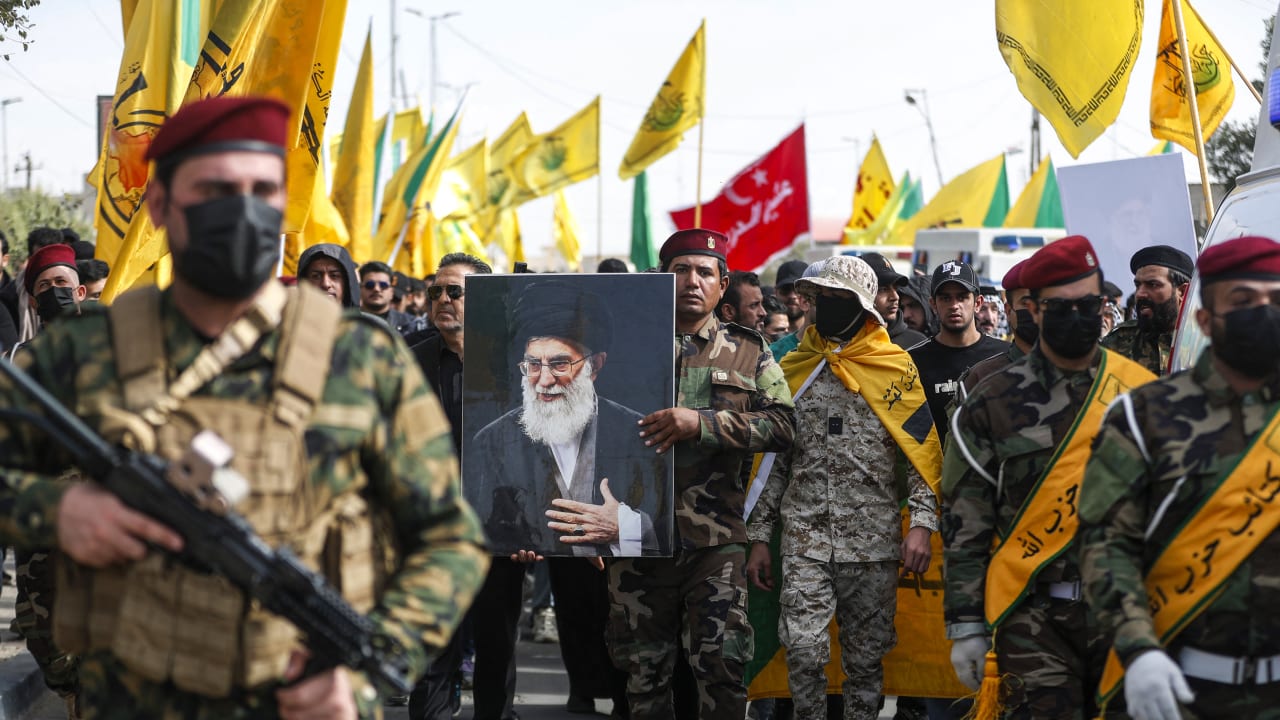

It took five weeks of combined military pressure exerted by Israel and the United States for Iran to yield and eventually agree to a tentative ceasefire. The critical question is why?
The answer is simple: Iran does not fear the West, nor does it fear its own public opinion.
As a brutal authoritarian regime, it slaughters its own people and shows no regard for its population’s suffering.
Iran’s strategy was to bide its time, hoping it could shape outcomes in its favor. It deliberately structured its network of proxies, including Hezbollah and Hamas, knowing the West would separate these terrorist organizations from the state that supports them.
Iran even resisted entering into negotiations with the United States, and set impossible conditions because it had prepared for this confrontation in advance.
Avoiding direct conflict
For decades, Western deterrence against Iran has steadily eroded, and the message in Tehran received was clear: The West prefers to avoid direct confrontation at almost any cost.
A deeper mistake made by the West was in its misunderstanding of the nature of the conflict itself. Many Western leaders continue to view it as a geopolitical dispute.
However, for Iran’s Islamic Revolutionary Guard Corps, a terrorist organization that effectively operates as the ruling power while conducting global terrorism and pursuing nuclear capabilities, this is a jihad – a religious war aimed at imposing a radical interpretation of Sharia law worldwide.
This makes the threat inherently global.
Yet across Europe, there remains a reluctance to acknowledge this reality. The prevailing assumption is that engagement, restraint, and careful diplomacy will moderate Iran’s ambitions, and that if tensions are managed and provocations avoided, the regime may eventually recalibrate its goals.
What is consistently overlooked is that such an approach does not reduce Iran’s threat but rather extends the timeline. It allows Iran to strengthen, expand, and entrench its capabilities.

This dynamic does not go unnoticed. The radical Sunni axis is watching and drawing conclusions. So, too, is the broader global alignment of powers, including Russia, China, North Korea, and others, observing what amounts to a real-time strategic experiment. The lesson they are absorbing is that the West struggles to respond decisively when faced with sustained, coordinated military pressure.
Threat to Europe
The regime in Tehran, driven by extreme religious ideology, is known for its persistence and willingness to pay costs far beyond what is acceptable in Western strategic thinking, all in the name of Allah.
The objective is perceived as absolute, and the path toward it can be long and patient, rooted in the Islamic principle of “sabr,” or endurance.
The Battle of Khaybar in 628 CE, which continues to serve as a guiding historical reference for the Iranian regime, illustrates this approach: Temporary agreements with the enemy are used as a means to regroup, strengthen, and prepare for the right moment to attack.
This is precisely how Iran has operated for decades. It built a vast network of proxies and terrorist organizations, accumulated military capabilities, and waited patiently.
The Hamas attack on Israel on October 7, 2023, was not an isolated event, but rather the manifestation of a long-term Iranian strategy that had been developing for years.
The threat is not limited to Israel. In 2015, British authorities uncovered tons of ammonium nitrate linked to Hezbollah, Iran’s primary proxy, stored in the outskirts of London. The material had been concealed in thousands of commercial ice packs, similar to those that contributed to the devastating 2020 explosion at the Beirut port.
This was not an isolated incident, but rather a clear indication that Iran’s terror infrastructure extends deep into Europe, serving as a strategic lever against Western governments.
And yet, when the West responds with caution instead of determination and resolve, Tehran does not interpret it as responsible policy, but as weakness to be exploited.
Even amid the recent war, the Iranian regime did not consider the increased military pressure from Israel and the US as sufficiently decisive or threatening. If the objective is to force a fundamental change, then the pressure must be intensified, expanded, and transformed into a unified international effort.
History has already provided the model. Just as the free world mobilized collectively against Nazi Germany during World War II, confronting a regime that refuses to yield requires overwhelming and coordinated force.
Only sustained and credible military pressure can dismantle such a threat and create the conditions for meaningful change, including the possibility of regime transformation.
Divisions within the Western alliance only reinforce Iran’s position. The United Kingdom, under Prime Minister Keir Starmer, made it clear that it was not willing to be drawn into a direct war with Iran, even after its bases in Cyprus were attacked and despite a formal request from the Trump administration to join an offensive coalition. This continued reliance on restraint and political arrangements further eroded deterrence, not only against Iran but against other adversaries observing Western behavior in real time.

Throughout the five week conflict, France pursued arrangements with Iran that allow its vessels to pass through the Strait of Hormuz. Rather than stabilizing the situation, such agreements signaled to Tehran that even under pressure, Europe remained willing to accommodate its interests. This only strengthened Iran’s confidence.
It is not merely a tactical issue: it is a test of alliances. It raises fundamental questions about Europe’s position toward Israel and the US, and about its willingness to confront a regime that poses an escalating threat.
The limitations of diplomacy are evident. Agreements and ceasefires, including those involving Hezbollah and Iran, have repeatedly resulted in recovery, rearmament, and preparation for the next round of conflict. It is likely in the most recent case too.
Careful balance
Israel, as a small state with limited resources, cannot afford to be drawn into endless cycles of confrontation. It must maintain a careful balance: upholding its moral commitment to minimize harm to innocent civilians, while at the same time refusing to accept ongoing attacks on its civilian population and the paralysis of its home front.
This reality cannot be sustained. Just as Israeli civilians cannot be expected to live under constant threat, it is unreasonable for normalcy to persist in environments from which such threats originate.
The often-made distinction between Hezbollah and Lebanon, or between the Iranian regime and the Iranian state, does not hold in strategic terms. A state that enables, hosts, or integrates terrorist actors cannot be entirely separated from their actions.
Ultimately, populations living under regimes that export terror bear a degree of responsibility to demand change from within. If they do not, international pressure, within the bounds of international law, becomes a necessary tool. It is not plausible for a government that includes elements of Hezbollah to simultaneously claim helplessness in confronting it.
Israel cannot be expected to bear the highest cost indefinitely in order to shield others from the consequences of terror originating in their own territory. This approach reflects a flawed conception of conflict. Historically, wars have not been won under such constraints.
Equally important is the internal discourse within the West. Statements suggesting that Iran or Hezbollah cannot be defeated carry strategic consequences. Adversaries listen. When such narratives take hold, they reinforce the perception that even their opponents lack belief in victory.
Perhaps the time has come to remove the constraints and act with the level of resolve required to change the equation. Regimes that do not fear consequences do not yield to agreements – they yield under power and clear defeat.■
Danny Ayalon is a former Israeli deputy foreign minister, Knesset member, and ambassador to the US.
Moran Alaluf is an analyst on Middle East affairs and counterterrorism, and a specialist on Iran and Hezbollah.