


In the central display cabinet of a small but focused exhibition at the Israel Antiquities Authority’s (IAA) new headquarters in Jerusalem sits a collection of shiny gold, silver, and bronze coins.
Some date back to a time when people in this area traded in nuggets of precious metals; others are so rare that they are valued at up to a million dollars and are eagerly sought by collectors and purveyors of ancient artifacts.
Yet, for archaeologists, this impressive cache is worth practically nothing because it was recovered from stolen loot being traded on the black market.
“It’s all very beautiful, but archaeologically it’s worth nothing because it was removed from its original place, and now I don’t know its story,” Amir Ganor, director of the IAA’s robbery prevention division, told The Jerusalem Report during a recent interview.
“If I had found it in the ground, I would know from which period it is; I would know exactly what it belongs to; it would tell me its historical story,” he explained. “Right now, it’s just a beautiful object.”
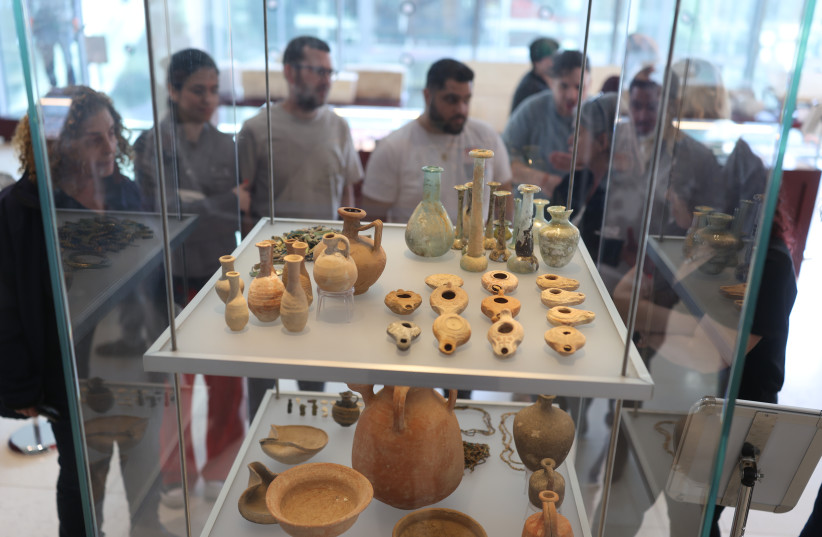
Ganor makes similar assertions about other artifacts on display here – ancient jewelry, makeup brushes, ornate weaponry, various types of pottery, and ossuaries of different shapes and sizes. All, he says, were tracked down diligently – sometimes covertly – by his unit and returned to the IAA for safekeeping and research.

“You see these spearheads? These are Philistine spearheads. They are made of lead, from 1500 BCE,” he said, pointing to a set of swords and daggers. “They were found in a burial cave in the Ela Valley area.”
Ancient graves, Ganor said, are “like a supermarket... If you open the door and the ceiling doesn’t collapse, you enter a room and can collect all the things from the shelves.
“In ancient burial caves, no matter the period, people were buried with objects meant to accompany them to the afterlife. So inside a burial cave, we can find around 1,500 vessels. Multiply each such vessel by $600; or if it has an inscription, its value can reach $100,000. These are what the looters are looking for.”
Decades of looting
The story of stolen antiquities in Israel is almost as old as the items themselves – and for decades, Ganor has been on the trail of criminal gangs trying to steal them.
Perhaps the most famous case of antiquities theft is the Dead Sea Scrolls, first found by a Bedouin shepherd in 1947 in a cave in Qumran and later recovered and acquired by Israeli archaeologists, including Yigael Yadin.
Today, Ganor, who has a long memory for missing artifacts, does something similar. With assistance from the Israel Police, the IDF, the Shin Bet (Israel Security Agency), and Interpol, he employs both covert and overt tactics to track down stolen goods and recover them from thieves, wealthy collectors, and even museums worldwide.
He described the criminal gangs as a series of rings. At the center are looters who trawl archaeological sites for the treasures, followed by the dealers who finance them, and the wealthy collectors who ultimately buy the goods.
“It’s Jews, it’s Arabs, and it’s also internationals because Israel is a source country for antiquities, and the antiquities that are looted here can reach a museum in the United States as well,” Ganor pointed out.
Additionally, Israel, as the only country in the Middle East where the law allows some level of antiquities – items discovered prior to 1978 – to be bought and sold, has also become a trafficking highway, with items smuggled in from across the region and out to Europe and beyond.
Reliable sources
Ganor pointed out a small clay lamp in one of the display cases in the exhibition.
“This lamp is pure intelligence work. I received information from a source that there was going to be a smuggling attempt at the border with Jordan. He told me there was something being smuggled in, in a red Toyota Prius, so I went and waited at the [border] crossing,” he recounted.
When the red Toyota Prius pulled up, Ganor told the border guards to search it.
“They dismantled the car and found nothing, but I insisted that there was definitely something in it. Then they took out the radio tape, and behind it was this lamp,” he said, describing how someone had paid upward of $250,000 for it – even though it ultimately turned out to be a forgery.
“If it was real, it would be worth millions,” Ganor chuckled.
Ganor estimates there are some 40 individuals who deal in antiquities, most of them based in Jerusalem. But, he said, the law forbids dealers from purchasing items not already logged in an existing antiquities database.
Part of his unit’s work is to “constantly monitor what they [the dealers] are putting into their inventory,” Ganor said, noting that while it is challenging, his team has had some success.
“When I started my job, I would enter an antiquities dealer’s shop and see a box of clay lamps that still smelled of earth. I would ask, ‘Where are these clay lamps from?’ The dealer would say, ‘I bought them yesterday from Muhammad in Shuafat.’ Now go find Muhammad in Shuafat,” he said.
“Today, however, he [the dealer] cannot buy from Muhammad in Shuafat because we changed the law in 2002. Now a dealer can only buy from another dealer who is registered with the Antiquities Authority,” Ganor explained.
Raising awareness
But the road to ending antiquities theft is long, and trade remains very active. Ganor said there are around 400 attempted thefts every year and roughly 60 to 70 gangs. Every year, around 150 people are caught red-handed and, if found guilty, can be sentenced to up to five years in prison.
Mostly, it’s the low-level thieves who are caught in the act, as the IAA unit tours the country looking for signs of looting or assigns guards to watch specific sites.
“We also follow social media networks and the dark Web, looking for clues,” Ganor said. “There are people who constantly reappear, in the end; the ones who create the demand for these antiquities are the millionaires and museums.”
While the IAA exhibition raises public awareness about the phenomenon, the main goal, Ganor said, is to rally Israeli lawmakers to create legislation making it much harder to steal the country’s historical treasures.
One of the ways, he said, is to ban metal detectors, or at least have users registered with the authorities. But such a step would not stop all thefts.
Among the items on display at the IAA center is loot from ancient ships wrecked off the Mediterranean coast – an area Ganor described as “lawless.” The techniques used in underwater thievery highlight just how organized and methodical some of the criminal gangs are.
“We intend to make legislative changes to the Antiquities Law so that it will help us fight the phenomenon of antiquities looting more effectively,” Ganor said. “Essentially, it is a bad phenomenon that destroys antiquities sites and causes irreversible damage.”■