
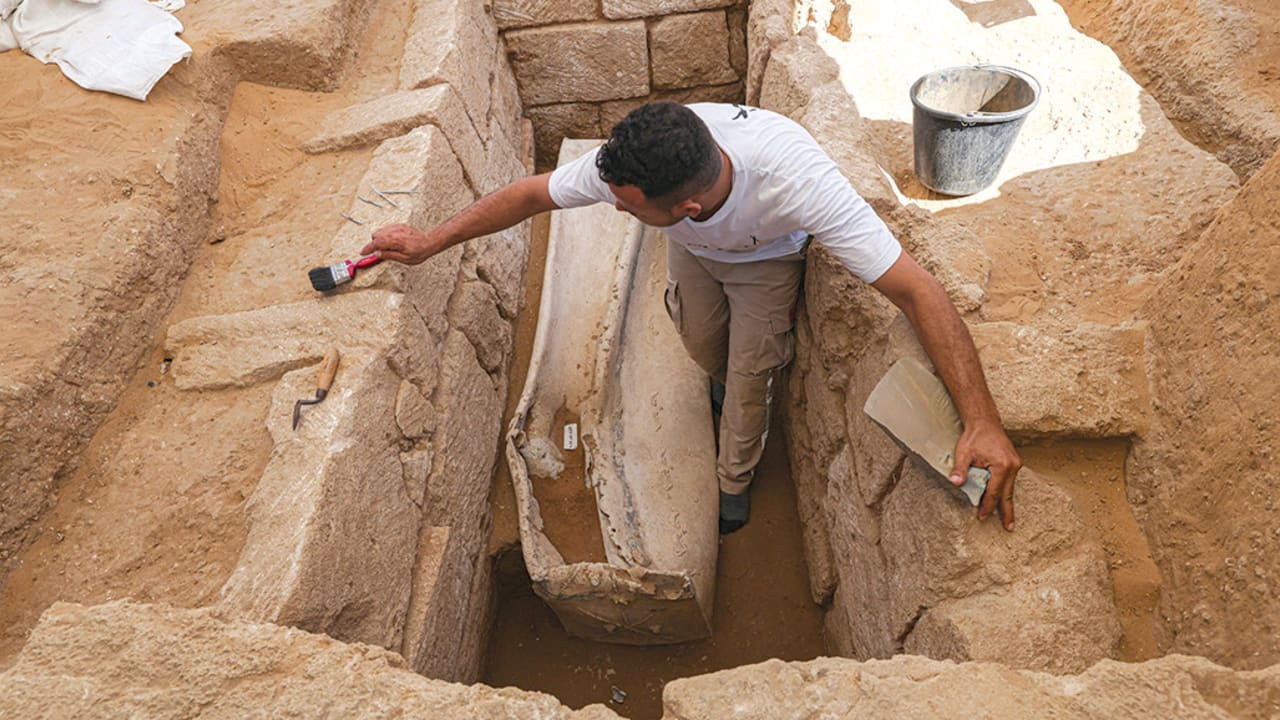

Archaeologists know that political borders are not the same as cultural borders; antiquity was marked by the ebb and flow of peoples across the landscape.
At no time was the land between the Mediterranean Sea and the Jordan River a homogeneous entity. At no time did everyone speak the same language or worship the same gods. But archaeology, strange as it may sound, is not about the past. Archaeologists are of the present, and what they uncover are the present remains of a multitude of pasts.
Because of this – and because the buried remains are considered the heritage and cultural wealth of the communities and nations that are the present inhabitants of the land – international law has long established that antiquities cannot be disentangled from the place in which they are found. Each modern state should care for the antiquities within its borders, for the benefit of its own inhabitants and for humanity at large.
In the age of empires, powerful states had license to rob the weak and poor and extract whatever they chose from wherever they could. Museums in the metropolitan centers of the West were stuffed with looted antiquities, where many remain to this day.
In addition to brute force, the imperial claim to antiquities was given a moral justification: The West is the heir to all earlier civilizations, it was said, and only the West can be trusted with the care of the world’s antiquities.
International law
In the wake of the two World Wars – which proved that “civilization” was no guarantee against barbarity and that the treasures of the world were no safer in the bombed-out museums of Europe than they were in their countries of origin – a new international order was established.
It allowed oppressed and colonized people the right of self-determination and ensured that each modern nation controlled its own natural and cultural resources. This was the order that created the State of Israel and gave it jurisdiction over more than a million years of cultural remains in its soil: Jewish, Christian, Muslim, pagan, prehistoric, and everything in between.
This is the same order that determines that Israel cannot legally extract antiquities from lands beyond its borders – in Jordan, Lebanon, Syria, Egypt, or in the Occupied Palestinian Territories – and vice versa.

In claiming jurisdiction over West Bank antiquities, Israel is defying international conventions and charters to which it is signatory, which together form the basis of international law. These conventions, as interpreted by the courts, state that Israel is an occupying power in the Palestinian areas and that the only permitted archaeological activity is that which is conducted to preserve and protect antiquities for the benefit of Palestinian communities. Because every archaeological excavation entails irreversible destruction, research excavations or the extraction of antiquities for the benefit of the occupier are prohibited. Just as is the case within Israel proper, these rules apply to antiquities of any age or culture.
In a recent Facebook post, Israel’s Heritage Minister, Amichai Eliyahu, uploaded a reel of his visit to the Herodium palace in Jericho, putting up an Israeli flag and declaring: “This is our land. Any place built on the heritage of the Jewish people – we will destroy it.”
By defining all “Judea and Samaria” antiquities as “ours” and extracting and appropriating cultural wealth from the ground, Israel impoverishes the Occupied Palestinian Territories. It reduces the Palestinians themselves to the status of strangers in their own land.
In recent years, this has served as a preface to ethnic cleansing. Less than a week after Eliyahu made his statement about “destroying” anything built on our heritage, Israeli settlers from the illegal Palace Farm outpost demolished 13 Palestinian houses in a nearby suburb of Jericho, claiming that they endangered antiquities.
Archaeological excavations across the West Bank, in places such as Susiya, Otniel, Auja al-Foka, and Fasa’il (to name but a few), have foreshadowed the destruction of dozens of Bedouin hamlets and the expulsion of their inhabitants from the southern Hebron Hills and the Jordan Valley. An archaeological park in Jerusalem threatens 100 homes in Silwan.
Jewish excavations
Israel’s archaeologists are routinely recruited by the settler movement to lay the groundwork for an ideological claim – that the only valid attachment to the past and to antiquity is that of the Jews.
In October 2025, Ezri Tubi from the settlement of Izhar in the northern West Bank, proudly declared in a social media post that Jewish boys from a nearby yeshiva, as opposed to “Arabs,” were now carrying out excavations at a local archaeological site.
“This week, I arrived at one of the new farms that was established a month ago … overlooking the city of Jenin, and thanks to it, archaeological excavations have begun at the site,” he wrote, adding, “Only this time, unlike the usual practice … where excavations are carried out by Arabs, this is the first time that the excavations are being conducted by Jews – boys from the Regavim Yeshiva in Binyamin.”
Palestinians, as far as Israel is concerned, have no heritage, nor may they claim any connection to the past. This is why Jewish youth were called in to excavate at the outpost on Har Bezeq instead of “Arabs.” This is why volunteers wear T-shirts issued by the Archaeological Staff Officer bearing the legend hafira ivrit, or “Hebrew excavation.”
An administrative weapon
Archaeology is also wielded as an administrative weapon in the West Bank and east Jerusalem. With as many as 6,000 archaeological sites in the database, legal restrictions on construction and development – as well as claims of damage and looting – are used to demolish Palestinian homes and constrain economic growth (in Israel, sites are routinely examined and, if necessary, removed to allow development).
A common Israeli claim is that Palestinians have “no interest” in antiquities. Beyond perpetuating a racist trope that justified centuries of looting by imperial powers (there are, in fact, hundreds of Palestinian archaeologists), this sentiment fails to recognize that it is Israel’s weaponization of archaeology that has become a threat to Palestinian land and identity. The more we [Israelis] insist that antiquities are ours and only ours, the more we endanger the very sites and artifacts we want to protect.
Only by realizing that the heritage of Israel and Palestine belongs to all who live between the river and the sea will we create the basic conditions for its preservation.■
Rafael Greenberg is professor emeritus of archaeology at Tel Aviv University and member of the board of Emek Shaveh, an NGO advocating for heritage justice.