


Palestinians are conflicted over the Israeli-American military operations in Iran and Tehran’s retaliatory strikes across the region, including against many Muslim Arab states. Both the Palestinian leadership and the public have reacted with a mix of confusion, anxiety, or indifference, as well as with contrasting views that reflect old rivalries between the Palestinian factions.
On the leadership level, Iran’s Palestinian proxies, Hamas and Islamic Jihad, explicitly sided with Iran, denouncing the Israeli-US “aggression,” while the Ramallah-based Palestinian Authority led by President Mahmoud Abbas, which has attempted to garner support from the US, emphasized its alignment with the Arab countries being targeted by the Ayatollah regime.
“We affirm our solidarity with our fellow Arab peoples and their states,” the PA said in an official statement issued on the first day of the war, referring to Saudi Arabia, Jordan, Qatar, Bahrain, Kuwait, the United Arab Emirates, and Iraq.
“We emphasize the full support of the state of Palestine for the measures taken by these states to preserve their security and stability,” the statement said.
The Palestinian leadership made clear that it strongly condemned Iran for violating the sovereignty of neighboring Arab states. However, its sympathy for these countries did not translate into open support for the US-Israeli operations against the Islamic Republic’s regime. Instead, the PA’s official position echoed that of Sunni Arab governments: limiting involvement and calling for de-escalation in the region.
An enduring alliance
Hamas, which has long enjoyed Iranian sponsorship and used it to bolster its military build-up in the Gaza Strip, strongly backed Tehran and mourned the assassination of the supreme leader, Ayatollah Ali Khamenei.
“This Israeli-American aggression is an attack on the security, stability, and sovereignty of the entire region,” the terrorist group stated. “We reaffirm our solidarity with Iran and call on the Arab and Islamic nations to unite and show solidarity to thwart this aggression, which aims to redraw the region according to the occupation’s ambitions to create a ‘Greater Israel’ at the expense of Arab and Islamic lands.”
One Palestinian analyst based in the West Bank explained that the PA has long viewed itself as part of the broader Arab bloc, particularly Egypt, Jordan, and Saudi Arabia.

“For the PA, its own place in the region is clearly tied to the Sunni regional system,” he said.
There have been tensions between the PA and Iran since 2007, when Hamas seized control of the Gaza Strip in a bloody coup. Iran’s financing and support for Hamas has served to increase the divisions between the two Palestinian factions.
PA officials’ frustration with Iran’s backing for Hamas was very clear in the years leading up to the October 7 attack on Israel, with the Islamic Republic’s backing of Hamas-led and other militias in the West Bank not only emboldened the groups to carry out terror attacks against Israel, but also to undermine the PA’s control.
But the weakening of the regime in Iran does not necessarily mean a solution for the Palestinian Authority. A source close to PA officials, speaking on condition of anonymity in order to talk more freely, told The Jerusalem Report that leaders in Ramallah did not believe that an Israeli victory in the war would bring them any closer to establishing a Palestinian state.
“On the contrary, they believe that it is likely to reduce the chances for a state,” the source said. “Palestinian officials are concerned that if Israel wins the war, a Palestinian state would be even less likely.”
According to their view, the source explained, if Israel emerges stronger from the war, it will only gain more influence in the region, thus leaving it less pressured to move in the direction of Palestinian statehood.
“In case of defeating the Iranian regime, Israelis will have more power in their hands and will see little reason to pursue the creation of a Palestinian state,” the source noted.
Uncertainty for Palestinians
After the opening strike on February 28, many Palestinians in the West Bank rushed out of their homes, heading to gas stations or local suppliers to fill up cooking gas cylinders. For them, the biggest concern was not necessarily the threat of missiles flying over their heads.
“We are much more worried about not having gas to cook with. It’s winter now; families are spending more time at home,” Mahmoud, a resident of the Hebron district, told the Report.
This concern has intensified in recent weeks in light of a gas crisis developing in the territory.
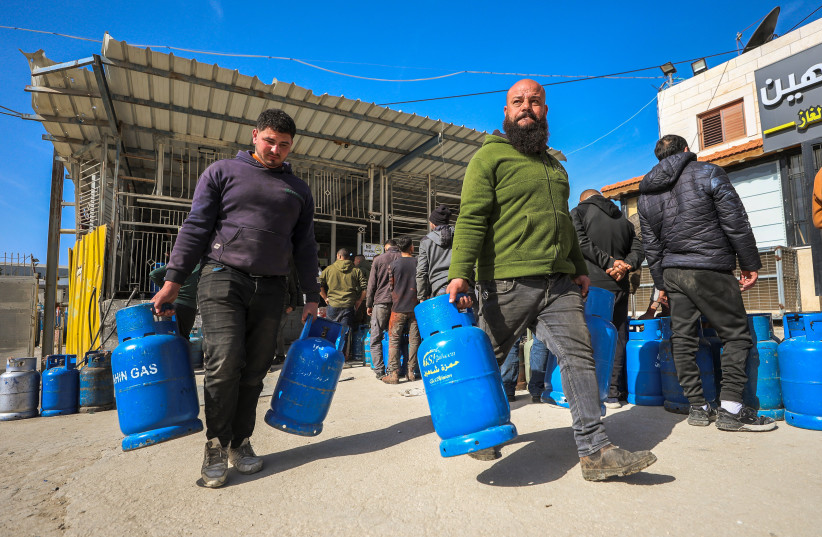
“We are primarily focusing now on how to secure food for our families. That’s the top priority. The war comes after that. People are not thinking about the war every single minute,” Mahmoud, who asked not to use his full name, said.
Yet he, and other residents, pointed out that they have no shelters or safe spaces to go to, and that they rely on the echo of warning sirens from nearby Israeli settlements to know when an attack is imminent.
“We constantly see ballistic missiles being intercepted by Israeli missiles,” Mahmoud described.
“Children didn’t go to school, though some people are continuing their lives as usual,” he added.
“The real worry is what will happen if the war drags on, bringing more restrictions on our movement, and if the crossings [into Israel] are closed – how the transfer of food, gas supplies, and other goods will be affected by that,” he said. ■