
A controversial bill aimed at creating a new civilian authority to oversee antiquities and heritage sites within the West Bank passed its first reading in the Knesset plenum overnight, between Monday and Tuesday.
Twenty-three MKs voted in favor of the bill while 14 MKs opposed it. It will return to the Knesset Education, Culture, and Sports Committee for further deliberation before being presented for its second reading. It must pass three readings in the plenum to become a law.
The West Bank is home to over 2,600 archaeological and heritage sites, the most famous of which include the Cave of the Patriarchs in Hebron, the Qumran Caves in the Judean Desert, and Sebastia (the capital of the ancient Kingdom of Israel) - as well as several Christian and Muslim archaeological sites, including the Church of the Nativity.
The bill, sponsored by MK Amit Halevi (Likud), proposes the establishment of a “Judea and Samaria Heritage Authority” that would operate under the Heritage Ministry in a fashion similar to that of the Israel Antiquities Authority (IAA), and require the appointment of a council and director.
As well, the bill seeks to ensure "a permanent budget for financing the authority's activities within the budget of the Ministry of Heritage."
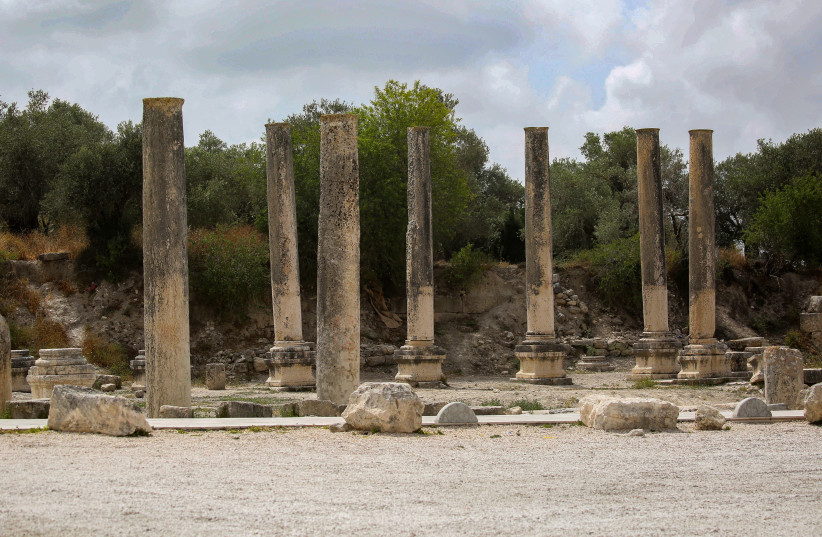
Should the bill pass, it would shift responsibility currently belonging to the Defense Ministry to the Heritage Ministry.
Currently, oversight of the West Bank’s antiquities and heritage sites belongs to the Civil Administration’s Archaeology Unit – a branch of the Defense Ministry’s Coordinator of Government Activities in the Territories (COGAT) - and its staff officer, Benyamin Har Even.
It is responsible for the preservation, management, and development of antiquities and archaeological sites in the West Bank, as well as preventing looting, antiquities smuggling, and illegal excavations in the region.
According to the bill, these responsibilities, as well as the ability to expropriate and acquire land needed for preservation, would be passed to the proposed Judea and Samaria Heritage Authority.
Under the Oslo Accords, Israel’s authority extends only to Area C, where it maintains both civil and military control. For Areas A and B, civil governance falls to the Palestinian Authority, which has its own Culture Ministry overseeing preservation efforts.
Criticism, praise of the bill
Supporters of the bill argue that the bill is critical to protecting antiquities and heritage sites in the West Bank and that without the formation of a formal authority, the risk of them being destroyed rises significantly.
“This is one of the laws that is most important for me to advance here,” committee chairperson MK Zvi Sukkot (Religious Zionist Party) said of the bill in February. “Jewish history is found less on Dizengoff and more in Shiloh.”
“The heritage of the Jewish people today lies desecrated beneath the ground,” he continued, giving the example of Joshua’s Altar on Mount Ebal, saying there is “Arabic graffiti on the altar and people hold barbecues there.”
“Antiquities are being destroyed and disappearing under our hands, almost on a daily basis, and we want to put order to this issue,” Sukkot added.
Critics of the bill argue the opposite, with many claiming the move to be nothing more than another annexation attempt that would place Palestinians residing in the region under Israeli governance.
Ahead of the bill’s approval by the Knesset’s Education, Culture, and Sports Committee in February, committee legal advisor Tami Sella warned that Knesset legislation had never granted such responsibility over the West Bank to a government organization.
“Even in the few cases in which Knesset legislation has addressed the area [West Bank], it has almost always applied personally to Israelis, primarily to create uniformity between the law applicable to Israelis in the area and in Israel,” Sella had said, noting that here, the bill “deviates from the principle of territorial sovereignty.”
“This legislation is not worthy in my view, first and foremost because it is part of creeping annexation,” MK Gilad Kariv (The Democrats) had stated at the time. “The bill uses archaeology as a tool to take over land and expel Palestinians from their homes.”