
Cypriot Foreign Affairs Minister Constantinos Kombos said on Friday that he supports UAE Ambassador Lana Nusseibeh as the next United Nations secretary-general.
Kombos wrote on X/Twitter that he has known Nusseibeh for years, noting that she "is an experienced, highly effective and well-respected diplomat, with an approach focusing on dialogue, compromise and tangible outcomes, while also having a strong track record in supporting multilateralism and the United Nations."
He also noted that it was time for a woman to become the next secretary-general, saying, "it is becoming time-sensitive to ensure that the selection process proceeds."
On Thursday, Gulf Cooperation Council (GCC) Secretary-General Jasem Mohamed Albudaiwi said member states unanimously endorsed the United Arab Emirates' nomination of the ambassador for the position, according to the Saudi Gazette.
This is important as support for Nusseibeh grows, with Albudaiwi attributing the unanimous support to the GCC countries' commitment to strengthening multilateral cooperation and reinforcing the UN's role in maintaining international peace and security in accordance with the principles and objectives of its Charter, the Saudi Gazette reported.
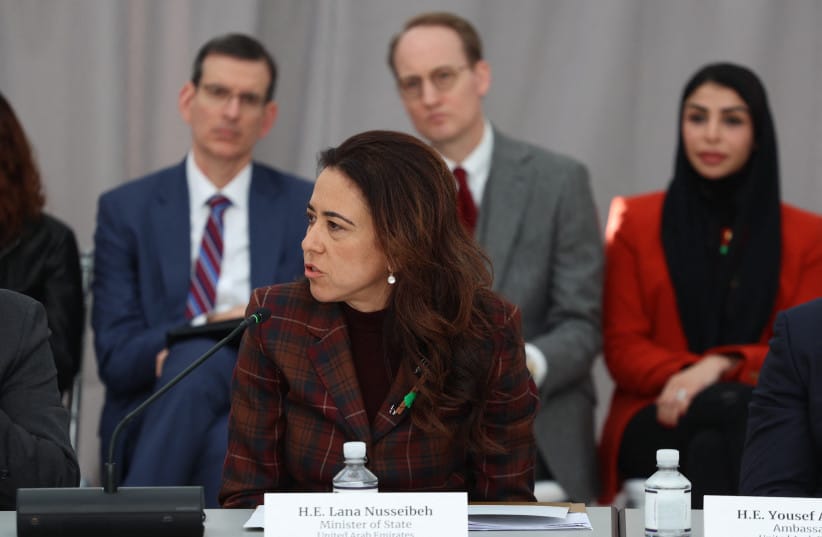
The Maldives, BoP's Nikolay Mladenov support Nusseibeh's nomination
The Maldives said on Sunday that it welcomed Nusseibeh's nomination. In addition, Nikolay Mladenov, who is a key official with the Gaza Board of Peace and formerly served as Bulgaria's defense minister and Foreign affairs minister, wrote on X that "Lana Nusseibeh has always understood that the #UN works when someone is willing to systematically build the bridges nobody else wants to build."
"In the Security Council she did that quietly and consistently and with great professionalism," said Mladenov. "She now has the chance to take that same spirit and ethos to the UN Secretariat. Wishing you courage and strength for the journey ahead and much success!"
Nusseibeh has served as the UAE’s foreign affairs minister and as the UAE’s permanent representative to the UN in New York from 2013 to 2024. She also served for four years as foreign affairs assistant minister for political affairs.
Since the organization was founded in 1945, the UN has had ten secretaries-general, including an acting leader from 1945 to 1946, though some have been more memorable than others. Sweden’s Dag Hammarskjöld, who served from 1953 to 1961, was an energetic leader who sought to achieve a ceasefire in the Congo. He died in a plane crash while on his way to Zambia.
U Thant, who served in the 1960s, was the first non-Western secretary-general. He was followed by Kurt Waldheim in the 1970s. Waldheim was an intelligence officer under Nazi Germany, which made his appointment strange, considering the UN was founded after the defeat of the Nazis. In the 1990s, former Egyptian diplomat Boutros Boutros-Ghali became the head of the UN. He was largely seen to have failed at key moments, such as during the Rwandan genocide.
In the last decades, the UN has seen secretaries-general who appeared relatively ineffectual, such as Kofi Annan, Ban Ki-moon, and current UN Secretary-General Antonio Guterres.
As part of a complex election process, an informal straw poll of officials in the deciding UN Security Council last week gave [former Costa Rican vice president Rebeca] Grynspan a narrow lead over her closest competitors: Guyana’s former Foreign Minister Carolyn Rodrigues-Birkett and Argentina’s International Atomic Energy Agency Director-General Rafael Grossi, Euro News reported.
The report notes that the winner needs at least nine votes from the 15-member UN Security Council without a veto from any of the five permanent members - the US, the UK, France, China and Russia - and they have until the end of December to choose the successor to Gutteres, before the UN General Assembly confirms the appointment.
Euro News also noted other candidates, including former Ecuadorian foreign minister Maria Fernanda Espinosa, former Senegalese president Macky Sall, former UN under-secretary-general Olara Otunnu of Uganda, and Ecuadorian diplomat Ivonne A-Baki.
Nusseibeh currently serving as UN Women Executive Board president
According to a UN biography of Nusseibeh, the ambassador currently serves as UN Women Executive Board president and was recently appointed co-facilitator of the Ad Hoc Working Group on the Revitalization of the UN General Assembly by the General Assembly president.
A website that appears to have been created for her candidacy notes that Nusseibeh is currently on leave from government responsibilities to focus on her UN secretary-general candidacy.
The website also includes a statement attributed to Nusseibeh, in which the ambassador says she is "stubbornly optimistic about the future of our world and the important role multilateralism will play in it."
"I am offering active, hands-on leadership on peace and security: acting earlier, bridging divides and pursuing practical first agreements that save lives now and create space for broader peace," she said, adding that she "will bring that same urgency and focus on results to development and human rights – building a more focused, responsive UN that delivers for the people it serves."
Nusseibeh was born in 1978, is married, and has two children. She has a BA and MA from Queens’ College at the University of Cambridge. She also has an MA in Israeli and Jewish Diaspora Studies from the School of Oriental and African Studies (SOAS), University of London.
Prior to her UN role, she established the UAE Foreign Affairs Ministry's Policy Planning Department in 2009 and served as its first director for three years. She also served as the UAE’s Co-Special Envoy to Afghanistan and Pakistan. She also headed the International Renewable Energy Agency (IRENA) task force at the ministry.
French-language media platform and digital news outlet IsraJ noted Nusseibeh’s important family background, saying her family originally lived in Jerusalem and that her Emirati citizenship came from her father, Emirati President Cultural Advisor Zaki Nusseibeh.
It added details about the family's rich academic and intellectual background and its long roots in Jerusalem and the region, with relative Anwar Nusseibeh having been a prominent figure in Palestinian and Jordanian politics.
Wounded in 1948, Anwar Nusseibeh served as Jordanian Defense Minister and later as Jerusalem Governor under Jordanian rule. After 1967, he conducted discreet contacts between Israel and Jordan regarding the future of the West Bank.
IsraJ further noted that the ambassador's uncle, Sari Nusseibeh, is a former president of Al-Quds University in the West Bank. He wrote several important books, including Once Upon a Country about his family and Palestinian issues.