
There is something both admirable in its intent and a profound detachment from reality in the words delivered on Sunday morning by Pope Leo in St. Peter’s Square. Admirable, because he speaks the language of peace with moral clarity. Detached, because he does so from a place where war is an abstraction, not a lived reality.
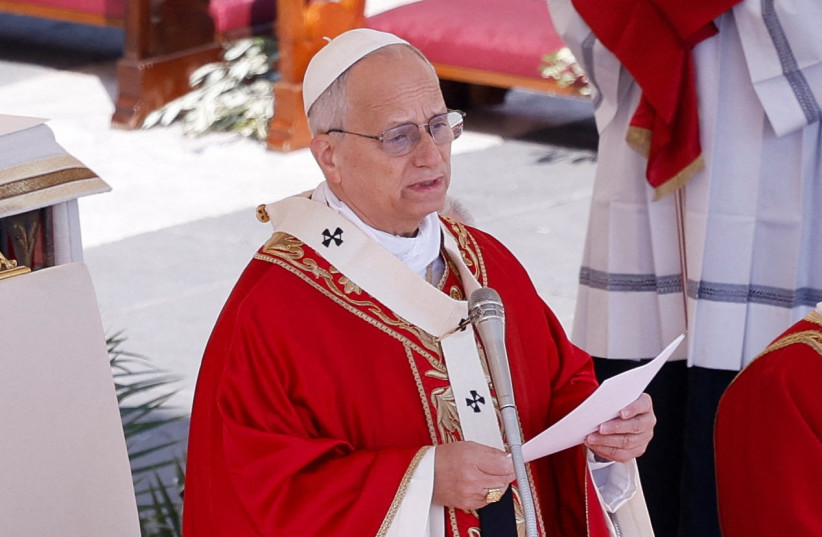
“God rejects the prayers of those who wage war,” the pontiff said, addressing tens of thousands of people in St. Peter’s Square on Palm Sunday, the celebration that opens the holiest week of the year in the lead-up to Easter.
As the conflict with Iran entered its second month, this is a powerful line from the man who is spiritually responsible for 1.4 billion Catholics. It is also one that is received very differently in Rome than in Tel Aviv or Jerusalem, or in the bomb shelters that have become a second home for millions of Israelis.
“[Jesus] does not listen to the prayers of those who wage war but rejects them, saying: ‘Even though you make many prayers, I will not listen: Your hands are full of blood,’” Pope Leo said, citing a Bible passage.
Hands full of blood - But whose hands? And whose blood?
The pontiff did not specifically name any world leaders, but he has been ramping up criticism of the Iran war in recent weeks. The pope, who is known for choosing his words carefully, has repeatedly called for an immediate ceasefire in the conflict.
Some US officials have invoked Christian language to justify the joint US-Israeli strikes on Iran. US Secretary of War Pete Hegseth, who has started leading Christian prayer services at the Pentagon, prayed at a service on Wednesday for “overwhelming violence of action against those who deserve no mercy.”
So, while the pope speaks of hands “full of blood” – whose hands, and whose blood? – we are used to politicians or world leaders uttering the usual statements in times of war, emergency, or disaster.
Phrases or words such as “de-escalation,” “all sides must show restraint,” or “avoid further escalation” are regular sound bites at such times.
But for 47 years, the Islamic Republic of Iran has built, funded, and unleashed a network of proxies whose sole strategic doctrine rests on indiscriminate violence and the destruction of the Jewish state.
From Hezbollah rockets raining down on northern Israel, to Hamas’s October 7 massacre, to terrorist groups in Iraq and Yemen targeting civilians and infrastructure, the story has repeated itself for nearly five decades.
This war has been going on a lot longer than February. And it has not been fought in Vatican City’s St. Peter’s Square.
It has been fought in playgrounds shattered by shrapnel and in the apartment blocks struck while families slept. It has led to Israeli children being left traumatized and suffering from post-traumatic stress disorder due to the air-raid sirens warning of incoming missiles that are designed to kill them indiscriminately.
Rhetorically, how many bombs have fallen on the pope’s children?
Because that is the question that sits unspoken beneath the Vatican’s appeals. The lived reality of those who have spent years under fire is very different from the pope’s experiences.
The pontiff invokes Jesus, who “did not arm himself.” That may be true. But Israel is not a man walking willingly to the cross. It is a country tasked with protecting its citizens – Jews, Muslims, and Christians alike – from enemies who have made no secret of their intent to destroy it.
There is a moral difference between initiating violence and responding to it. Between targeting civilians and targeting those who target civilians. Between a state that warns before it strikes and a regime that celebrates death as a strategy.
The war against Iran is popular among Israelis, despite the deaths and trauma they have suffered, because they understand that the status quo of Iran’s regime of death cannot continue unperturbed, and the chance to remove the regime and replace it with one of peace is too good an opportunity to pass up.
To frame Operation Roaring Lion as the same as the indiscriminate campaigns carried out by Tehran’s proxy network is to misunderstand or ignore the nature of the conflict. Of course, the pope is right about one thing. War is terrible, and innocent people always suffer.
But inaction will only lead to worse. So will allowing a regime like the Islamic Republic to operate with impunity, to arm its proxies, to export instability, and to turn entire regions into battlegrounds.
How is peace achieved?
Peace is often achieved painfully by confronting those who make it impossible.
The pope is a man of faith, and his words carry weight for more than a billion people. But he does not live here. He has no children who are woken in the night by sirens, and they do not run for shelter as rockets fall indiscriminately from the sky.
Nor, it should be said, does scripture sustain the idea that all war exists outside God’s moral realm. The Hebrew Bible is brimming with example after example of the Jews going to war with direct communication with God. Joshua went into battle under divine instruction. Gideon sought reassurance from God before going out to fight. David, before facing the Philistines, asked plainly: “Shall I go up?” and was told: “Go.”
These were Jewish leaders carrying the terrible burden of defending their people. The biblical tradition does not glorify war, but neither does it pretend that peace is preserved by refusing to confront evil. There are times when the greater sin is not to fight but to leave your people exposed to those who would butcher them without a second thought.
It is easy to preach restraint from a place untouched by its consequences. Think of the appeasement of 1938.
The pontiff has noble intentions, and he is a man of peace – even though, for hundreds of years, the pontiffs were often the biggest warmongers in Europe.
But sometimes, the road to peace requires men to take action, and here in Israel, we believe that our God is listening to our prayers – regardless of whether Pope Leo agrees.