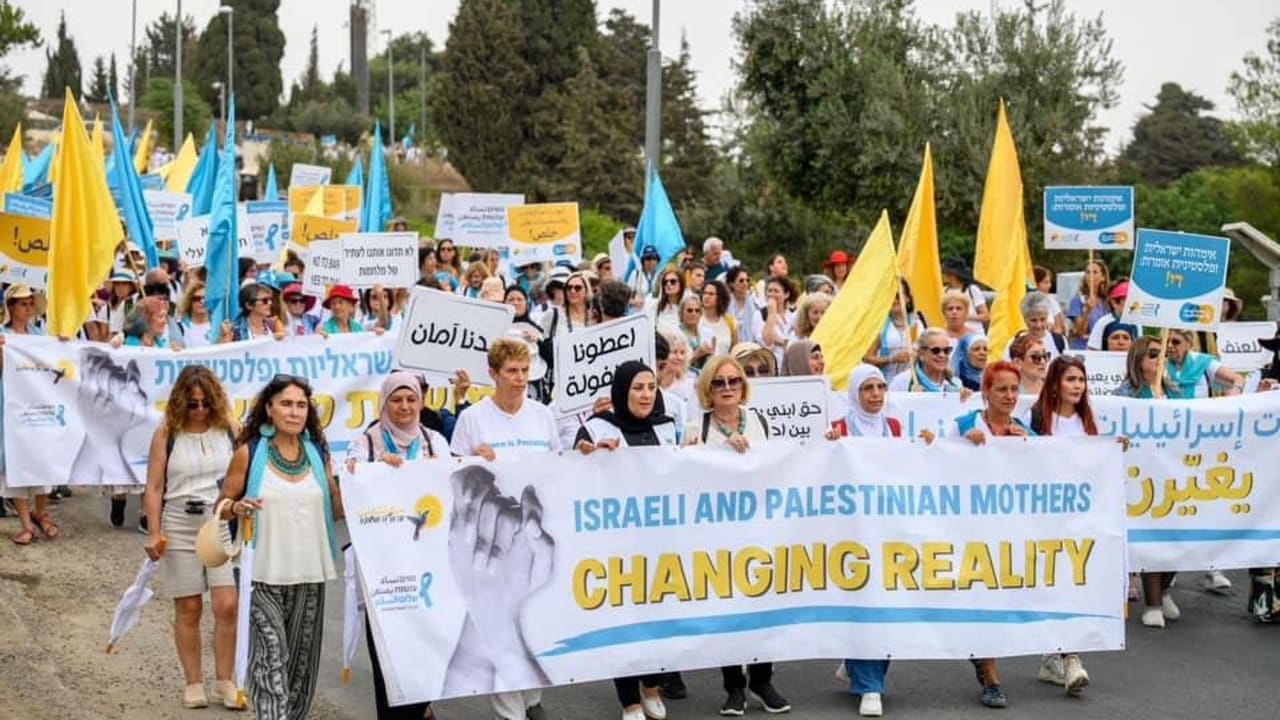
This week, hundreds of women from Israeli and Palestinian peace movements will perform a barefoot walk through Rome, marking the launch of their joint initiative, “The Mothers’ Call.”
Israeli members of Women Wage Peace (WWP) and Palestinian members of Women of the Sun are joining together to demonstrate their dedication to a future of peace and political agreements, which they hope to achieve through women’s participation.
The week’s events include meetings with high-level diplomats in Rome, from meetings at the Italian Parliament to an audience with the Pope, where they will demand “a clear political horizon and a return to civic responsibility,” the WWP stated.
WWP is the largest grassroots peace movement in Israel, with over 44,000 active members. It has been active for 10 years, working to influence decision makers and the Israeli public to opt for peace instead of continued war.
Ahead of the week's events, The Jerusalem Post interviewed WWP chair and co-founder Dr. Yael Admi, WWP co-director Dr. Yael Braudo-Bahat, and WWP activist Orna Ashkenazi.

Importance of acting now
Dr. Admi explained that the group wasn't launching the initiative now because of the war with Iran, but acting “despite this moment.”
She said that “women are often told to wait, that it’s not the time to talk about it, to wait until the war is over - but the war is not over, it keeps coming back.”
The group is advocating for a plan “for the day after,” for when the war will end, so that Israel doesn’t continue to fight in an “endless war,” because they “want Israel to thrive.”
Dr. Admi also explained the significance of the barefoot walk, saying that “we want to feel the ground, it is soaked with the blood of our children, and from that pain and grief, we want to bring hope.”
Ashkenazi shared a personal anecdote about her four-year-old grandson, who lives in Tel Aviv but has been staying with her in Caesarea since the beginning of the war with Iran.
“Yesterday, he said to me, ‘I want home, I want home, I want home’ … I don’t want to have to wait until he is 18 years old and a soldier.” She added that she is marching so her grandchildren can return home safely.
Calling for a ‘political horizon’
These Israeli and Palestinian women are marching together to advocate for a future of peace and prosperity, but they are not advocating for a specific solution. Rather, they are seeking the opportunity to support leaders in the path to peace that they choose.
“The drawers are full of solutions and plans; what we need is courage and will,” said Dr. Admi.
Dr. Braudo-Bahat explained, “We don’t advocate for a specific solution, not because we don’t think the solutions are okay, but because we need to consider not only territories and geography, for it to be sustainable.”
She emphasized the importance of having women around the decision-making tables, saying that the solutions, “one state or two states or whatever, deal with the territories, with where the border will be, with who will control it. When women come to the table … they [hear] the voices of the communities, it’s about the communities - not just about borders.”
She compared it to Northern Ireland and the Good Friday Agreement (GFA) of 1998, which moved the country away from violence and bombings into a post-conflict situation, but notably hasn’t brought it peace.
Dr. Admi acknowledged this failure of the GFA, admitting that “the process of reconciliation and healing the communities is quite demanding and should be taken seriously.”
Message to Israeli and Palestinian leaders
Dr. Braudo-Bahat explained that the group’s message was to “demand the beginning of negotiations and the planning of a political horizon, otherwise we won't be able to survive,” and to insist that “we want to help, we want to be involved, we are the voices on the ground.”
“We are willing to do whatever it takes, so we invite the leaders to be assisted by us.”
Ashkenazi said that Israeli leaders should “see the [peace] agreements with Egypt and Jordan, and see that it’s possible, that peace is possible.”
“People say that we are naive because we want peace. We say naive are the ones who think that doing the same thing over and over again will give them better results,” said Dr. Admi.
“This crisis is an opportunity to give peace, security, and freedom to all children in our area.”