
Rabbi Sholom Duchman
For nearly half a century, Rabbi Sholom Duchman has quietly built one of Israel’s most consequential humanitarian networks.
In 1978, when Duchman was just 25, the Lubavitcher Rebbe, Rabbi Menachem Mendel Schneerson, personally entrusted him with the leadership and expansion of Colel Chabad. The responsibility carried extraordinary historical weight: Founded in 1788 by Rabbi Schneur Zalman of Liadi, the first Chabad Rebbe, Colel Chabad is Israel’s oldest continuously operating charitable institution.
What Duchman built from that mandate is remarkable.
When he assumed responsibility, Colel Chabad was a comparatively small operation whose entire donor record could fit into a single box of index cards. Today, under his leadership, Colel Chabad provides approximately $200 million every year in direct aid and chesed (acts of kindness), operating one of Israel’s largest and most diverse social-welfare networks.
Its reach spans virtually every stage of life: food security for struggling families, soup kitchens and Meals on Wheels, support for Holocaust survivors and the elderly, daycare, medical and rehabilitation facilities, assistance for people with disabilities, weddings for couples in need, and long-term care for widows and orphaned children.

Central to Duchman’s approach is a conviction that charity must preserve human dignity – and that helping people at scale requires building permanent systems, not merely responding to individual crises.
That philosophy proved especially consequential after October 7. When Israel suddenly faced unprecedented humanitarian needs, Colel Chabad already had the kitchens, warehouses, personnel, government partnerships, and nationwide distribution infrastructure necessary to mobilize immediately and deliver assistance at scale.
Duchman’s influence also extends to the broader Chabad-Lubavitch movement. He sits on two of the three boards of Chabad’s umbrella organizations, including Machne Israel, its social-welfare arm, and Merkos L’Inyonei Chinuch, its educational arm, which oversees Chabad’s global network of emissaries and educational institutions. These roles place him among those entrusted with responsibility for some of the movement’s most central institutions.
Yet Duchman’s influence is perhaps best understood not through titles or headlines but through impact.
For nearly five decades, he has transformed a historic charity into a modern humanitarian infrastructure delivering some $200m. in chesed annually. His influence can be measured in institutions built, systems transformed, and hundreds of thousands of lives touched.
What began as an assignment from the Rebbe to a 25-year-old has become one of Israel’s largest and most enduring networks of chesed.
Rabbi Dov Landau
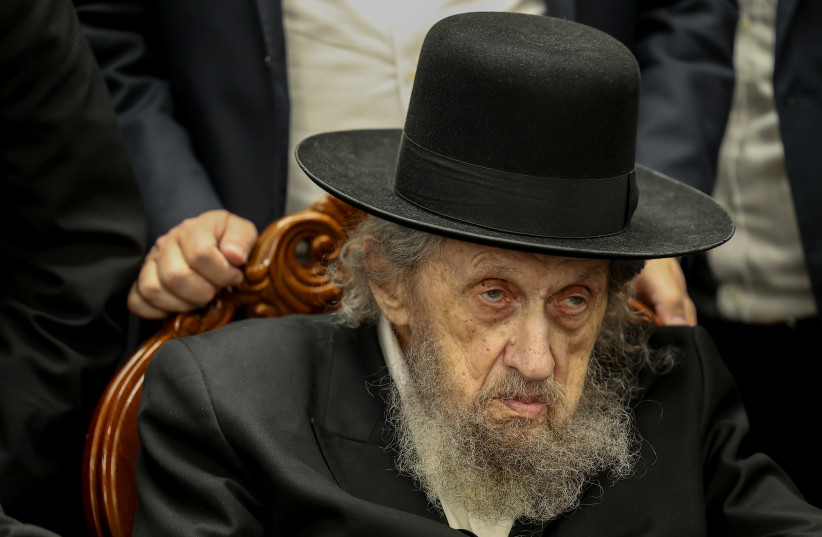
An avid anti-Zionist and pillar of ultra-Orthodoxy, Rabbi Dov Landau looms over Israel and the haredi (ultra-Orthodox) Jewish world.
Landau heads the Slabodka Yeshiva in Bnei Brak and the Council of Torah Sages for Degel Hatorah, the Lithuanian faction of the United Torah Judaism (UTJ) party. In this capacity, he has a major say in the party’s policies and actions.
This became especially clear over the past year, when his long-running fight over the drafting of yeshiva students into the IDF reshaped Israeli politics. Having threatened to force his party from the government, in July 2025 he did just that, pulling UTJ from the coalition and leaving Netanyahu with a razor-thin majority. The rupture deepened in May 2026, when Landau ordered Degel Hatorah’s lawmakers to dissolve the Knesset, declaring that he no longer had confidence in Netanyahu. Parliament dissolved that July, sending Israel to elections in October 2026 — the first Knesset in decades to serve out its full term.
The 96-year-old Landau has been extremely vocal in his opposition to the haredi draft and Zionism, having called for Arabs to rule over Israel as well as the withdrawal of all haredim from Zionist organizations. In the wake of draft dodgers being arrested, he and other haredi leaders declared that the State of Israel had “declared war on Torah scholars” and called for a global resistance.
With a legion of followers and the authority to back it up, Landau’s influence – for better or for worse – is undeniable.
Rabbi Ephraim Mirvis
Sir Ephraim Mirvis, UK Chief Rabbi, has been one of the most visible Jewish leaders of the past year, repeatedly stepping into moments of crisis and controversy. As one of the world’s most prominent Orthodox rabbis, he emerged as a fierce critic of the Labour government’s foreign policy. When former prime minister Keir Starmer announced in mid-2025 that Britain would recognize a Palestinian state, Mirvis condemned the move as a “profound betrayal,” warning that recognizing statehood while Hamas held power and hostages remained captive would only reward terrorism and undermine peace. When recognition proceeded that September, he branded it a “historic error of foreign policy.”
His warnings took on tragic resonance in October 2025, when a terrorist attacked the Heaton Park Hebrew Congregation in Manchester on Yom Kippur, killing two worshippers. Mirvis called it “the day we hoped we would never see, but which, deep down, we knew would come,” linking it to an “unrelenting wave of Jew hatred” and urging authorities to confront inflammatory street demonstrations.
Mirvis also carried his leadership abroad. Following the December 2025 Bondi Beach mass shooting at a Hanukkah gathering in Sydney, he traveled to Australia on a solidarity mission, returning again in March 2026 to comfort survivors, rededicate the Great Synagogue, and meet community leaders amid rising antisemitism. Throughout, he balanced these high-profile interventions with quieter pastoral work in his own community.
Across a turbulent year, Mirvis embodied the vital role of pulpit leadership – offering comfort, moral clarity, and an unflinching public voice when his community needed it most.
Rabbi Rick Jacobs
As president of the Union for Reform Judaism, Jacobs leads the congregational arm of Reform Judaism – some 850 synagogues and well over a million affiliated Jews across the US and Canada, making it the continent’s largest Jewish denomination.
Over the past year, he has been an outspoken public voice at a turbulent moment. He confronted the Evangelical Lutheran Church over a resolution he called one-sided on Israel, pressing a “both/and” case for supporting Israel while defending Palestinian rights. He issued sharp statements on rising antisemitism, synagogue attacks, the war with Iran, and New York politics, and pushed his movement’s democracy and civil-rights advocacy through the Religious Action Center.
Rejecting “managing decline,” he has called for a Reform renaissance – expanding teen engagement through a new BBYO partnership and reorienting the movement toward growth, spiritual depth, and moral clarity.
Rabbi Mendy Kotlarsky
As executive director of Merkos 302 – the innovation and research hub of Chabad-Lubavitch – Kotlarsky sits at the operational center of a network reaching Jews in more than 110 countries. Since succeeding his late father, Rabbi Moshe Kotlarsky, at the helm of the International Conference of Shluchim (Kinus Hashluchim), he has driven a “Judaism on the offense” strategy centered on Jewish pride, education, and rapid growth.
This past year, he steered ambitious Keren Hashluchim (funding) campaigns for new emissaries and mikvaot worldwide, expanded the Merkos Torah kollel network, and oversaw the rollout of new digital tools, including a Messiah-focused learning app launched at the annual conference. He remains a fixture at regional gatherings from London to Taipei, guiding thousands of emissaries navigating antisemitism, campus outreach, and AI-era challenges. Recognized on the Algemeiner’s J100, Kotlarsky has become one of global Jewry’s most consequential institutional leaders.