
For Rabbi Dr. Yakov Nagen, the saying “All roads lead to Rome” has more than a casual meaning.
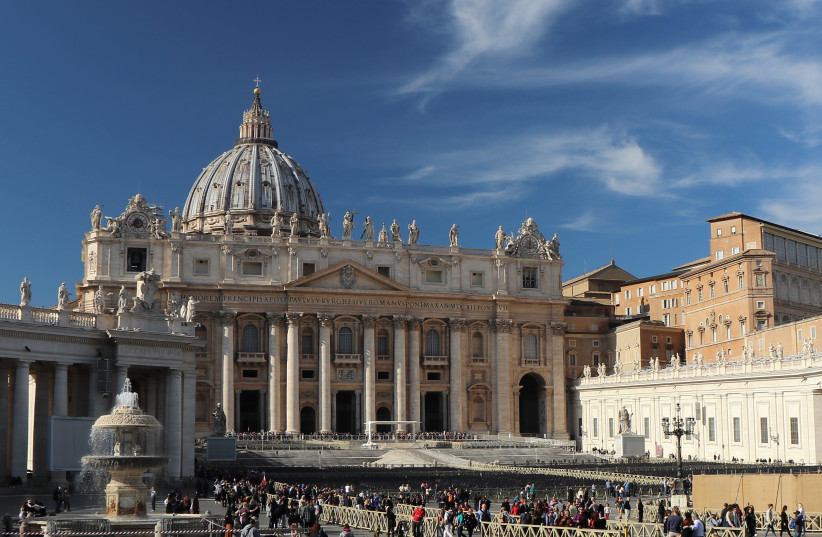
In October, Nagen, director of Ohr Torah Stone’s Blickle Institute for Interfaith Dialogue and head of its Beit Midrash for Judaism and Humanity, was walking through the streets of the Italian capital, proudly wearing his tallit (prayer shawl) and tefillin (phylacteries), on his way to the Vatican to celebrate the 60th anniversary of Nostra Aetate (Latin for “in our time”), the declaration of the Catholic Church in 1965 that revolutionized its attitude toward Jews and Judaism.
Nostra Aetate was part of Vatican II, the ecumenical council convened in 1962 by Pope John XXIII, which concluded three years later under his successor, Pope Paul VI. The declaration consisted of three main elements: the formal rejection of the accusation that the Jews had killed Jesus; the Church’s statements regarding the positive aspects of Judaism and other religions; and a condemnation of antisemitism.
What is the significance of Nostra Aetate that brought Nagen to Rome, together with three members of his beit midrash (study hall)? “Sixty years ago, there was a mega change in the Catholics’ approach to Jews and Judaism,” he explains.
“We’ve forgotten history and don’t realize how bad things were,” Nagen says. “Until Nostra Aetate, they believed in the collective responsibility of every Jew for killing God; and as a result of being cursed by God, they recited prayers on Good Friday for the ‘perfidious’ Jews to convert. It is inconceivable how bad things were.”

Rewriting a painful history
The Church’s about-face from its long-standing anti-Jewish positions is credited to French-Jewish historian Jules Isaac (1877-1963) and to Pope John XXIII (1881-1963), who served as pontiff from 1958 until his death in 1963. Isaac survived the Holocaust, but his wife and daughter perished in Auschwitz. He sought to discover the roots of the antisemitism that had swept through Europe in the 19th and 20th centuries, tracing it to early Christian texts that blamed Jews collectively for the death of Jesus and viewed Judaism as a failed relationship between God and humanity.
The pope, who had saved thousands of Jewish lives during World War II while serving as an archbishop in Istanbul, read Isaac’s work and met with him in 1960. The historian persuaded the pope to place the issue of anti-Jewish behavior in Christianity on the agenda of the Second Vatican Council. Though neither Isaac nor Pope John was alive when Nostra Aetate was issued, it was largely shaped by their influence.
After 1965, the Catholic Church’s position toward Judaism became more favorable. In 1979, John Paul II became the first pope to visit Auschwitz, and in April 1986 he became the first pope to visit the Great Synagogue of Rome. In 1993, the Vatican recognized the State of Israel, and in March 2000 John Paul visited Israel on a five-day trip, becoming the first pope to visit the Western Wall.
He inserted a handwritten note into the crevices of the wall that read, “God of our fathers, You chose Abraham and his descendants to bring Your Name to the Nations: We are deeply saddened by the behavior of those who in the course of history have caused these children of Yours to suffer, and asking Your forgiveness, we wish to commit ourselves to genuine brotherhood with the people of the Covenant.”
Why Nostra Aetate still matters
Ten years ago, on the 50th anniversary of the issuance of Nostra Aetate, the Vatican’s Commission of Religious Relations with Jews (CRRJ) issued a major document titled “The Gifts and the Calling of God are Irrevocable,” affirming God’s covenant with the Jewish people, exploring ways of combating antisemitism, and ending missionary work to convert Jews. As Nagen explains, the document stated that “Jews do not have to accept Christ or become Christian. Therefore, the missionary work to the Jewish people was canceled because [it] is for those who need salvation, but the Jews have their salvation.”
Nagen recognizes that 60 years after its issuance, Nostra Aetate has little meaning or relevance for most Jews in their daily lives. Many have never heard of the declaration. However, for Christians, it remains a landmark document.
“The issue of relations with the Jewish people is profoundly significant for Christians,” says the interfaith dialogue director. “It could lead to love, it could sometimes lead to hatred, but it won’t be indifference. Jews are often indifferent to Nostra Aetate, but for the billions of Christians in the world, there’s an understandable obsession with the Jewish people.”
For Christians, he explains, the relationship with the Jewish people is profoundly significant because Jesus and his disciples were Jewish, and the core book of their faith is the Tanach (Hebrew acronym for Torah, Prophets, and Writings).
Dialogue as a Jewish responsibility
Nagen avers that Jews need to be aware of the significance of Nostra Aetate. “We have to be there, and we have to be part of the process,” he says. “Some may say that it isn’t our issue and that it is their problem. But it is our issue because we live in a global world. My personal belief is that part of the vision for humanity is, as we say in the Aleinu prayer, one of humanity together calling in the name of God.
“So I feel that, in terms of a Jewish prayer and a Jewish vision, it is important to be in contact and dialogue to create a vision of the verse in Zephaniah (3:9), which reads, ‘For then I will convert the peoples to a purer language, that they may all call upon the name of the Lord, to serve Him with one shoulder.’”
Nagen says that because Jews are part of society, they need to retain contact with the Christian world. “We’re in a global society – and in order to survive, we can’t alienate people, and we have to work on building bridges. There are billions of Christians in the world. We have to be there, both to build stronger bridges and to speak out against places where the old patterns persist.”
On Monday morning, October 27, the first day of the conference, Nagen himself experienced the “old pattern” of antisemitism while attending a lecture at the Pontifical Gregorian University in Rome titled “Nostra Aetate: A Theological Understanding,” delivered by Swiss Jesuit Mario Imperatori, who teaches at the Southern Italy Faculty of Theology in Naples.
Calling the lecture “viciously antisemitic,” Nagen says that Imperatori compared the Nazi extermination of the Jews of Europe to Israel’s conduct in the war in Gaza. He accused the Jewish people in Israel of “false messianism,” identifying this with the seduction of Satan in the New Testament. “This brings us back to the identification of Jews and Satan of Christian antisemitism,” says Nagen.
In response, he stood up before the other attendees and said, “I traveled from Jerusalem for this event with a heart filled with love and filled with hope. Instead, I fear that I will return to Jerusalem with a broken heart and with tears.
“Our great hope from Nostra Aetate was that after so much suffering, we could overcome the demonization of the Jewish people that led to all these horrors,” Nagen said. “At a conference devoted to Nostra Aetate, referring to the State of Israel, where the Jewish people are fulfilling their deepest aspirations, as false messianism and ultimately equating this with Satan has brought us back to the dark times.”
Moments of reconciliation
On the second day of the conference, Nagen attended an evening event in the massive Vatican auditorium that hosted thousands of religious leaders from around the world. Pope Leo XIV was in attendance, as was Cardinal Kurt Koch, head of the Vatican’s Commission for Religious Relations with the Jews. “They spoke beautifully about the special connection of the Church and love for the Jewish people, and spoke out against antisemitism,” he reports.
On a somewhat humorous note, Nagen says that before the arrival of Pope Leo that evening, the Vatican choir sang “Imagine,” the 1971 song penned by John Lennon, whose lyrics include “Imagine there’s no countries, it isn’t hard to do, nothing to kill or die for, and no religion, too.”
At that event, Nagen planned to present the pope with a copy of his book God Shall Be One, published by Ohr Torah Stone and Maggid Books, which examines halachic and theological issues between the Jewish people and the rest of humanity. He was sitting near the front of the room and planned to give it to one of the guards to present to Pope Leo. Nagen searched through his bag but realized that he had forgotten to bring it.
Upon returning to his hotel room that night, he found the book among his belongings and spent much of the evening writing a personal dedication to the pontiff, with the unlikely hope that he might somehow get the book to him the next day at Pope Leo’s public lecture. “I realized that there were going to be 100,000 people at the pope’s public lecture. I figured that you never know, but there was little chance that I would be able to present it to him.”
Nagen and Rabbi Sarel Rosenblatt, a fellow member of the Beit Midrash for Judaism and Humanity, arrived outside the Vatican the next morning for the lecture, wearing their tallit and tefillin. “Different religious leaders wear something that represents something about them,” Nagen explains. “I felt that I wanted to come not just as somebody who is Jewish, but as a representative of the Jewish people and of Judaism.”
Nagen says that Pope Leo spoke about the special place of love that the Church has for the Jewish people and stated that the Jews were the chosen people of God. “He came over to where the Jews were standing; when he passed by, I thanked him for his words and for his role. Then I handed him the book with a special personal inscription and dedication, and I said, ‘Pope Leo, this is a Jewish Nostra Aetate. I wrote a special personal blessing for you in it.’ He smiled, and there was warm energy, two white yarmulkes – mine and his – and two American accents. We were able to have that moment of contact,” Nagen recounts.
Toward a Jewish-Muslim Nostra Aetate
Just as Nostra Aetate led to reconciliation between Judaism and Christianity, says Nagen, a similar document is needed to lead to a rapprochement between Judaism and Islam.
Citing US President Donald Trump’s peace plan for Gaza, he points out that the 18th item recognizes the need for “an interfaith dialogue process… to try to change mindsets and narratives of Palestinians and Israelis.” If religion helped build the walls between two peoples, it must also help take them down, says Nagen.
In his view, several elements comprise what he terms a “Jewish theology of Islam.” They include a shared belief in God; the path of Abraham; mutual acknowledgment of a shared ethnicity; certain shared religious texts, including the sanctity of the Torah; and shared stories of God’s interactions with humanity, such as the creation, Noah, the patriarchs, the Egyptian enslavement and the redemption of the Jewish people, the covenant at Sinai, the journey to the Land of Israel, King David, and King Solomon.
A reconciliation between Judaism and Islam, he says, would require taking the initiative.
“For this to happen, just like the original Nostra Aetate, we can’t wait for other people to do it by themselves. It happened because of personal encounters, such as the one between Jules Isaac and the pope. So, too, we need to continue the process: We need to be there.”
Nagen has prepared a monograph on the subject, titled Jewish-Muslim Religious Fraternity – A Renewed Paradigm for a Shared Future, available in Hebrew, English, Arabic, Farsi, Urdu, and German, that expresses these ideas.
“The first half of the document,” he explains, “is a Jewish approach toward Islam. The second half, after many years of joint study, discussion, and personal study with Islamic leaders around the world, presents Islamic views on Judaism. I have my reading of the Quran and the Hadith, based on dialogue with many global Muslim leaders. Since then, I have begun discussions and have been receiving documents from global Muslim leaders.”
In 2023, Nagen visited Muhammed Fethullah Gülen, a Turkish Muslim scholar who had fled to the United States and was known for practicing a more tolerant form of Islam. Nagen requested that Gülen prepare a document on the status of Jews, Judaism, and the Torah from an Islamic perspective. He assented and sent Nagen the text, which Nagen translated into Hebrew and English and which influenced his section on Islamic views of Judaism.
After Oct. 7
After politely listening to Nagen for almost two hours, I had to pose a most serious question, the proverbial elephant in the room. “After Oct. 7,” I said, “it seems difficult to hope for religious reconciliation in light of the pronouncements made by those who want to destroy us, many of whom object to us and our presence here solely on religious grounds.”
Nagen’s response: “I truly believe there are two vectors in the world in the Middle East. There’s real evil in the world. It’s dangerous, and it’s powerful, and it must be defeated. However, not everyone is out to destroy us.
“The trauma of feeling that everybody hates us is certainly understandable. But in the same way, it is disconnected from reality to say everybody loves us; it is equally unrealistic to say that everybody’s against us. If this is how we think and act based on it, it could be a self-fulfilling prophecy,” he says.
“There’s pathological, demonic evil, and it’s real, and it’s dangerous. But at the same time, there are many other [good] forces that we should not take for granted – because if we do, they won’t be there, and we’ll realize too late how important they were. And [all the] more so, if we know how to interact with them, we could strengthen those voices.”
Nagen points out that following the Yom Kippur War in 1973, the Arab world united in an oil boycott against Israel and the West. Yet, after the Hamas attack on Israel, the Abraham Accords remained intact, and flights to and from the United Arab Emirates continued. The actions of these countries represent the second vector of Arab behavior toward Israel.
“Both vectors are strong and influential,” he says. “How can we empower the vectors that see a Jewish-Muslim identity as connecting us for a shared story and stand up against those vectors that create conflict?
“There’s a lot to do to strengthen the Abraham Accords, to strengthen the vectors of Jews and Muslims. Our shared Abrahamic identity can make us closer and help us stand up against those powerful forces that are doing everything they can to convince us that there’s inherent conflict between Judaism and Islam.”
In the eyes of Rabbi Yakov Nagen, interfaith dialogue between Judaism and Islam can reshape how Jews perceive their identity, as well as the identity of others. “For the long term,” he says, “we have to have a narrative – which I believe is the authentic one – that there isn’t a conflict between our deep identities.”■