
The Farnborough International Airshow kicked off on Monday with major defense companies, including Israeli firms, showcasing their solutions and platforms as military budgets have skyrocketed due to wars in the Middle East and Ukraine.
At the event, Israel Aerospace Industries (IAI) unveiled ELLYON, its newest next‑generation multi‑role aircraft designed to operate from stand‑off ranges of hundreds of kilometers, allowing it to influence contested environments while remaining outside the reach of hostile threats.
According to the company, the aircraft integrates electronic attack capabilities across the electromagnetic spectrum with advanced SIGINT (Signals intelligence) and ISTAR (Intelligence, Surveillance, Target Acquisition, and Reconnaissance) capabilities. It also has long‑range SAR/GMTI radar, electro‑optical sensors, and satellite communications, creating a unified platform capable of both gathering intelligence and shaping the electromagnetic battlespace.
With the advanced technologies, ELLYON “significantly shortens intelligence‑cycle closure and expands the freedom of action for forces even in the most challenging operational environments,” said IAI vice president and ELTA Systems CEO Dror Bar.
IAI Chairman Boaz Levy said that the ELLYON multi-mission aircraft “continues the tradition of combining technological innovation with proven operational experience, unifying advanced intelligence, electronic warfare, and mission management into a single airborne platform that provides significant operational advantage in evolving combat arenas.”

Along with IAI, Israel’s Rafael Advanced Defense Systems showed off several of its platforms at Farnborough, including the Iron Beam high-energy laser air defense system as well as its layered air-defense architecture that integrates the Iron Beam and Iron Dome.
The Iron Dome is the world's most combat-tested air defense system and has intercepted thousands of threats, including rockets, cruise missiles, and UAVs, across successive operational campaigns over the past 15 years of operational use.
The company also showed off its precision‑strike weapons, such as SPICE 250, ROCKS, and the ICE BREAKER cruise missile, alongside the LITENING 5 targeting pod.
Litening 5 is a fifth-generation targeting system already operational with 28 air forces worldwide, including the Royal Air Force. In March, a RAF Typhoon downed Iranian drones over Jordan using a Litening 5 pod to target with Advanced Precision Kill Weapon System (APKWS), a precision-guided munition aimed to destroy the hostile platform.
Elbit Systems, through its subsidiary Elbit System UK, used Farnborough to highlight its role as a major supplier to the British Armed Forces, showcasing synthetic training systems, electronic warfare (EW) technologies for the Royal Navy’s MEWSIC (Maritime Electronic Warfare System Integrated Capability) program, and its Thor and Magni‑X uncrewed aerial systems already in service with the British Army.
The company also presented its X‑Sight helmet‑mounted display, designed to give helicopter pilots enhanced situational awareness through wide‑field overlays of mission and sensor data.
Farnborough comes shortly after France’s Eurosatory defense exhibition.
France had restricted Israeli participation from the beginning, barring government officials and prohibiting offensive weapons from being displayed. While Israeli companies were limited to defensive systems, over a dozen Israeli companies that followed the restrictions had their booths blocked off with giant black walls.
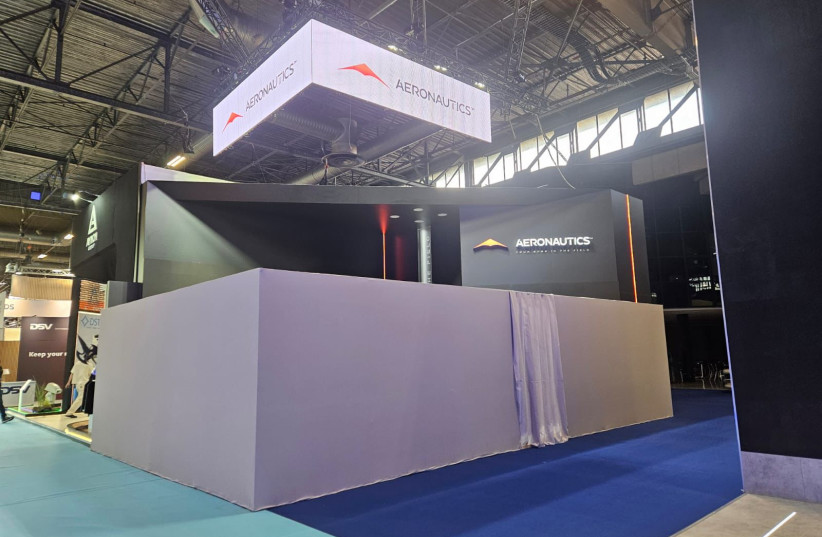
Farnborough, a commercially driven aerospace-focused event rather than weapons systems, imposed no such constraints, allowing Israeli companies to present full portfolios without limitations, including precision‑strike weapons, electronic‑warfare suites, and next‑generation laser systems.
According to Reuters, organizers say defense companies will make up half of a record 1,600 exhibitors at the show, highlighting a shift from the commercial aviation roots of an event that began in 1948 as a showcase for British aerospace technology.
The shift reflects how conflicts from Ukraine to the Middle East have transformed spending priorities and accelerated demand for new defense technologies, including unmanned fighter jets, kamikaze drones, and autonomous AI software.
"The security environment has changed fundamentally, and so have the expectations placed on defense suppliers. The threshold has shifted. Proven performance and reliable delivery are now the baseline requirements, not differentiators,” said Rafael’s CEO and president Yoav Tourgeman.
Tourgeman added that the systems showcased at Farnborough “are not concepts or prototypes. They are combat-validated systems, refined through operational experience in the most demanding environments any defense technology has faced, backed by an industrial ecosystem built to deliver at pace."