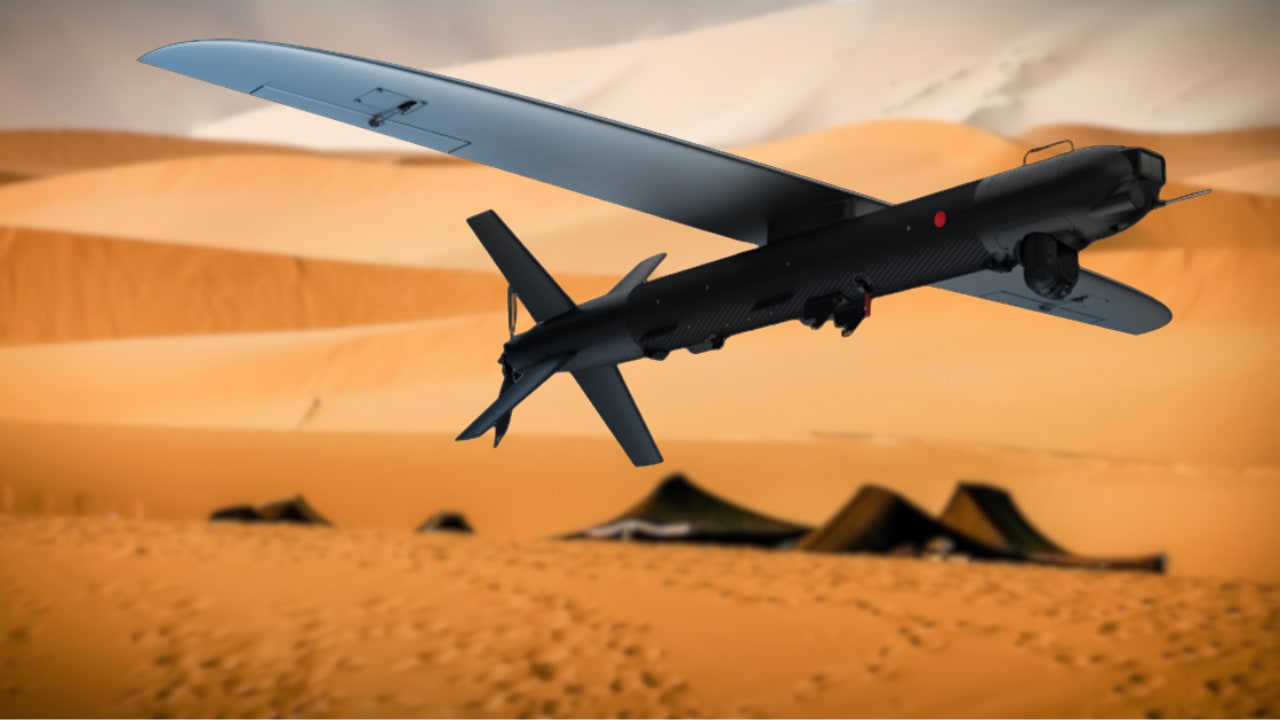
On the outskirts of Casablanca, in the Benslimane industrial zone, a milestone in North African defense industrialization unfolded in November 2025. Israel Aerospace Industries (IAI) subsidiary BlueBird Aero Systems inaugurated a dedicated production facility for its SpyX loitering munitions – the first such factory anywhere in North Africa or the Middle East outside Israel.
These Israeli-designed, man-portable systems feature a 50 kilometer operational radius, up to 90-120 minutes of loiter time, terminal dive speeds exceeding 250 km/h, and a 2.5 kilogram warhead, optimized for precision strikes against armored vehicles, command posts, and high-value targets.
Equipped with electro-optical/infrared (EO/IR) seekers and autonomous target-tracking algorithms, the SpyX enables two operators in a single tactical vehicle to deliver stand-off effects with minimal logistical footprint. Moroccan engineers, trained at BlueBird facilities in Israel as recently as November 2025, now handle local assembly, integration, and sustainment under a full technology-transfer model.
This is not merely an arms sale. It is the cornerstone of Rabat’s sovereign defense-industrial strategy: building indigenous human capital, engineering ecosystems, and supply-chain resilience to operate advanced unmanned systems independently during crises. Morocco has positioned itself as the continent’s most technically sophisticated defense partner – and Washington has now formalized that role.
At the African Land Forces Summit in Rome on March 23 to 24, Gen. Christopher Donahue, commander of US Army Europe and Africa, announced plans to establish the continent’s first dedicated drone training center in Morocco. The hub will train operators from across Africa in small UAS, loitering munitions, counter-drone systems, and integrated electronic warfare (EW) operations.

“It is about a sustainable, enduring capability,” Donahue said. “Once we prove its effectiveness, we can take it to other parts of Africa.”
The initiative will leverage upcoming African Lion 2026 exercises as the initial proving ground before scaling into a permanent, AFRICOM-backed regional node. No other African partner combines the required stability, infrastructure, and demonstrated operational maturity.
The announcement came weeks after Israel and Morocco signed their joint military work plan for 2026, during the third session of the Joint Military Committee in Tel Aviv in early January – exactly five years after the Abraham Accords restored diplomatic ties.
The plan structures year-round military dialogue, joint industrial projects, force-development exercises, and strategic alignment on evolving threats. Israeli officials now describe Morocco as Jerusalem’s most vital security partner on the African continent: a bridge where cutting-edge Middle Eastern defense technology meets African operational requirements.
The depth of integration is striking. Morocco has fielded IAI’s Barak MX modular air-and-missile defense system (the advanced evolution of the Barak 8 family), featuring ELTA ELM-2084 AESA radars for simultaneous multi-threat tracking and engagement of aircraft, UAV swarms, cruise missiles, and ballistic threats. It operates Elbit Systems’ ATMOS 155 mm wheeled self-propelled howitzers for rapid shoot-and-scoot artillery fire support, 20 Elta radars integrated onto upgraded F-5E Tiger II fighters for enhanced air-to-air and air-to-ground situational awareness, and Elbit EXTRA extended-range precision rockets delivering 150 km. stand-off strikes with 10-meter CEP accuracy. Layered atop this is domestic SpyX production. No other Abraham Accords partner has absorbed Israeli systems across air defense, precision fires, reconnaissance, and unmanned strike at this institutional level.
Rabat’s strategic clarity extends beyond any single supplier. In parallel, Turkish firm Baykar established its Atlas Defense subsidiary in Rabat (with production elements advancing in Benslimane) under a $70 million program targeting annual output of up to 1,000 platforms, including the combat-proven Bayraktar TB2 MALE ISR/strike UAV and the heavier Akinci HALE system with its 1,500 kg. payload capacity and extended endurance.

This dual-track approach – Israeli loitering munitions for tactical precision and Turkish heavy strike drones for persistent overwatch – creates genuine redundancy. It ensures operational depth that cannot be disrupted by any single supplier’s political or logistical constraints.
Operational trust has already been stress-tested. Moroccan and US forces have conducted integrated electronic-warfare exercises in the Agadir desert, with Moroccan operators fully embedded from mission planning through classroom EW/cyber instruction to live-field execution alongside American troops employing drone-mounted jammers, portable counter-UAS kits, and real-time spectrum dominance tools. Such interoperability does not emerge overnight; it reflects years of deliberate investment in doctrine, training pipelines, and institutional culture – the exact prerequisites AFRICOM demands before siting sensitive training infrastructure on foreign soil.
This convergence is deliberate. Across Africa, adversaries are exploiting cheap commercial drones and loitering munitions in asymmetric campaigns. The US response includes evaluating scalable counter-drone architectures – swarms of 25 to over 100 interceptor unmanned aerial systems (UAS) supported by AI-driven sensors and commercial off-the-shelf (COTS) command-and-control layers – to protect forward bases. Morocco’s emerging drone ecosystem slots directly into this architecture. It is a proven partner capable of training, maintaining, and exporting the very systems African militaries need for light, agile, network-enabled forces, rather than legacy heavy armor.
Morocco’s approach stands in sharp contrast to Algeria’s record $25 billion annual defense outlay – largely funneled into Russian legacy platforms and Cold War-era attrition models financed through deficit spending. Morocco, by contrast, has directed multi-billion-dollar resources toward qualitative modernization and a genuine domestic defense industry, prioritizing Western interoperability, technology transfer, and sovereign industrial capacity.
The US decision to anchor its continental drone strategy in Moroccan soil, paired with Israel’s deepening defense architecture, is the clearest validation yet of which model delivers enduring strategic advantage.
The writer is a fellow at the Middle East Forum, is a policy analyst and writer based in Morocco. Follow him on X: @amineayoubx