
The Israeli aerospace company that suffered a hit from an Iranian ballistic missile is determined to restore capabilities “as soon as possible,” Defense & Tech by The Jerusalem Post has learned.
AeroSentinel’s production facility was mere meters away from the impact zone of a 400-kilogram Iranian missile and sustained heavy damage late Thursday night. The company, a boutique Israeli drone manufacturer specializing in covert intelligence‑gathering drones, is based in Petach Tikva and is a subsidiary of Aero Sol.
“For 21 years, our company has been developing advanced UAVs and aerial solutions for the defense industry and security forces, supporting critical operational missions and national security needs,” the company told D&T.
“Despite the direct hit to the factory, the extraordinary resilience, professionalism, and determination of our team over the past 24 hours enabled the preservation of critical knowledge, capabilities, and core operational assets that will allow us to restore activity as quickly as possible.”
The company’s platforms are short- and medium-range drones that are optimized for tactical operations, border patrol, and other sensitive surveillance and reconnaissance (ISR) missions.
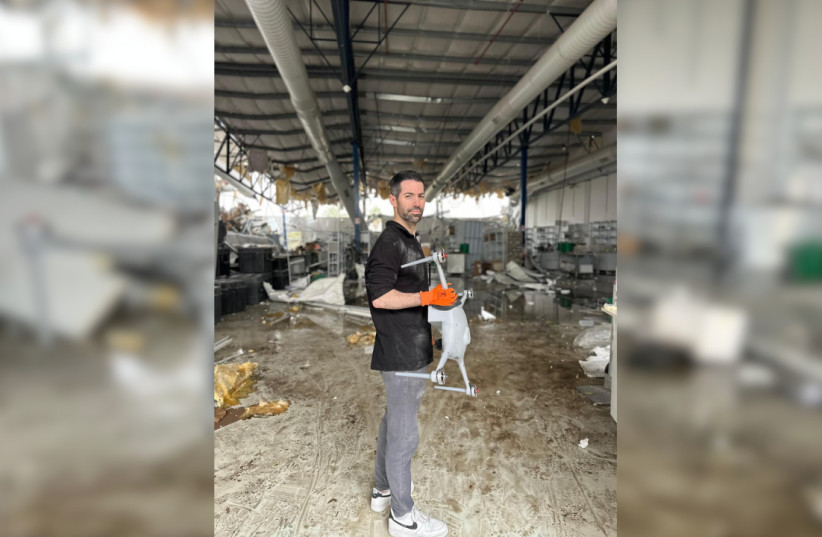
The company’s drones are designed for missions requiring extended flight time of up to 90 minutes and minimal noise, capabilities that have become increasingly valuable in modern military operations, such as in Lebanon and Iran.
The 8-pound (3.6 kilo-) drones can be assembled in under five minutes by operators and securely transmit data in real time to a mobile ground control station up to 3 miles (4.8 kilometers) away.
AeroSentinel’s product line includes a family of four intelligence, surveillance, and reconnaissance (ISR) drones of varying sizes. Some models can carry payloads of up to 10 kg, while others are known for their extended endurance.
AeroSentinel drones used in Operation Roaring Lion
In an earlier article, D&T published that the company’s platforms have been used in covert missions during Operation Roaring Lion, where they have detected hostile forces and served as force protection.
“The fact that we were targeted as a high-value strategic objective speaks for itself. It reflects the quality, relevance, and operational importance of the systems we provide. This attack will not break us. On the contrary, it only strengthens our resolve to return to full production at the earliest possible moment and to deliver even greater quantities of UAVs and advanced aerial solutions that will support this critical war effort,” the company said.
“We will not be broken. We will return stronger, grow further, and continue our mission with even greater determination,” they added.
The company operates modern manufacturing facilities and has over 13 years of experience in supplying drone systems to defense and governmental clients. It reports annual revenues of NIS 15-20 million.
The platforms are already in service with elite IDF units and Israel Police, as well as civil defense teams and international military customers in Europe, Morocco, Japan, the Netherlands, and others.
At the end of March, Aero Sol was purchased by Veloryx, a homeland security solutions company. The deal saw Veloryx acquire a 70 percent controlling stake in the company. The deal, valued at approximately NIS 26 million for the majority stake of 70%, includes an additional NIS 9 million investment in several installments to support Aero Sol’s expansion. Under the proposed structure, Veloryx would also receive an option to acquire the remaining shares at a pre‑agreed price.