- Price (base/test vehicle): NIS 177,000 /176,000.
- Competitors: Dacia Duster, Dacia Bigster.
- What we liked: Off-road capability, ride comfort, ergonomics, improved engine performance.
- What we didn’t like: Interior space, noisy engine, modest cabin, fuel consumption.
- Score: 8/10.

The “Crosstrek” name arrived here only about two years ago, but Subaru’s compact crossover has been sold locally since 2012 under the name XV. The current model is the third generation of the brand, but the changes it has undergone are very modest. The body is almost identical to its predecessors despite occasional improvements in plastic cladding, from the wheel arches to the roof rails. The cabin has received minor upgrades, and the engine? Until recently, the Crosstrek stuck with the same 2.0-liter naturally aspirated engine and CVT gearbox, just like in 2012. In an era where competitors have moved to turbocharged engines and dual-clutch gearboxes (not to mention the electric/hybrid revolution), Subaru’s boxer engine starts to look like a vintage unit struggling to deliver performance, efficiency, or refinement. We will never know whether this conservatism comes from brand philosophy or budget constraints, but the truth is that it also has many positives.

There are customers who are always looking for the latest innovation, revolutionary design, or half a second faster acceleration. It can be assumed that such innovation-seekers will not be attracted to the conservative Crosstrek, but there are many customers who do not want to be on the cutting edge of technology. They are looking for calm and confidence in a familiar product, they do not want to operate 15-inch screens full of menus, they want a reliable and easy-to-resell vehicle. The Crosstrek fits into this conservative niche, and Subaru enjoys a high rate of repeat customers who replace an XV with a Crosstrek, or a Forester with another Forester.

The Crosstrek is sold locally in three trim levels: “Touring” at NIS 176,000, the test vehicle “Luxury” at NIS 177,000, and the more luxurious “Executive” at NIS 186,000. In today’s car market these are relatively modest sums, especially for an AWD vehicle with off-road capability beyond what is typical in the crossover world. It is already being offered in 0-km deals through leasing companies and car dealers at lower prices, with an additional ownership registration. The only direct competitors of Subaru, in similar size and with all-wheel drive options, are the Dacia Duster and Bigster, but these currently come only with manual gearboxes and relatively weak mild-hybrid petrol engines.

Design
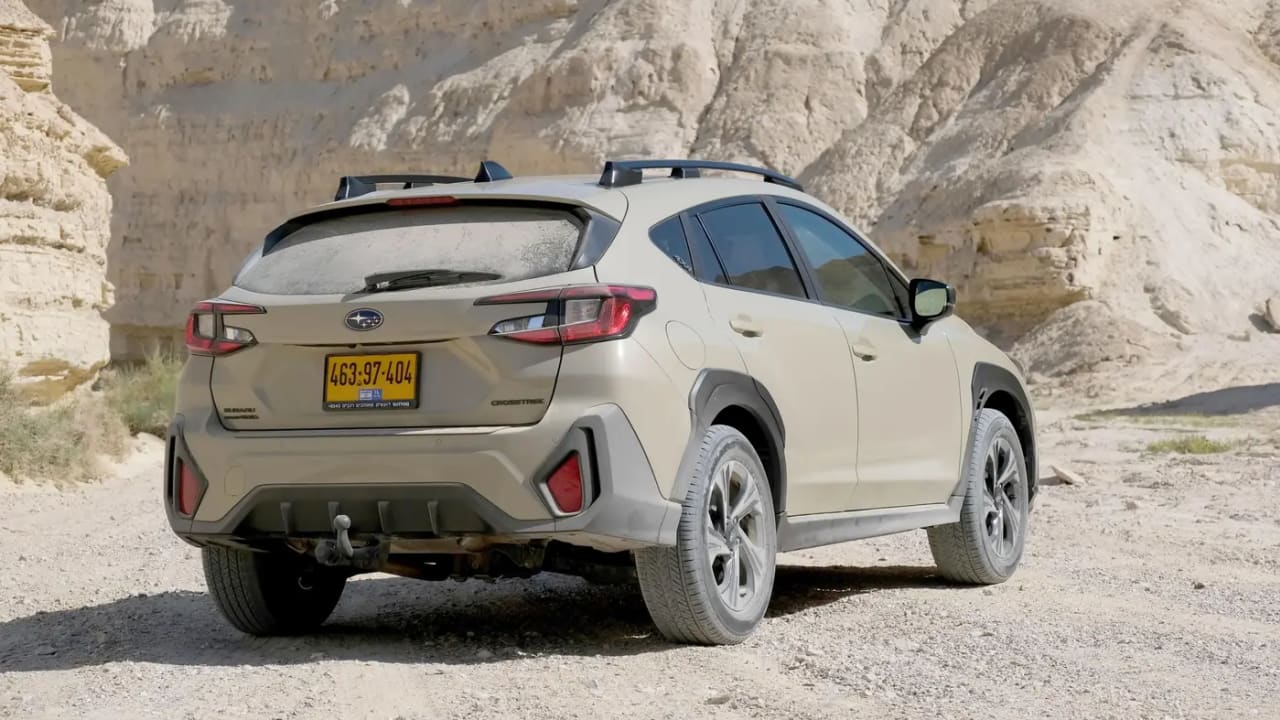
The current Crosstrek is not different from those sold here in recent years, since the main change is under the hood. The base body is derived from a compact Impreza from the early 2000s, but the black plastic cladding gives the Crosstrek a stronger presence. The roof rails are useful for carrying gear, but they look somewhat bulky.

Interior
In a time when every Chinese crossover is packed with gadgets and flashy tech, the Crosstrek’s cabin reveals its advanced age. It looks basic, and the trim materials are durable but simple. The driver’s instrument cluster is mostly analog, with a small digital display. In the center sits an 11.6-inch vertical multimedia screen. The screen is easy to operate and logically divided, including a fixed area for climate control with prominent physical buttons. It was pleasant to find physical controls for the audio system, avoiding unnecessary menu navigation. Touch buttons at the bottom of the screen for climate control remain fixed even when switching to Android Auto/CarPlay.
Across both rows of seats there are a total of five charging ports, but there is no rear air vent, which is a pity. The front seats are heated. Interior space is not generous, but four adults can sit comfortably; in the rear there is limited headroom, so it is not a car for basketball players. The front seating position is relatively high, as is outward visibility through the large windows. The fabric seats look simple but are very comfortable, with good supportive ergonomics. Seat adjustment is manual; electric seats (and a sunroof) are available only in the Executive trim. The trunk is modest in size, but beneath it there is a compact spare wheel. Off-road enthusiasts can fit a full-size tire there, which is essential for those who plan to leave paved roads.

Equipment
Touring (from NIS 176,000) comes with 17-inch alloy wheels, a 7-inch infotainment screen, and a 7-inch driver display. Luxury (from NIS 177,000) upgrades to an 11.6-inch infotainment screen, heated front seats and steering wheel, front fog lights, a smart key, and blind-spot monitoring. Executive (from NIS 186,000) adds a power-adjustable driver seat and a sunroof with a shade.

Engine
The 2026 Crosstrek says goodbye to the 2.0-liter engine as part of a change made by Subaru in the US-spec version imported here. Under the hood now sits a 2.5-liter four-cylinder boxer engine producing 180 hp (compared to 152 before) and 27 kgm (vs 24.6). The larger engine does not turn the Crosstrek into a traffic-light rocket, but it provides power and immediacy that were missing in the outgoing unit. The transmission remains a CVT but is better tuned to simulate 8 gears. Paddle shifters behind the steering wheel work well, including engine braking on long descents. The 0–100 km/h time is 9.3 seconds, compared to 10.5 seconds previously.
We did not like the engine’s tendency to quickly climb to 3,000–4,000 rpm even in normal starts. This is not surprising, since peak torque arrives only at 3,700 rpm. Hard acceleration pushes the engine to 5,000 noisy rpm. It is surprising that Subaru did not improve the hood insulation. The car is relatively quiet in normal driving, but wind noise comes through the bulky roof rails.
Fuel consumption was pleasantly surprising, with an average of 12 km per liter on a mixed test route including mountainous driving, highway cruising, and some light off-road sections. In the US there is also a hybrid Crosstrek, which improves efficiency and throttle response, but there are currently no plans to bring it to Israel.

Ride and handling
There are areas where you do not want changes, and ride comfort is one of them. With 225/60R17 tires, the Crosstrek offers good ride comfort compared to modern crossovers, absorbing road imperfections softly even at urban speeds where more expensive competitors fail. Road behavior is stable and predictable, with light steering that quickly turns the nose into corners. The AWD system did not matter much in dry testing, but in winter driving it has clear value. One of the highlights is the strong communication between car and driver – brakes, steering, and overall feedback make it easy to feel the limits of the vehicle and enjoy driving even if it is not a sporty machine.
The car includes adaptive LED headlights, Subaru EyeSight safety system with lane keeping, automatic emergency braking (including reverse), blind spot monitoring, and adaptive cruise control. It received a 5-star Euro NCAP safety rating and has 10 airbags.

Off-road
The Crosstrek is not the most luxurious crossover, but off-road it is one of the best in its category. Originally designed for snowy regions (Subaru is very popular in places like Colorado or Switzerland), in our market it has become a relatively affordable alternative to a real off-road vehicle. It has 22 cm of ground clearance and an X-Mode system that effectively transfers power to the wheels on trails. These capabilities make it suitable for sand and dirt trails at a level not possible in most AWD crossovers with a sporty-urban focus.
Still, it is not a real off-road vehicle – there is no low-range gear, the front bumper is vulnerable, and the mechanical systems are not designed for extreme use. There are many videos online showing Subarus conquering difficult terrain, but you probably do not want to see the repair bills afterward. In the US there is also a rugged Wilderness version, but it is unlikely to come here.

Bottom line
If you judge the Crosstrek purely by specifications or interior luxury, it may seem like an outdated underdog. But during the test we found that what it loses at first glance, it gains over time. The 2.5-liter engine does not make it a performance car or a fuel-saving champion, but it maintains a solid and capable pace. Its conservatism may appeal to customers who are not addicted to constant change, combined with a strong reputation for reliability and resale value. Recently, the Crosstrek was named “the most reliable crossover in the US” in a JD Power survey, which may explain its popularity and strong used-car demand.
We liked the solid, no-nonsense feeling of the Crosstrek and the sense that engineers, not marketing people, designed it. And beyond all that, there is its off-road capability: It is not a Land Cruiser or Defender, but there is no other automatic 4x4 vehicle under NIS 210,000 that can drive off-road as well as this clever Crosstrek. And that, we really like.

Technical details: Subaru Crosstrek Luxury
Engine: Petrol, 2,498 cc. Output 180 hp, torque 24.6 kgm
Transmission: CVT automatic, permanent all-wheel drive
Performance (manufacturer):
0–100 km/h: 9.3 seconds
Top speed: 208 km/h
Combined fuel consumption (manufacturer): 12.3 km/l
Combined fuel consumption (test): 12 km/l
Dimensions:
Length: 4.48 m
Width: 1.80 m
Height: 1.60 m
Wheelbase: 2.67 m
Cargo capacity: 315 liters
Curb weight: 1,695 kg
Off-road:
Approach/departure angles: 31/18 degrees
Ground clearance: 22 cm
Spare wheel: Yes
Safety:
Euro NCAP crash test rating: 5 out of 5 stars (2024)
Active safety: Autonomous emergency braking (forward and reverse), adaptive cruise control, lane keep assist, blind spot monitoring, automatic high beams
Warranty:
3 years or 100,000 km.