
Archaeologists unearthed a previously undiscovered tomb during excavations at the Theban necropolis located on the west bank of the Nile, Egypt’s Tourism and Antiquities Ministry announced last week.
The tomb, dating back to the Ramesside period, was unearthed in the lower Sheikh Abdel-Qarna area by a Dutch archaeological mission led by Dr. Karina van den Hoven of Leiden University.
Inscriptions found within the tomb bear the name of its owner, “Paser,” as well as wall paintings depicted Paser worshipping the shrines of several deities. Additional paintings portray Paser and his wife standing before an altar.
What further intrigued archaeologists was the tomb’s layout, which followed the traditional style of Thebes’s private tombs during the New Kingdom period, explained Head of the Ancient Egyptian Antiquities Sector at the Supreme Council of Antiquities Mohamed Abdel-Badie.
It consists of an outer courtyard, an inverted "T” shaped chapel carved into the rock, and burial chambers hidden below the surface.
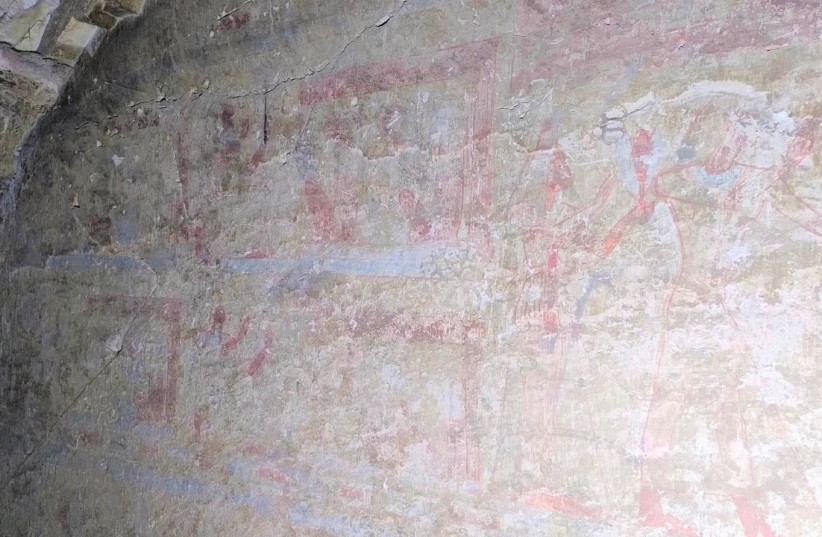
Tomb's courtyard preserved in good condition
Abdel-Badie added that the tomb's courtyard contained several architectural elements that have been preserved in good condition, including a mudbrick platform with a niche in its center designed to hold a funerary stela, as well as a staircase flanked on both sides by ramps leading to the tomb's entrance.
Egyptian Tourism and Antiquities Minister Sherif Fathy praised the efforts of foreign archaeological missions working in Egypt, and affirmed their contribution to uncovering more secrets of ancient Egyptian civilization.
Secretary-General of the Supreme Council of Antiquities Hisham El-Leithy noted that the ongoing excavation project at the site is meant to prepare the site for its first comprehensive archaeological study.
Further, he affirmed that the Dutch team will continue to document the tomb in order to more extensively identify those buried within, as well as studying the tomb itself through its historical and archaeological context.
Over 30 mummified cats, ancient Egyptian tombs, coffins found at site
In May, Egypt's Tourism and Antiquities Ministry announced that several previously unrecorded individuals and ancient Egyptian artifacts has been discovered at a nearby site in the area of Draʻ Abu el-Naga’s necropolis.
The excavations began in November 2025, and have been focused on the southeastern part of the tomb of Roy, an 18th Dynasty royal scribe and his wife.
The tomb has been covered in debris from archaeological missions from over a century ago.
In the courtyard between the tomb of Roy and the nearby tomb of Baki, archaeologists have discovered a collection of 10 wooden coffins hidden within a burial shaft. All 10 were found to be in good condition, bearing a variety of scenes and texts.
According to preliminary studies, four of the coffins date to the 18th Dynasty, including one bearing the name of Merit, believed to be a chantress of Amun.
A second coffin, dating to the Ramesside period (the 19th and 20th Dynasty periods), bears the name Padi-Amun (“he who Amun gave”), who was a priest in the Temple of Amun.
The remaining coffins dated to the Late Period of Egypt, circa 664–332 BCE, which encompassed the 26th-31st dynasties.
Buried, mummified animals, including over 30 mummified wild and domestic cats, were also discovered within layers of debris south of the tomb of Baki.
This discovery “reflects the richness of the archaeological site and the diversity of the finds uncovered, as well as the wide range of periods to which they belong,” the ministry stated.