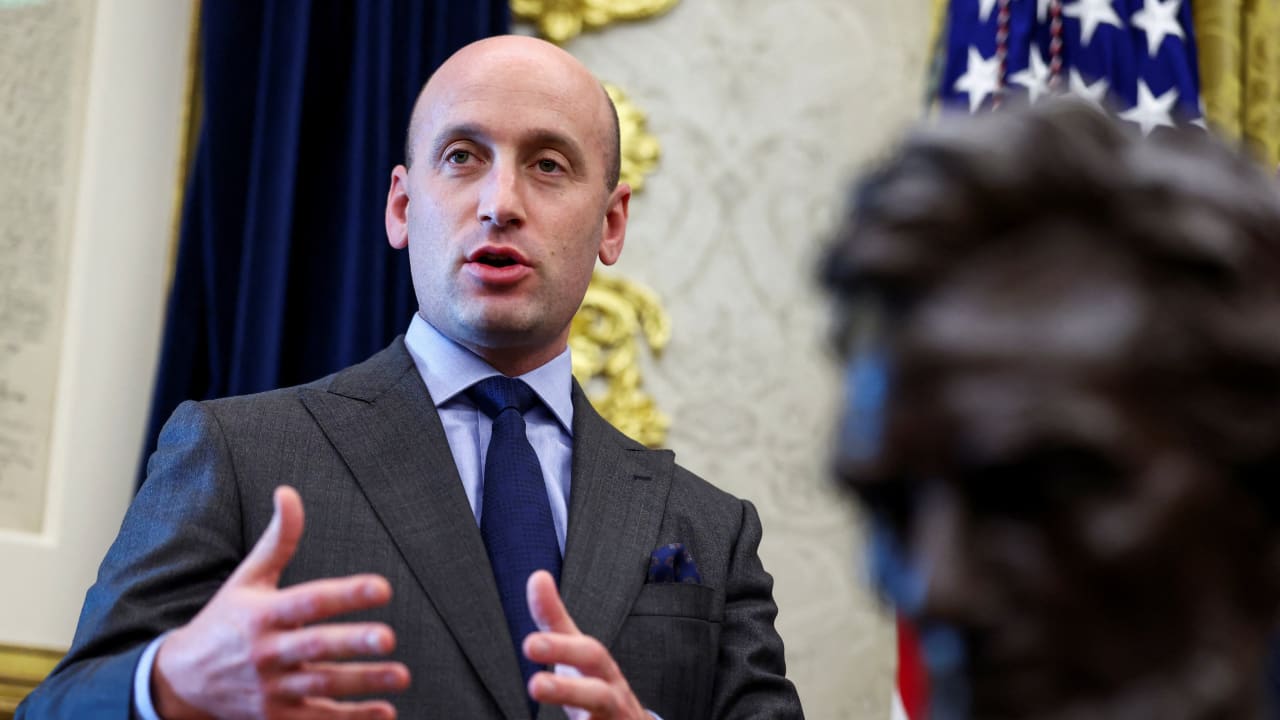
US President Donald Trump announced on Friday that Stephen Miller, 41, would replace Susie Wiles as White House chief of staff, following the Republican defeat in the midterm elections and its loss of both chambers of Congress.
Trump announced Miller’s appointment on Friday after Republicans lost both chambers of Congress, elevating the hardline immigration architect to one of Washington’s most powerful positions.
Rather than moderate his policies after the electoral setback, Trump is promoting one of his most uncompromising architects. The appointment, which takes effect on Monday, signals a political choice.
Miller is not simply another adviser seeking to please Trump. Over the past decade, he has become one of the few people who can translate the president’s political instincts into executive orders, operational directives, and government policy.
Now, he will also be the man deciding who gets access to the Oval Office, which issues reach the president’s desk, and how the White House operates.

From a liberal California high school to the top of a Republican administration
Miller’s story begins in a place few would have expected to produce one of the leading symbols of the American Right. He was born and raised in Santa Monica, a liberal city on the Pacific coast, in a Jewish family with Democratic roots. Yet, even as a teenager, he developed distinctly conservative views and clashed with teachers and fellow students over immigration, multiculturalism, and political correctness.
He began appearing on conservative radio programs, criticized the use of Spanish at school, and argued that the education system was imposing a liberal worldview on its students. Following the September 11 terrorist attacks, his opposition to what he described as anti-Americanism in educational institutions intensified.
He later became close to conservative activist David Horowitz, who had moved from the radical Left to the political Right.
Miller continued to stir controversy as a student at Duke University. He gained national attention when he defended members of the university’s lacrosse team accused of rape in a case that rocked the campus in 2006.
The charges were subsequently dropped, and Miller, who appeared on television to defend the players, began establishing a reputation as a fighter against the liberal establishment.
After graduating, he moved to Washington, working for Republican members of Congress and later for Alabama senator Jeff Sessions, considered one of the most prominent opponents of illegal immigration.
It was there that Miller’s worldview took shape, with immigration seen not merely as a matter of law enforcement but as a question concerning the national and cultural identity of the United States.
When Trump launched his presidential campaign in 2015, Miller found a candidate who openly expressed ideas he had long believed in. He joined the campaign, became one of Trump’s leading speechwriters, and helped shape his anti-immigration messaging and “America First” ideology.
Architect of immigration policy becomes one of Trump's closest allies
During Trump’s first term, Miller was involved in shaping some of the administration’s most controversial measures: restrictions on entry from Muslim-majority countries, reductions in refugee admissions programs, and the policy that led to children being separated from their parents at the Mexican border. Parents were sent to criminal custody and their children to the custody of the Office of Refugee Resettlement (ORR) or Department of Health and Human Services (HHS).
The measures drew fierce criticism and legal challenges but strengthened Miller’s standing among supporters of strict immigration enforcement.
Unlike many advisers who parted ways with Trump following his defeat in the 2020 election, Miller remained by his side.
During Joe Biden’s presidency, he co-founded the legal organization America First Legal, pursuing legal challenges against policies introduced by the Democratic administration, while maintaining close ties with the former president. When Trump returned to the White House in January 2025, Miller was appointed deputy chief of staff for policy and homeland security adviser.
In May 2025, Axios reported that Miller and then-homeland security secretary Kristi Noem had demanded that senior Immigration and Customs Enforcement (ICE) officials meet a target of at least 3,000 arrests a day, roughly three times the rate at the beginning of Trump’s second term.
The policy led to widespread raids in American cities and confrontations between armed immigration agents and residents and protesters.
Miller was also involved in efforts to restrict legal immigration pathways, impose limitations on asylum, and change the constitutional interpretation that grants American citizenship to people born on US soil. But his influence has long since extended beyond immigration.
He has also played a central role in the administration’s battles with universities, efforts to eliminate diversity, equity and inclusion (DEI) programs, and the promotion of a vision that grants broader powers to the executive branch.
When the courts blocked administration measures, Miller did not hesitate to confront them as well.
After judges struck down some of Trump’s import tariffs, Miller described the ruling as a “judicial coup.” On other occasions, he attacked judges as Marxists and Communists.
In an interview with Bloomberg in January 2026, former House Speaker Newt Gingrich described Miller’s standing as nearly equivalent to that of a cabinet secretary. According to Gingrich, Trump views him as someone capable of performing “six or seven different jobs.”
Beyond immigration: Influence extending into foreign policy
Indeed, Miller has begun expanding his involvement in foreign policy and national security. He participated in discussions concerning the American operation in Venezuela and the fight against drug cartels in Latin America.
When Trump raised the possibility of taking control of Greenland, Miller articulated a worldview in which international relations are ultimately determined by force.
“We live in a world where you can talk all you want about international niceties,” he said in an interview with CNN’s Jake Tapper. “But in the real world, Jake, force, power, and the use of force are what govern. Those are the iron laws of the world and have been since the beginning of time.”
Against the backdrop of that worldview, a New York Times report is particularly noteworthy.
According to the report, one of the arguments Miller made in favor of his appointment as chief of staff was the need to bring the war in Iran to an end.
According to people who heard his remarks, Miller explained that some of Trump’s core supporters viewed the campaign as a betrayal of his promises to avoid prolonged wars in the Middle East.
The report does not necessarily indicate a change in Miller’s fundamental position on the use of military force. It does, however, illustrate how closely he monitors the sentiments of the Make America Great Again (MAGA) movement and the political dangers facing Trump.
His Jewish family and criticism from within
Miller’s Jewish identity occupies a distinctive place in his story.
He is married to Katie Miller, who is also Jewish and has held positions in the Trump administration.
The couple married in 2020 in a ceremony officiated by Rabbi Aryeh Lightstone, who later helped advance the Abraham Accords and is now a member of the Board of Peace. They have three children.
Yet, some of the harshest disagreements over Miller’s policies have emerged within his own family and the Jewish community. His maternal uncle, David Glosser, published an article in Politico in 2018 accusing his nephew of hypocrisy on immigration. He recalled that the family’s ancestors had fled persecution in Europe and that one of them, Wolf-Leib Glosser, arrived in the United States in 1903 with just $8 in his pocket.
According to his uncle, had Miller’s preferred immigration policies been in place at the time, his family might never have reached America and escaped persecution.
Rabbi Neil Comess-Daniels, who taught Miller as a child at a synagogue in Santa Monica, also sharply criticized him, arguing that his policies contradicted the humanitarian Jewish values he had tried to instill in him.
In 2019, rabbinical organizations affiliated with the Reform, Conservative, and Reconstructionist movements called for Miller’s dismissal following the publication of his correspondence, which prompted accusations that he had promoted white supremacist ideas.
Miller rejected the criticism and has previously argued that some of the attacks against him stemmed from antisemitism directed at a Jewish administration official.
By contrast, the Republican Jewish Coalition considers him one of Trump’s most important allies. Following his appointment as chief of staff, the organization’s executive director, Matt Brooks, congratulated him and described him as one of the most influential and effective architects of the MAGA movement.
“He has never wavered in his determined and passionate defense of American sovereignty, freedom, and prosperity,” Brooks said, adding that Miller was the right person to lead the president’s team during the remaining two years of his term.
Among Democrats, however, the reactions were entirely different.
House Democratic leader Hakeem Jeffries called Miller a “dangerous xenophobe,” while Senate Democratic leader Chuck Schumer argued that the appointment proved Trump had learned nothing from the electoral defeat.
Rep. Robert Garcia, who is expected to chair the House Oversight Committee, warned that Democrats would continue investigating Miller’s involvement in deportation policies and advised him to “get a lawyer.”
'I pledge you my absolute loyalty'
For his part, Miller makes no secret of how he views his new role. In a speech at Mar-a-Lago following the announcement of his appointment, he delivered what amounted to an almost unconditional declaration of loyalty to the president.
“Without President Trump, the United States would not exist today. This man saved America,” he said. “He saved our military from collapse, our economy from destruction, and our border from ruin.”
He then addressed Trump directly. “It is the greatest honor of my life to be your chief of staff. I pledge to you, Mr. President, my absolute loyalty, my unwavering commitment, and my complete dedication to your success and the success of this country.”
Miller will now face a very different test from those he has encountered throughout his career.
For years, he was the man pushing Trump to fulfill his promises, sometimes through confrontation with other branches of government.
As chief of staff, he will also have to manage the White House, mediate between cabinet members and senior officials, contend with a Democratic-controlled Congress, and maintain the priorities of a president who is not known for organizational discipline.
The major question in Washington is whether a man who has made ideological struggle his life’s work can also become an effective manager, or whether his appointment will turn Trump’s final two years in the White House into a prolonged, head-on confrontation with his political opponents.
As chief of staff, he will also have to manage the White House, mediate between cabinet members and senior officials, contend with a Democratic-controlled Congress, and maintain the priorities of a president who is not known for organizational discipline.
The major question in Washington is whether a man who has made ideological struggle his life's work can also become an effective manager, or whether his appointment will turn Trump's final two years in the White House into a prolonged, head-on confrontation with his political opponents.
Either way, the Jewish boy who stood before students at a liberal California school nearly a quarter of a century ago and promised to say things no one else dared to say now occupies a position in which his words can influence the policies of the world's most powerful nation.